ATI NURSING FUNDAMENTALS 2026-2027 UPDATE EXAM DATABASE
NURSING FUNDAMENTALS
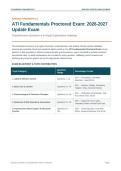
ATI Fundamentals Proctored Exam: 2026-2027
Update Exam
Comprehensive Questions & In-Depth Explanations Database
This educational resource is a highly structured, comprehensive, and student-friendly practice database
covering the essential clinical and academic topics tested on the ATI Fundamentals Proctored Exam. Every
question is fully grounded in official nursing principles and procedures, and is formatted to provide maximum
educational value. In-depth explanations are included for every question, validating correct answers and
clarifying why incorrect options are not the appropriate clinical choice.
EXAM BLUEPRINT & TOPIC DISTRIBUTION
Question
Topic Category Percentage / Focus
Range
20% — Precautions, Fall Safety,
1. Safety & Infection Control Questions 1 - 20
Restraints, Legal/HIPAA
20% — Nutrition, Mobility, Positioning,
2. Basic Care & Comfort Questions 21 - 40
Hygiene, Sleep, Assistive Devices
20% — Medication Administration, Safe
3. Pharmacological & Parenteral Therapies Questions 41 - 60
IVs, Enteral Tube, Insulin
20% — Diagnostic Tests, Vitals,
4. Reduction of Risk Potential & Assessment Questions 61 - 80
Laboratory values, Wound/Trach Care
5. Psychosocial, Ethical-Legal & Professional Questions 81 - 20% — Client Education, Autonomy,
Practice 100 Ethics, Advance Directives, End of Life
Nursing Test Bank & Comprehensive Study Companion Page 1
,ATI NURSING FUNDAMENTALS 2026-2027 UPDATE EXAM DATABASE
SAFETY & INFECTION CONTROL
Question 1: A nurse is planning care for a client who has a Clostridium difficile infection. Which of
the following actions should the nurse take to prevent transmission of this infection to other
clients?
A. Instruct the client to wear a surgical mask during transport.
B. Place the client in a room with negative-pressure airflow.
C. Have family members and other visitors wear a gown and gloves when visiting.
D. Use a dry paper towel to wipe down surface areas in the room.
ANSWER : C — Have family members and other visitors wear a gown and gloves when visiting.
Explanation: Clostridium difficile is transmitted via direct and indirect contact with physical spores. Contact precautions
must be implemented, which includes requiring family members and visitors to wear a gown and gloves when visiting the
client to prevent contamination of hands and clothing. Negative-pressure airflow rooms are used for airborne precautions
(e.g., tuberculosis), not contact precautions. Masking the client is not required for contact precautions.
Question 2: A nurse is admitting a client who has a suspected active tuberculosis (TB) infection.
Which of the following transmission-based precautions and room assignments should the nurse
implement?
A. Place the client in a semi-private room with a client who has the same diagnosis.
B. Place the client in a room with negative-pressure airflow and wear gloves for oral care.
C. Initiate droplet precautions and wear a surgical mask within 3 feet of the client.
D. Maintain positive-pressure airflow in the client's room and perform hand hygiene with soap and water.
ANSWER : B — Place the client in a room with negative-pressure airflow and wear gloves for oral care.
Explanation: Tuberculosis requires airborne precautions. The client must be placed in a private room with
negative-pressure airflow. The nurse must wear gloves when assisting the client with oral care to prevent contact with
infectious secretions and use an antimicrobial hand sanitizer for hand hygiene. Positive-pressure rooms are used for
protective environments (such as for stem cell transplant recipients), and droplet precautions are insufficient for airborne
pathogens like TB.
Nursing Test Bank & Comprehensive Study Companion Page 2
,ATI NURSING FUNDAMENTALS 2026-2027 UPDATE EXAM DATABASE
Question 3: A nurse is admitting a client who has an abdominal wound with a large amount of
purulent drainage. Which of the following types of transmission precautions should the nurse
initiate?
A. Airborne precautions
B. Droplet precautions
C. Contact precautions
D. Protective environment
ANSWER : C — Contact precautions
Explanation: Contact precautions are initiated for clients who have infections that are spread by direct contact with the
client or their environment, such as a wound with purulent drainage that cannot be contained. Airborne precautions are for
pathogens transmitted by micro-droplet nuclei (e.g., measles, varicella, tuberculosis). Droplet precautions are for larger
droplets (e.g., pertussis, influenza, diphtheria). Protective environments are used to protect immunocompromised clients.
Question 4: A nurse is admitting a client who has varicella (chickenpox). Which of the following
types of transmission precautions should the nurse initiate?
A. Contact precautions only
B. Droplet precautions
C. Airborne precautions
D. Protective environment
ANSWER : C — Airborne precautions
Explanation: Varicella (chickenpox) is transmitted via airborne droplets that remain suspended in the air. Therefore, the
nurse must initiate airborne precautions, which includes placing the client in a negative-pressure airflow room and wearing
an N95 respirator. Contact precautions are also used if skin lesions are weeping, but the primary transmission-based
precaution is airborne.
Question 5: A nurse is preparing to care for a client who has pharyngeal diphtheria. Which of the
following transmission-based precautions should the nurse initiate?
A. Contact precautions
B. Droplet precautions
C. Airborne precautions
D. Protective isolation
ANSWER : B — Droplet precautions
Explanation: Pharyngeal diphtheria is transmitted through large droplets expelled during coughing, sneezing, or talking.
The nurse must initiate droplet precautions, which includes placing the client in a private room (or cohort) and wearing a
surgical mask when within 3 feet of the client. Airborne precautions are for smaller particles like varicella, and contact
precautions are for contact-transmitted pathogens.
Nursing Test Bank & Comprehensive Study Companion Page 3
, ATI NURSING FUNDAMENTALS 2026-2027 UPDATE EXAM DATABASE
Question 6: A nurse is caring for a client who has diarrhea due to a Shigella infection. Which of the
following infection control precautions should the nurse take?
A. Place the client in a negative-pressure room and wear a mask.
B. Wash hands with soap and water before and after contact with the client.
C. Restrict all visitors from entering the client's room.
D. Wear an N95 respirator when delivering the client's food tray.
ANSWER : B — Wash hands with soap and water before and after contact with the client.
Explanation: Shigella is an enteric pathogen transmitted via the fecal-oral route. Contact precautions are required, and the
nurse must wash her hands before and after contact with the client or their immediate environment to prevent the spread of
the pathogen. Negative-pressure rooms and respirators are not indicated for Shigella as it is not an airborne infection.
Question 7: A nurse in a surgical suite notes documentation on a client's medical record indicating
a severe latex allergy. In preparation for the client's procedure, which of the following precautions
should the nurse take?
A. Clean the monitoring cords with chlorhexidine prior to use.
B. Wrap monitoring cords with stockinette and tape them in place.
C. Apply latex gloves over vinyl utility gloves for double protection.
D. Schedule the procedure as the last case of the day.
ANSWER : B — Wrap monitoring cords with stockinette and tape them in place.
Explanation: To protect a client with a latex allergy from exposure to latex in monitoring cords (which often contain
rubber/latex components), the nurse should wrap the cords with stockinette and tape them securely so they do not come
into direct contact with the client's skin. Latex gloves must never be used. Latex allergy procedures should be scheduled as
the first case of the day to minimize airborne latex allergen levels.
Question 8: A nurse on a medical-surgical unit is caring for a client who has a new prescription for
wrist restraints. Which of the following actions should the nurse take?
A. Pad the client's wrist before applying the restraints.
B. Secure the restraint straps to the bed's side rails using a double knot.
C. Ensure the restraints are tight enough that a single finger cannot fit underneath.
D. Renew the prescription for restraints every 48 hours.
ANSWER : A — Pad the client's wrist before applying the restraints.
Explanation: The nurse should pad the client's wrists before applying restraints to prevent friction, skin breakdown, and
trauma to the underlying tissues. Restraints should be secured to the bed frame (never the side rails) using a quick-release
knot. The nurse must make sure two fingers can fit under the restraints to ensure adequate circulation, and restraint
prescriptions must be renewed regularly (e.g., every 4 hours for adults, up to 24 hours total, not 48 hours).
Nursing Test Bank & Comprehensive Study Companion Page 4
NURSING FUNDAMENTALS
ATI Fundamentals Proctored Exam: 2026-2027
Update Exam
Comprehensive Questions & In-Depth Explanations Database
This educational resource is a highly structured, comprehensive, and student-friendly practice database
covering the essential clinical and academic topics tested on the ATI Fundamentals Proctored Exam. Every
question is fully grounded in official nursing principles and procedures, and is formatted to provide maximum
educational value. In-depth explanations are included for every question, validating correct answers and
clarifying why incorrect options are not the appropriate clinical choice.
EXAM BLUEPRINT & TOPIC DISTRIBUTION
Question
Topic Category Percentage / Focus
Range
20% — Precautions, Fall Safety,
1. Safety & Infection Control Questions 1 - 20
Restraints, Legal/HIPAA
20% — Nutrition, Mobility, Positioning,
2. Basic Care & Comfort Questions 21 - 40
Hygiene, Sleep, Assistive Devices
20% — Medication Administration, Safe
3. Pharmacological & Parenteral Therapies Questions 41 - 60
IVs, Enteral Tube, Insulin
20% — Diagnostic Tests, Vitals,
4. Reduction of Risk Potential & Assessment Questions 61 - 80
Laboratory values, Wound/Trach Care
5. Psychosocial, Ethical-Legal & Professional Questions 81 - 20% — Client Education, Autonomy,
Practice 100 Ethics, Advance Directives, End of Life
Nursing Test Bank & Comprehensive Study Companion Page 1
,ATI NURSING FUNDAMENTALS 2026-2027 UPDATE EXAM DATABASE
SAFETY & INFECTION CONTROL
Question 1: A nurse is planning care for a client who has a Clostridium difficile infection. Which of
the following actions should the nurse take to prevent transmission of this infection to other
clients?
A. Instruct the client to wear a surgical mask during transport.
B. Place the client in a room with negative-pressure airflow.
C. Have family members and other visitors wear a gown and gloves when visiting.
D. Use a dry paper towel to wipe down surface areas in the room.
ANSWER : C — Have family members and other visitors wear a gown and gloves when visiting.
Explanation: Clostridium difficile is transmitted via direct and indirect contact with physical spores. Contact precautions
must be implemented, which includes requiring family members and visitors to wear a gown and gloves when visiting the
client to prevent contamination of hands and clothing. Negative-pressure airflow rooms are used for airborne precautions
(e.g., tuberculosis), not contact precautions. Masking the client is not required for contact precautions.
Question 2: A nurse is admitting a client who has a suspected active tuberculosis (TB) infection.
Which of the following transmission-based precautions and room assignments should the nurse
implement?
A. Place the client in a semi-private room with a client who has the same diagnosis.
B. Place the client in a room with negative-pressure airflow and wear gloves for oral care.
C. Initiate droplet precautions and wear a surgical mask within 3 feet of the client.
D. Maintain positive-pressure airflow in the client's room and perform hand hygiene with soap and water.
ANSWER : B — Place the client in a room with negative-pressure airflow and wear gloves for oral care.
Explanation: Tuberculosis requires airborne precautions. The client must be placed in a private room with
negative-pressure airflow. The nurse must wear gloves when assisting the client with oral care to prevent contact with
infectious secretions and use an antimicrobial hand sanitizer for hand hygiene. Positive-pressure rooms are used for
protective environments (such as for stem cell transplant recipients), and droplet precautions are insufficient for airborne
pathogens like TB.
Nursing Test Bank & Comprehensive Study Companion Page 2
,ATI NURSING FUNDAMENTALS 2026-2027 UPDATE EXAM DATABASE
Question 3: A nurse is admitting a client who has an abdominal wound with a large amount of
purulent drainage. Which of the following types of transmission precautions should the nurse
initiate?
A. Airborne precautions
B. Droplet precautions
C. Contact precautions
D. Protective environment
ANSWER : C — Contact precautions
Explanation: Contact precautions are initiated for clients who have infections that are spread by direct contact with the
client or their environment, such as a wound with purulent drainage that cannot be contained. Airborne precautions are for
pathogens transmitted by micro-droplet nuclei (e.g., measles, varicella, tuberculosis). Droplet precautions are for larger
droplets (e.g., pertussis, influenza, diphtheria). Protective environments are used to protect immunocompromised clients.
Question 4: A nurse is admitting a client who has varicella (chickenpox). Which of the following
types of transmission precautions should the nurse initiate?
A. Contact precautions only
B. Droplet precautions
C. Airborne precautions
D. Protective environment
ANSWER : C — Airborne precautions
Explanation: Varicella (chickenpox) is transmitted via airborne droplets that remain suspended in the air. Therefore, the
nurse must initiate airborne precautions, which includes placing the client in a negative-pressure airflow room and wearing
an N95 respirator. Contact precautions are also used if skin lesions are weeping, but the primary transmission-based
precaution is airborne.
Question 5: A nurse is preparing to care for a client who has pharyngeal diphtheria. Which of the
following transmission-based precautions should the nurse initiate?
A. Contact precautions
B. Droplet precautions
C. Airborne precautions
D. Protective isolation
ANSWER : B — Droplet precautions
Explanation: Pharyngeal diphtheria is transmitted through large droplets expelled during coughing, sneezing, or talking.
The nurse must initiate droplet precautions, which includes placing the client in a private room (or cohort) and wearing a
surgical mask when within 3 feet of the client. Airborne precautions are for smaller particles like varicella, and contact
precautions are for contact-transmitted pathogens.
Nursing Test Bank & Comprehensive Study Companion Page 3
, ATI NURSING FUNDAMENTALS 2026-2027 UPDATE EXAM DATABASE
Question 6: A nurse is caring for a client who has diarrhea due to a Shigella infection. Which of the
following infection control precautions should the nurse take?
A. Place the client in a negative-pressure room and wear a mask.
B. Wash hands with soap and water before and after contact with the client.
C. Restrict all visitors from entering the client's room.
D. Wear an N95 respirator when delivering the client's food tray.
ANSWER : B — Wash hands with soap and water before and after contact with the client.
Explanation: Shigella is an enteric pathogen transmitted via the fecal-oral route. Contact precautions are required, and the
nurse must wash her hands before and after contact with the client or their immediate environment to prevent the spread of
the pathogen. Negative-pressure rooms and respirators are not indicated for Shigella as it is not an airborne infection.
Question 7: A nurse in a surgical suite notes documentation on a client's medical record indicating
a severe latex allergy. In preparation for the client's procedure, which of the following precautions
should the nurse take?
A. Clean the monitoring cords with chlorhexidine prior to use.
B. Wrap monitoring cords with stockinette and tape them in place.
C. Apply latex gloves over vinyl utility gloves for double protection.
D. Schedule the procedure as the last case of the day.
ANSWER : B — Wrap monitoring cords with stockinette and tape them in place.
Explanation: To protect a client with a latex allergy from exposure to latex in monitoring cords (which often contain
rubber/latex components), the nurse should wrap the cords with stockinette and tape them securely so they do not come
into direct contact with the client's skin. Latex gloves must never be used. Latex allergy procedures should be scheduled as
the first case of the day to minimize airborne latex allergen levels.
Question 8: A nurse on a medical-surgical unit is caring for a client who has a new prescription for
wrist restraints. Which of the following actions should the nurse take?
A. Pad the client's wrist before applying the restraints.
B. Secure the restraint straps to the bed's side rails using a double knot.
C. Ensure the restraints are tight enough that a single finger cannot fit underneath.
D. Renew the prescription for restraints every 48 hours.
ANSWER : A — Pad the client's wrist before applying the restraints.
Explanation: The nurse should pad the client's wrists before applying restraints to prevent friction, skin breakdown, and
trauma to the underlying tissues. Restraints should be secured to the bed frame (never the side rails) using a quick-release
knot. The nurse must make sure two fingers can fit under the restraints to ensure adequate circulation, and restraint
prescriptions must be renewed regularly (e.g., every 4 hours for adults, up to 24 hours total, not 48 hours).
Nursing Test Bank & Comprehensive Study Companion Page 4