

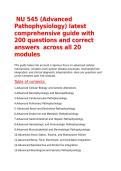
NU 545 (Advanced
Pathophysiology) latest
comprehensive guide with
200 questions and correct
answers across all 20
modules
This guide takes into account a rigorous focus on advanced cellular
mechanisms, complex multi-system disease processes, neuroendocrine
integration, and clinical diagnostic interpretation. Here are questions and
correct answers split into modules.
Table of contents
1.Advanced Cellular Biology and Genetic Alterations
2.Advanced Neurophysiology and Neuropathology
3 Advanced Cardiovascular Pathophysiology
4.Advanced Pulmonary Pathophysiology
5. Advanced Renal and Electrolyte Pathophysiology
6.Advanced Endocrine and Metabolic Pathophysiology
7.Advanced Gastrointestinal and Hepatic Pathophysiology
8.Advanced Hematologic and Immunologic Pathophysiology
9.Advanced Musculoskeletal and Dermatologic Pathophysiology
10.Advanced Shock States, Trauma, and Multisystem Failure
11.Advanced Renal, Fluid, Electrolyte, and Acid-Base Integration
12.Advanced Reproductive and Endocrine Integration
13.Advanced Neurological and Sensory Pathophysiology
,14.Advanced Vascular and Congenital Pathophysiology
15.Advanced Hematologic and Oncologic Pathophysiology
16.Advanced Infectious Disease and Immune Pathophysiology
17.Advanced Dermatologic and Rheumatologic Pathophysiology
18.Advanced Multi-System and Metabolic Pathophysiology
19.Advanced Gerontological and Integrative Pathophysiology
20.Advanced Clinical Diagnostics and Integration
Advanced Cellular Biology and Genetic
Alterations
Question: What primary cellular organelle is responsible for ATP synthesis
via oxidative phosphorylation, and how does its dysfunction lead to cellular
injury? Answer: The mitochondria; its dysfunction causes adenosine
triphosphate (ATP) depletion, leading to failure of the
Na
+
/
K
+
pump, cellular swelling, and eventual necrosis.
Question: What is the pathophysiological difference between necrosis and
apoptosis? Answer: Necrosis is accidental, unregulated cell death resulting
from acute injury that triggers an inflammatory response; apoptosis is
programmed, energy-dependent cell death that does not elicit inflammation.
Question: How do reactive oxygen species (ROS) cause cellular damage?
Answer: By stealing electrons from surrounding lipids, proteins, and nucleic
acids, causing lipid peroxidation, protein misfolding, and DNA fragmentation.
,Question: What genetic mechanism causes Down syndrome (Trisomy 21)?
Answer: Nondisjunction during maternal meiotic division, resulting in an
extra copy of chromosome 21.
Question: What is the inheritance pattern and molecular defect in Marfan
syndrome? Answer: Autosomal dominant; caused by a mutation in the FBN1
gene encoding fibrillin-1, leading to abnormal elastic tissue.
Question: What is the primary biochemical consequence of cystic fibrosis?
Answer: A mutation in the CFTR gene impairs chloride transport across
epithelial cell membranes, resulting in thick, viscous secretions in the lungs
and pancreas.
Question: What distinguishes epigenetic modifications from genetic
mutations? Answer: Epigenetic modifications (e.g., DNA methylation, histone
acetylation) alter gene expression without changing the underlying DNA
nucleotide sequence.
Question: What is the role of proto-oncogenes when mutated? Answer: They
become oncogenes, driving unchecked cellular proliferation and tumor
growth.
Question: What is the function of tumor suppressor genes like TP53? Answer:
They regulate the cell cycle, halt division in the presence of DNA damage,
and initiate apoptosis if damage cannot be repaired.
Question: How do cachexia and tumor-induced metabolic shifts alter patient
physiology in advanced cancer? Answer: Tumors induce systemic
inflammation, hypermetabolism, and accelerated protein catabolism, leading
to severe, involuntary skeletal muscle and adipose tissue wasting.
, Advanced Neurophysiology and
Neuropathology
Question: What pathophysiological cascade occurs during an ischemic
penumbra following an acute ischemic stroke? Answer: Depleted ATP causes
glutamate excitotoxicity, massive intracellular calcium influx, activation of
degradative enzymes, and delayed neuronal apoptosis surrounding the
necrotic core.
Question: What differentiates an epidural hematoma from a subdural
hematoma regarding vascular source and clinical presentation? Answer:
Epidural hematomas involve arterial bleeding (typically middle meningeal
artery) with a classic "lucid interval"; subdural hematomas involve venous
bleeding (bridging veins) with a more gradual symptom onset.
Question: What is Cushing's triad, and what does it signify? Answer:
Hypertension with a widening pulse pressure, bradycardia, and irregular
respirations; it signifies life-threatening elevated intracranial pressure (ICP)
and impending brainstem herniation.
Question: What neurotransmitter deficit characterizes Alzheimer's disease?
Answer: A profound deficiency of acetylcholine within the cerebral cortex and
hippocampus.
Question: What are the pathological hallmarks of Parkinson's disease?
Answer: Degeneration of dopaminergic neurons in the substantia nigra pars
compacta and the accumulation of intracellular alpha-synuclein aggregates
known as Lewy bodies.
Question: How does myasthenia gravis disrupt neuromuscular transmission?
Answer: Circulating IgG autoantibodies bind to postsynaptic acetylcholine
receptors at the neuromuscular junction, blocking transmission and causing
receptor destruction.
Pathophysiology) latest
comprehensive guide with
200 questions and correct
answers across all 20
modules
This guide takes into account a rigorous focus on advanced cellular
mechanisms, complex multi-system disease processes, neuroendocrine
integration, and clinical diagnostic interpretation. Here are questions and
correct answers split into modules.
Table of contents
1.Advanced Cellular Biology and Genetic Alterations
2.Advanced Neurophysiology and Neuropathology
3 Advanced Cardiovascular Pathophysiology
4.Advanced Pulmonary Pathophysiology
5. Advanced Renal and Electrolyte Pathophysiology
6.Advanced Endocrine and Metabolic Pathophysiology
7.Advanced Gastrointestinal and Hepatic Pathophysiology
8.Advanced Hematologic and Immunologic Pathophysiology
9.Advanced Musculoskeletal and Dermatologic Pathophysiology
10.Advanced Shock States, Trauma, and Multisystem Failure
11.Advanced Renal, Fluid, Electrolyte, and Acid-Base Integration
12.Advanced Reproductive and Endocrine Integration
13.Advanced Neurological and Sensory Pathophysiology
,14.Advanced Vascular and Congenital Pathophysiology
15.Advanced Hematologic and Oncologic Pathophysiology
16.Advanced Infectious Disease and Immune Pathophysiology
17.Advanced Dermatologic and Rheumatologic Pathophysiology
18.Advanced Multi-System and Metabolic Pathophysiology
19.Advanced Gerontological and Integrative Pathophysiology
20.Advanced Clinical Diagnostics and Integration
Advanced Cellular Biology and Genetic
Alterations
Question: What primary cellular organelle is responsible for ATP synthesis
via oxidative phosphorylation, and how does its dysfunction lead to cellular
injury? Answer: The mitochondria; its dysfunction causes adenosine
triphosphate (ATP) depletion, leading to failure of the
Na
+
/
K
+
pump, cellular swelling, and eventual necrosis.
Question: What is the pathophysiological difference between necrosis and
apoptosis? Answer: Necrosis is accidental, unregulated cell death resulting
from acute injury that triggers an inflammatory response; apoptosis is
programmed, energy-dependent cell death that does not elicit inflammation.
Question: How do reactive oxygen species (ROS) cause cellular damage?
Answer: By stealing electrons from surrounding lipids, proteins, and nucleic
acids, causing lipid peroxidation, protein misfolding, and DNA fragmentation.
,Question: What genetic mechanism causes Down syndrome (Trisomy 21)?
Answer: Nondisjunction during maternal meiotic division, resulting in an
extra copy of chromosome 21.
Question: What is the inheritance pattern and molecular defect in Marfan
syndrome? Answer: Autosomal dominant; caused by a mutation in the FBN1
gene encoding fibrillin-1, leading to abnormal elastic tissue.
Question: What is the primary biochemical consequence of cystic fibrosis?
Answer: A mutation in the CFTR gene impairs chloride transport across
epithelial cell membranes, resulting in thick, viscous secretions in the lungs
and pancreas.
Question: What distinguishes epigenetic modifications from genetic
mutations? Answer: Epigenetic modifications (e.g., DNA methylation, histone
acetylation) alter gene expression without changing the underlying DNA
nucleotide sequence.
Question: What is the role of proto-oncogenes when mutated? Answer: They
become oncogenes, driving unchecked cellular proliferation and tumor
growth.
Question: What is the function of tumor suppressor genes like TP53? Answer:
They regulate the cell cycle, halt division in the presence of DNA damage,
and initiate apoptosis if damage cannot be repaired.
Question: How do cachexia and tumor-induced metabolic shifts alter patient
physiology in advanced cancer? Answer: Tumors induce systemic
inflammation, hypermetabolism, and accelerated protein catabolism, leading
to severe, involuntary skeletal muscle and adipose tissue wasting.
, Advanced Neurophysiology and
Neuropathology
Question: What pathophysiological cascade occurs during an ischemic
penumbra following an acute ischemic stroke? Answer: Depleted ATP causes
glutamate excitotoxicity, massive intracellular calcium influx, activation of
degradative enzymes, and delayed neuronal apoptosis surrounding the
necrotic core.
Question: What differentiates an epidural hematoma from a subdural
hematoma regarding vascular source and clinical presentation? Answer:
Epidural hematomas involve arterial bleeding (typically middle meningeal
artery) with a classic "lucid interval"; subdural hematomas involve venous
bleeding (bridging veins) with a more gradual symptom onset.
Question: What is Cushing's triad, and what does it signify? Answer:
Hypertension with a widening pulse pressure, bradycardia, and irregular
respirations; it signifies life-threatening elevated intracranial pressure (ICP)
and impending brainstem herniation.
Question: What neurotransmitter deficit characterizes Alzheimer's disease?
Answer: A profound deficiency of acetylcholine within the cerebral cortex and
hippocampus.
Question: What are the pathological hallmarks of Parkinson's disease?
Answer: Degeneration of dopaminergic neurons in the substantia nigra pars
compacta and the accumulation of intracellular alpha-synuclein aggregates
known as Lewy bodies.
Question: How does myasthenia gravis disrupt neuromuscular transmission?
Answer: Circulating IgG autoantibodies bind to postsynaptic acetylcholine
receptors at the neuromuscular junction, blocking transmission and causing
receptor destruction.


