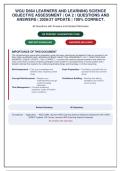
WGU D664 LEARNERS AND LEARNING SCIENCE
OBJECTIVE ASSESSMENT | OA 2 | QUESTIONS AND
ANSWERS | 2026/27 UPDATE | 100% CORRECT.
80 Questions with Answers and Detailed Rationales
100 PERCENT GUARANTEED PASS
INSTANT DOWNLOAD ANSWERS INCLUDED
IMPORTANCE OF THIS DOCUMENT
This comprehensive examination preparation guide has been meticulously developed to help you succeed in the
WGU D664 LEARNERS AND LEARNING SCIENCE OBJECTIVE ASSESSMENT | OA 2 | QUESTIONS AND
ANSWERS | 2026/27 UPDATE | 100% CORRECT.. It contains 80 carefully selected questions that reflect the
most current exam content and testing strategies. Each question is accompanied by a correct answer and a
detailed rationale that explains the underlying pathophysiology, pharmacology, or clinical reasoning.
Self-Assessment – Test your knowledge and Exam Preparation – Familiarize yourself with the
identify areas requiring further question format and content
study areas
Concept Reinforcement – Deepen your Confidence Building – Develop test-taking
understanding through strategies and reduce
evidence-based exam anxiety
rationales
Time Management – Practice answering
questions under simulated
exam conditions
Review Summary 80 Questions
Foundations - Application - WGU D664 Learners AND Learning Science Objective Assessment OA 2 AND
2026/27 Update 100 Correct Learners AND Learning Science Graduate
All answers with rationales
,Table of Contents
Content Area Questions Key Topics
Learner Development 1-14 Learning, Student, Concept, Cognitive LOAD, Strategy
Learning Theories 15-28 Teacher, Student, Learning, Solve, Problems
Cognitive Processes 29-42 Students, Theory, Learning, Teacher, Approach
Motivation AND Engagement 43-56 Student, Theory, Learning, Teacher, Design
Individual Differences 57-70 Students, Instruction, Classroom, Teacher, Learning
Learning Environments 71-80 Theory, Learning, Teacher, Students, Explained
TOTAL 80 All questions include answers and detailed rationales
,Section A - Learner Development
Q1.
A curriculum team is redesigning a physics course to promote deep understanding.
Which instructional approach best aligns with constructivist principles?
A. Direct instruction with worked examples B. Inquiry-based labs where students
and frequent formative quizzes generate and test their own hypotheses
C. Flipped classroom with video lectures at D. Spaced retrieval practice with interleaved
home and problem-solving in class problem sets
Correct: B - Inquiry-based labs where students generate and test their own hypotheses
Rationale:Constructivism emphasizes learners actively building knowledge through
experience and reflection. Inquiry-based labs allow students to construct understanding by
posing questions, experimenting, and revising ideas. Direct instruction, flipped classrooms,
and retrieval practice are compatible with cognitive science but do not center on
learner-driven knowledge construction.
Why the other answers are wrong:
A. Direct instruction is teacher-centered and does not emphasize active knowledge
construction by the learner.
C. Flipped classroom still relies on direct transmission of content via videos, not active
construction.
D. Spaced retrieval is a cognitive strategy that enhances retention but does not inherently
involve constructing new understanding.
Reference: Bransford, J.D., et al. (2000). How People Learn. National Academy Press.
Q2.
A student confidently asserts that all chemicals are harmful. After a lab demonstration
shows water as a chemical, the student revises their belief. This process best illustrates
which concept?
A. Assimilation B. Accommodation
C. Equilibration D. Scaffolding
Correct: B - Accommodation
Rationale:Accommodation occurs when existing schemas are modified to incorporate new
information that conflicts with current understanding. The student's schema of 'chemicals' had
to be changed to include water. Assimilation would involve interpreting the new experience
within an existing schema without change. Equilibration is the driving mechanism, and
scaffolding is an instructional support.
Page 3
, Section A - Learner Development
Why the other answers are wrong:
A. Assimilation would mean the student fit the new information into the existing 'harmful' schema without changing it.
C. Equilibration is the broader process of balancing assimilation and accommodation, not the specific schema change.
D. Scaffolding refers to external support provided by a more knowledgeable other, not an internal cognitive process.
Reference: Piaget, J. (1970). The Science of Education and the Psychology of the Child. Orion Press.
Q3.
Which instructional strategy is most likely to reduce extraneous cognitive load in a
complex multimedia lesson?
A. Adding background music to enhance B. Segmenting the lesson into self-paced
emotional engagement parts with clear labels
C. Presenting the same information in both D. Embedding hyperlinks to supplementary
audio and on-screen text simultaneously resources within the main content
Correct: B - Segmenting the lesson into self-paced parts with clear labels
Rationale:Segmenting reduces extraneous load by allowing learners to process smaller
chunks of information at a time, preventing overload. Background music and redundant
audio/text increase extraneous load. Hyperlinks can cause navigation and split-attention
costs.
Why the other answers are wrong:
A. Background music is extraneous material that competes for working memory resources.
C. Simultaneous audio and text redundancy can overload visual and auditory channels when
text is identical.
D. Hyperlinks encourage non-linear navigation, increasing cognitive load and potential
disorientation.
Reference: Sweller, J., et al. (2011). Cognitive Load Theory. Springer.
Q4.
A student who values learning for personal growth is more likely to persist on a
challenging task than a student who is externally regulated. This phenomenon is best
explained by which theory?
A. Expectancy-Value Theory B. Self-Determination Theory
C. Social Cognitive Theory D. Attribution Theory
Correct: B - Self-Determination Theory
Page 4
OBJECTIVE ASSESSMENT | OA 2 | QUESTIONS AND
ANSWERS | 2026/27 UPDATE | 100% CORRECT.
80 Questions with Answers and Detailed Rationales
100 PERCENT GUARANTEED PASS
INSTANT DOWNLOAD ANSWERS INCLUDED
IMPORTANCE OF THIS DOCUMENT
This comprehensive examination preparation guide has been meticulously developed to help you succeed in the
WGU D664 LEARNERS AND LEARNING SCIENCE OBJECTIVE ASSESSMENT | OA 2 | QUESTIONS AND
ANSWERS | 2026/27 UPDATE | 100% CORRECT.. It contains 80 carefully selected questions that reflect the
most current exam content and testing strategies. Each question is accompanied by a correct answer and a
detailed rationale that explains the underlying pathophysiology, pharmacology, or clinical reasoning.
Self-Assessment – Test your knowledge and Exam Preparation – Familiarize yourself with the
identify areas requiring further question format and content
study areas
Concept Reinforcement – Deepen your Confidence Building – Develop test-taking
understanding through strategies and reduce
evidence-based exam anxiety
rationales
Time Management – Practice answering
questions under simulated
exam conditions
Review Summary 80 Questions
Foundations - Application - WGU D664 Learners AND Learning Science Objective Assessment OA 2 AND
2026/27 Update 100 Correct Learners AND Learning Science Graduate
All answers with rationales
,Table of Contents
Content Area Questions Key Topics
Learner Development 1-14 Learning, Student, Concept, Cognitive LOAD, Strategy
Learning Theories 15-28 Teacher, Student, Learning, Solve, Problems
Cognitive Processes 29-42 Students, Theory, Learning, Teacher, Approach
Motivation AND Engagement 43-56 Student, Theory, Learning, Teacher, Design
Individual Differences 57-70 Students, Instruction, Classroom, Teacher, Learning
Learning Environments 71-80 Theory, Learning, Teacher, Students, Explained
TOTAL 80 All questions include answers and detailed rationales
,Section A - Learner Development
Q1.
A curriculum team is redesigning a physics course to promote deep understanding.
Which instructional approach best aligns with constructivist principles?
A. Direct instruction with worked examples B. Inquiry-based labs where students
and frequent formative quizzes generate and test their own hypotheses
C. Flipped classroom with video lectures at D. Spaced retrieval practice with interleaved
home and problem-solving in class problem sets
Correct: B - Inquiry-based labs where students generate and test their own hypotheses
Rationale:Constructivism emphasizes learners actively building knowledge through
experience and reflection. Inquiry-based labs allow students to construct understanding by
posing questions, experimenting, and revising ideas. Direct instruction, flipped classrooms,
and retrieval practice are compatible with cognitive science but do not center on
learner-driven knowledge construction.
Why the other answers are wrong:
A. Direct instruction is teacher-centered and does not emphasize active knowledge
construction by the learner.
C. Flipped classroom still relies on direct transmission of content via videos, not active
construction.
D. Spaced retrieval is a cognitive strategy that enhances retention but does not inherently
involve constructing new understanding.
Reference: Bransford, J.D., et al. (2000). How People Learn. National Academy Press.
Q2.
A student confidently asserts that all chemicals are harmful. After a lab demonstration
shows water as a chemical, the student revises their belief. This process best illustrates
which concept?
A. Assimilation B. Accommodation
C. Equilibration D. Scaffolding
Correct: B - Accommodation
Rationale:Accommodation occurs when existing schemas are modified to incorporate new
information that conflicts with current understanding. The student's schema of 'chemicals' had
to be changed to include water. Assimilation would involve interpreting the new experience
within an existing schema without change. Equilibration is the driving mechanism, and
scaffolding is an instructional support.
Page 3
, Section A - Learner Development
Why the other answers are wrong:
A. Assimilation would mean the student fit the new information into the existing 'harmful' schema without changing it.
C. Equilibration is the broader process of balancing assimilation and accommodation, not the specific schema change.
D. Scaffolding refers to external support provided by a more knowledgeable other, not an internal cognitive process.
Reference: Piaget, J. (1970). The Science of Education and the Psychology of the Child. Orion Press.
Q3.
Which instructional strategy is most likely to reduce extraneous cognitive load in a
complex multimedia lesson?
A. Adding background music to enhance B. Segmenting the lesson into self-paced
emotional engagement parts with clear labels
C. Presenting the same information in both D. Embedding hyperlinks to supplementary
audio and on-screen text simultaneously resources within the main content
Correct: B - Segmenting the lesson into self-paced parts with clear labels
Rationale:Segmenting reduces extraneous load by allowing learners to process smaller
chunks of information at a time, preventing overload. Background music and redundant
audio/text increase extraneous load. Hyperlinks can cause navigation and split-attention
costs.
Why the other answers are wrong:
A. Background music is extraneous material that competes for working memory resources.
C. Simultaneous audio and text redundancy can overload visual and auditory channels when
text is identical.
D. Hyperlinks encourage non-linear navigation, increasing cognitive load and potential
disorientation.
Reference: Sweller, J., et al. (2011). Cognitive Load Theory. Springer.
Q4.
A student who values learning for personal growth is more likely to persist on a
challenging task than a student who is externally regulated. This phenomenon is best
explained by which theory?
A. Expectancy-Value Theory B. Self-Determination Theory
C. Social Cognitive Theory D. Attribution Theory
Correct: B - Self-Determination Theory
Page 4