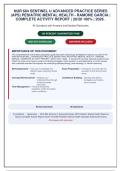
NUR 684 SENTINEL U ADVANCED PRACTICE SERIES
(APS) PEDIATRIC MENTAL HEALTH - RAMONE GARCIA |
COMPLETE ACTIVITY REPORT | 20/20 100% | 2026 .
90 Questions with Answers and Detailed Rationales
100 PERCENT GUARANTEED PASS
INSTANT DOWNLOAD ANSWERS INCLUDED
IMPORTANCE OF THIS DOCUMENT
This comprehensive examination preparation guide has been meticulously developed to help you succeed in the
NUR 684 SENTINEL U ADVANCED PRACTICE SERIES (APS) PEDIATRIC MENTAL HEALTH - RAMONE
GARCIA | COMPLETE ACTIVITY REPORT | 20/20 100% | 2026 .. It contains 90 carefully selected questions that
reflect the most current exam content and testing strategies. Each question is accompanied by a correct answer
and a detailed rationale that explains the underlying pathophysiology, pharmacology, or clinical reasoning.
Self-Assessment – Test your knowledge and Exam Preparation – Familiarize yourself with the
identify areas requiring further question format and content
study areas
Concept Reinforcement – Deepen your Confidence Building – Develop test-taking
understanding through strategies and reduce
evidence-based exam anxiety
rationales
Time Management – Practice answering
questions under simulated
exam conditions
Review Summary 90 Questions
Foundations - Application - NUR 684 Sentinel U Advanced Series APS Pediatric Mental Health Ramone
Garcia Complete Activity Report 20/20 100 2026 Pediatric Mental Health Graduate Advanced Nursing
All answers with rationales
,Table of Contents
Content Area Questions Key Topics
Psychiatric Assessment AND 1-15 Pediatric, Disorder, Child, Adolescent, Approach
Diagnosis
Neurodevelopmental AND 16-30 Pediatric, Mental Health, Disorder, Child, Anxiety
Behavioral Disorders
Anxiety MOOD AND 31-45 Child, Disorder, Pediatric, Considering, Health
Trauma-related Disorders
Psychopharmacology IN 46-60 Child, Disorder, Pediatric, Therapy, Mental Health
Pediatric Mental Health
Therapeutic Communication 61-75 Pediatric, Disorder, Appropriate, Medication, Critical
AND Family Engagement
Crisis Intervention AND 76-90 Pediatric, Child, Disorder, Mental Health, Practitioner
Safety Planning
TOTAL 90 All questions include answers and detailed rationales
,Section A - Psychiatric Assessment AND Diagnosis
Q1.
In a pediatric primary care setting, which assessment approach best distinguishes
attention-deficit/hyperactivity disorder (ADHD) from anxiety-related inattention?
A. Observing the child during structured play B. Administering a continuous performance
and academic tasks test (CPT) alone
C. Gathering symptom reports from multiple D. Initiating a stimulant trial and monitoring
settings and informants response
Correct: C - Gathering symptom reports from multiple settings and informants
Rationale:ADHD and anxiety can both present with inattention, but ADHD symptoms are
typically pervasive and present across settings, while anxiety-related inattention is often
situation-specific. Collecting collateral information from home and school helps differentiate,
as per AAP guidelines.
Why the other answers are wrong:
A. Observation in a single setting is insufficient and may not capture situational variability.
B. CPTs are not diagnostic and do not differentiate ADHD from anxiety.
D. Stimulant trials are not appropriate without a confirmed diagnosis and could worsen anxiety.
Reference: American Academy of Pediatrics. (2019). ADHD: Clinical Practice Guideline for the
Diagnosis, Evaluation, and Treatment.
Q2.
Which pharmacogenetic finding would most alter the prescribing of aripiprazole in an
adolescent with irritability associated with autism spectrum disorder?
A. CYP2D6 poor metabolizer status B. CYP3A4 inducer phenotype
C. HLA-B*1502 allele positivity D. UGT1A1*28 polymorphism
Correct: A - CYP2D6 poor metabolizer status
Rationale:Aripiprazole is partially metabolized by CYP2D6; poor metabolizers have higher
plasma concentrations, increasing adverse effect risk. Dose adjustment or alternative agent is
indicated. CYP3A4 induction affects metabolism but less clinically significant, and
HLA-B*1502 is linked to carbamazepine-induced SJS, not aripiprazole.
Why the other answers are wrong:
B. CYP3A4 induction reduces aripiprazole levels but is not the primary pharmacogenetic
concern.
C. HLA-B*1502 is associated with carbamazepine hypersensitivity, not aripiprazole.
D. UGT1A1*28 affects irinotecan metabolism, not aripiprazole.
Page 3
, Section A - Psychiatric Assessment AND Diagnosis
Reference: Lehne, R.A. (2026). Pharmacology for Nursing Care, 12th Ed., Ch. 17.
Q3.
A child presents with recurrent abdominal pain, school refusal, and excessive worry about
parental safety. Which intervention is most aligned with a trauma-informed,
evidence-based approach?
A. Prescribe a selective serotonin reuptake B. Refer for trauma-focused
inhibitor (SSRI) immediately cognitive-behavioral therapy (TF-CBT)
C. Advise the family to ignore the somatic D. Recommend a gastrointestinal workup
complaints before any mental health referral
Correct: B - Refer for trauma-focused cognitive-behavioral therapy (TF-CBT)
Rationale:These symptoms suggest possible anxiety or trauma-related disorder. TF-CBT is
first-line for trauma-exposed children and addresses underlying fears and somatic symptoms.
SSRIs may be adjunctive but not first without assessment, and dismissing symptoms or
delaying mental health referral is inappropriate.
Why the other answers are wrong:
A. SSRIs are not first-line without a thorough assessment and may not address the underlying
trauma.
C. Ignoring somatic complaints invalidates the child's experience and may worsen symptoms.
D. Unnecessary GI workup delays appropriate mental health intervention and may reinforce
illness behavior.
Reference: Cohen, J.A., Mannarino, A.P., & Deblinger, E. (2017). Trauma-Focused CBT for Children and
Adolescents.
Q4.
Which combination of factors most strongly predicts a poor response to stimulant
monotherapy in pediatric ADHD?
A. Comorbid oppositional defiant disorder B. Predominantly inattentive presentation
and family conflict and female sex
C. High intellectual ability and structured D. Presence of a single nucleotide
school environment polymorphism in DRD4
Correct: A - Comorbid oppositional defiant disorder and family conflict
Rationale:Comorbid ODD and family conflict are associated with reduced stimulant response
and require adjunctive behavioral interventions. Inattentive presentation still responds, high IQ
does not preclude response, and DRD4 variants have inconsistent evidence.
Why the other answers are wrong:
B. Inattentive presentation and sex are not strong predictors of nonresponse.
C. High ability and structure generally improve outcomes, not reduce response.
Page 4
(APS) PEDIATRIC MENTAL HEALTH - RAMONE GARCIA |
COMPLETE ACTIVITY REPORT | 20/20 100% | 2026 .
90 Questions with Answers and Detailed Rationales
100 PERCENT GUARANTEED PASS
INSTANT DOWNLOAD ANSWERS INCLUDED
IMPORTANCE OF THIS DOCUMENT
This comprehensive examination preparation guide has been meticulously developed to help you succeed in the
NUR 684 SENTINEL U ADVANCED PRACTICE SERIES (APS) PEDIATRIC MENTAL HEALTH - RAMONE
GARCIA | COMPLETE ACTIVITY REPORT | 20/20 100% | 2026 .. It contains 90 carefully selected questions that
reflect the most current exam content and testing strategies. Each question is accompanied by a correct answer
and a detailed rationale that explains the underlying pathophysiology, pharmacology, or clinical reasoning.
Self-Assessment – Test your knowledge and Exam Preparation – Familiarize yourself with the
identify areas requiring further question format and content
study areas
Concept Reinforcement – Deepen your Confidence Building – Develop test-taking
understanding through strategies and reduce
evidence-based exam anxiety
rationales
Time Management – Practice answering
questions under simulated
exam conditions
Review Summary 90 Questions
Foundations - Application - NUR 684 Sentinel U Advanced Series APS Pediatric Mental Health Ramone
Garcia Complete Activity Report 20/20 100 2026 Pediatric Mental Health Graduate Advanced Nursing
All answers with rationales
,Table of Contents
Content Area Questions Key Topics
Psychiatric Assessment AND 1-15 Pediatric, Disorder, Child, Adolescent, Approach
Diagnosis
Neurodevelopmental AND 16-30 Pediatric, Mental Health, Disorder, Child, Anxiety
Behavioral Disorders
Anxiety MOOD AND 31-45 Child, Disorder, Pediatric, Considering, Health
Trauma-related Disorders
Psychopharmacology IN 46-60 Child, Disorder, Pediatric, Therapy, Mental Health
Pediatric Mental Health
Therapeutic Communication 61-75 Pediatric, Disorder, Appropriate, Medication, Critical
AND Family Engagement
Crisis Intervention AND 76-90 Pediatric, Child, Disorder, Mental Health, Practitioner
Safety Planning
TOTAL 90 All questions include answers and detailed rationales
,Section A - Psychiatric Assessment AND Diagnosis
Q1.
In a pediatric primary care setting, which assessment approach best distinguishes
attention-deficit/hyperactivity disorder (ADHD) from anxiety-related inattention?
A. Observing the child during structured play B. Administering a continuous performance
and academic tasks test (CPT) alone
C. Gathering symptom reports from multiple D. Initiating a stimulant trial and monitoring
settings and informants response
Correct: C - Gathering symptom reports from multiple settings and informants
Rationale:ADHD and anxiety can both present with inattention, but ADHD symptoms are
typically pervasive and present across settings, while anxiety-related inattention is often
situation-specific. Collecting collateral information from home and school helps differentiate,
as per AAP guidelines.
Why the other answers are wrong:
A. Observation in a single setting is insufficient and may not capture situational variability.
B. CPTs are not diagnostic and do not differentiate ADHD from anxiety.
D. Stimulant trials are not appropriate without a confirmed diagnosis and could worsen anxiety.
Reference: American Academy of Pediatrics. (2019). ADHD: Clinical Practice Guideline for the
Diagnosis, Evaluation, and Treatment.
Q2.
Which pharmacogenetic finding would most alter the prescribing of aripiprazole in an
adolescent with irritability associated with autism spectrum disorder?
A. CYP2D6 poor metabolizer status B. CYP3A4 inducer phenotype
C. HLA-B*1502 allele positivity D. UGT1A1*28 polymorphism
Correct: A - CYP2D6 poor metabolizer status
Rationale:Aripiprazole is partially metabolized by CYP2D6; poor metabolizers have higher
plasma concentrations, increasing adverse effect risk. Dose adjustment or alternative agent is
indicated. CYP3A4 induction affects metabolism but less clinically significant, and
HLA-B*1502 is linked to carbamazepine-induced SJS, not aripiprazole.
Why the other answers are wrong:
B. CYP3A4 induction reduces aripiprazole levels but is not the primary pharmacogenetic
concern.
C. HLA-B*1502 is associated with carbamazepine hypersensitivity, not aripiprazole.
D. UGT1A1*28 affects irinotecan metabolism, not aripiprazole.
Page 3
, Section A - Psychiatric Assessment AND Diagnosis
Reference: Lehne, R.A. (2026). Pharmacology for Nursing Care, 12th Ed., Ch. 17.
Q3.
A child presents with recurrent abdominal pain, school refusal, and excessive worry about
parental safety. Which intervention is most aligned with a trauma-informed,
evidence-based approach?
A. Prescribe a selective serotonin reuptake B. Refer for trauma-focused
inhibitor (SSRI) immediately cognitive-behavioral therapy (TF-CBT)
C. Advise the family to ignore the somatic D. Recommend a gastrointestinal workup
complaints before any mental health referral
Correct: B - Refer for trauma-focused cognitive-behavioral therapy (TF-CBT)
Rationale:These symptoms suggest possible anxiety or trauma-related disorder. TF-CBT is
first-line for trauma-exposed children and addresses underlying fears and somatic symptoms.
SSRIs may be adjunctive but not first without assessment, and dismissing symptoms or
delaying mental health referral is inappropriate.
Why the other answers are wrong:
A. SSRIs are not first-line without a thorough assessment and may not address the underlying
trauma.
C. Ignoring somatic complaints invalidates the child's experience and may worsen symptoms.
D. Unnecessary GI workup delays appropriate mental health intervention and may reinforce
illness behavior.
Reference: Cohen, J.A., Mannarino, A.P., & Deblinger, E. (2017). Trauma-Focused CBT for Children and
Adolescents.
Q4.
Which combination of factors most strongly predicts a poor response to stimulant
monotherapy in pediatric ADHD?
A. Comorbid oppositional defiant disorder B. Predominantly inattentive presentation
and family conflict and female sex
C. High intellectual ability and structured D. Presence of a single nucleotide
school environment polymorphism in DRD4
Correct: A - Comorbid oppositional defiant disorder and family conflict
Rationale:Comorbid ODD and family conflict are associated with reduced stimulant response
and require adjunctive behavioral interventions. Inattentive presentation still responds, high IQ
does not preclude response, and DRD4 variants have inconsistent evidence.
Why the other answers are wrong:
B. Inattentive presentation and sex are not strong predictors of nonresponse.
C. High ability and structure generally improve outcomes, not reduce response.
Page 4