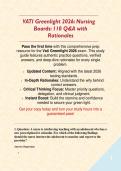
VATI Greenlight 2026: Nursing
Boards: 110 Q&A with
Rationales
Pass the first time with this comprehensive prep
resource for the Vati Greenlight 2026 exam. This study
guide features authentic practice questions, verified
answers, and deep-dive rationales for every single
problem.
• Updated Content: Aligned with the latest 2026
testing standards.
• In-Depth Rationales: Understand the why behind
correct answers.
• Critical Thinking Focus: Master priority questions,
delegation, and clinical judgment.
• Instant Boost: Build the stamina and confidence
needed to secure your green light.
Get your copy today and turn your study hours into a
guaranteed pass!
1. Question: A nurse is reinforcing teaching with an adolescent who has a
new prescription for cefazolin. For which of the following findings
should the nurse instruct the adolescent to monitor and report to the
provider?
Answer: Depression
•
1
, • Detailed Rationale: While cephalosporins like cefazolin are mostly known for
gastrointestinal and hypersensitivity side effects, certain central nervous system (CNS)
adverse effects can occur, including mood alterations like depression, anxiety, or
confusion. The nurse must teach the client to report any psychological changes
immediately to ensure safety and medication reassessment. [1, 2, 3, 4]
•
2. Question: A nurse is caring for a school-age child who has epistaxis.
Which of the following actions should the nurse take?
Answer: Apply pressure at the bridge of the child's nose
•
• Detailed Rationale: For a child with epistaxis (nosebleed), applying continuous
pressure to the bridge of the nose or pinching the soft part of the nostrils for at least 10
minutes helps tamponade the bleeding vessels. The child should also sit upright and tilt
their head slightly forward—not backward—to prevent blood aspiration or swallowing,
which can cause gastric irritation and vomiting. [5, 6, 7]
•
3. Question: A nurse is reinforcing teaching with a group of expectant
parents regarding the proper use of a car seat. Which of the following
statements by a parent indicates an understanding of the teaching?
Answer: "I can place a rolled towel on each side of my newborn's head until he can hold
his head up."
•
• Detailed Rationale: Newborns lack head and neck control. Placing small, rolled
towels on either side of the head prevents lateral movement and keeps the airway open
without interfering with the car seat straps. Heavy commercial inserts or pads that do not
come with the car seat should be avoided as they can compromise safety testing and
harness tightness. [5, 8]
•
4. Question: A nurse working in an inpatient mental health facility is
assisting with the plan of care for a client who has anorexia nervosa.
2
,Which of the following should the nurse recommend to include in the
plan of care?
Answer: Maintain continuity of staff members.
•
• Detailed Rationale: Clients with anorexia nervosa often experience severe anxiety
and can exhibit manipulative behaviors around eating habits. Maintaining staff
continuity helps build trust, ensures consistent enforcement of the treatment plan,
minimizes staff splitting, and provides a structured environment critical for the client's
psychological recovery. [5, 8]
•
5. Question: A nurse is assisting with an admission interview for a client
who has schizophrenia. He tells the nurse that he is receiving special
audible messages from the Central Intelligence Agency that no one else is
able to hear. The nurse should identify that the client is having which of
the following alterations in perception?
Answer: Hallucination
•
• Detailed Rationale: A hallucination is a sensory perception experienced in the
absence of an external stimulus. Because the client is hearing "audible messages" that no
one else can hear, this represents an auditory hallucination. In contrast, a delusion is a
fixed, false belief (e.g., believing they are a CIA agent), rather than a direct sensory
perception error.
•
6. Question: A nurse is reinforcing teaching with a postpartum client
about bathing her newborn. Which of the following statements should
the nurse include?
Answer: "Wash your newborn's head under a stream of running water."
•
• Detailed Rationale: When bathing a newborn, the head should be washed efficiently to
prevent excessive heat loss. Holding the infant securely in a football hold and washing
3
, the hair under warm running water allows for proper rinsing without immersing the
unhealed umbilical cord or risking water aspiration.
•
7. Question: A nurse is caring for a client who has heart failure and
reports difficulty limiting sodium in his diet. Which of the following
recommendations should the nurse provide?
Answer: Replace bottled salad dressing with homemade vinegar and oil dressing.
•
• Detailed Rationale: Commercially prepared, bottled salad dressings are notoriously
high in hidden sodium contents used as chemical preservatives. Making a homemade
dressing using vinegar and oil gives the client full control over the ingredients,
significantly lowering sodium intake to better manage fluid retention associated with
heart failure.
•
8. Question: A nurse is reinforcing teaching with a client who is
scheduled for a mammogram. Which of the following instructions should
the nurse include in the teaching?
Answer: Refrain from using deodorant on the morning of the test
•
• Detailed Rationale: Many deodorants, antiperspirants, powders, and lotions contain
aluminum or calcium compounds. On a mammogram X-ray, these tiny metallic particles
can mimic the appearance of microcalcifications, which are early signs of breast cancer,
potentially leading to false-positive results.
•
9. Question: A nurse is preparing a client's insulin regimen. Which of the
following insulins can be mixed?
Answer: Insulin aspart, regular insulin, insulin lispro
•
4
Boards: 110 Q&A with
Rationales
Pass the first time with this comprehensive prep
resource for the Vati Greenlight 2026 exam. This study
guide features authentic practice questions, verified
answers, and deep-dive rationales for every single
problem.
• Updated Content: Aligned with the latest 2026
testing standards.
• In-Depth Rationales: Understand the why behind
correct answers.
• Critical Thinking Focus: Master priority questions,
delegation, and clinical judgment.
• Instant Boost: Build the stamina and confidence
needed to secure your green light.
Get your copy today and turn your study hours into a
guaranteed pass!
1. Question: A nurse is reinforcing teaching with an adolescent who has a
new prescription for cefazolin. For which of the following findings
should the nurse instruct the adolescent to monitor and report to the
provider?
Answer: Depression
•
1
, • Detailed Rationale: While cephalosporins like cefazolin are mostly known for
gastrointestinal and hypersensitivity side effects, certain central nervous system (CNS)
adverse effects can occur, including mood alterations like depression, anxiety, or
confusion. The nurse must teach the client to report any psychological changes
immediately to ensure safety and medication reassessment. [1, 2, 3, 4]
•
2. Question: A nurse is caring for a school-age child who has epistaxis.
Which of the following actions should the nurse take?
Answer: Apply pressure at the bridge of the child's nose
•
• Detailed Rationale: For a child with epistaxis (nosebleed), applying continuous
pressure to the bridge of the nose or pinching the soft part of the nostrils for at least 10
minutes helps tamponade the bleeding vessels. The child should also sit upright and tilt
their head slightly forward—not backward—to prevent blood aspiration or swallowing,
which can cause gastric irritation and vomiting. [5, 6, 7]
•
3. Question: A nurse is reinforcing teaching with a group of expectant
parents regarding the proper use of a car seat. Which of the following
statements by a parent indicates an understanding of the teaching?
Answer: "I can place a rolled towel on each side of my newborn's head until he can hold
his head up."
•
• Detailed Rationale: Newborns lack head and neck control. Placing small, rolled
towels on either side of the head prevents lateral movement and keeps the airway open
without interfering with the car seat straps. Heavy commercial inserts or pads that do not
come with the car seat should be avoided as they can compromise safety testing and
harness tightness. [5, 8]
•
4. Question: A nurse working in an inpatient mental health facility is
assisting with the plan of care for a client who has anorexia nervosa.
2
,Which of the following should the nurse recommend to include in the
plan of care?
Answer: Maintain continuity of staff members.
•
• Detailed Rationale: Clients with anorexia nervosa often experience severe anxiety
and can exhibit manipulative behaviors around eating habits. Maintaining staff
continuity helps build trust, ensures consistent enforcement of the treatment plan,
minimizes staff splitting, and provides a structured environment critical for the client's
psychological recovery. [5, 8]
•
5. Question: A nurse is assisting with an admission interview for a client
who has schizophrenia. He tells the nurse that he is receiving special
audible messages from the Central Intelligence Agency that no one else is
able to hear. The nurse should identify that the client is having which of
the following alterations in perception?
Answer: Hallucination
•
• Detailed Rationale: A hallucination is a sensory perception experienced in the
absence of an external stimulus. Because the client is hearing "audible messages" that no
one else can hear, this represents an auditory hallucination. In contrast, a delusion is a
fixed, false belief (e.g., believing they are a CIA agent), rather than a direct sensory
perception error.
•
6. Question: A nurse is reinforcing teaching with a postpartum client
about bathing her newborn. Which of the following statements should
the nurse include?
Answer: "Wash your newborn's head under a stream of running water."
•
• Detailed Rationale: When bathing a newborn, the head should be washed efficiently to
prevent excessive heat loss. Holding the infant securely in a football hold and washing
3
, the hair under warm running water allows for proper rinsing without immersing the
unhealed umbilical cord or risking water aspiration.
•
7. Question: A nurse is caring for a client who has heart failure and
reports difficulty limiting sodium in his diet. Which of the following
recommendations should the nurse provide?
Answer: Replace bottled salad dressing with homemade vinegar and oil dressing.
•
• Detailed Rationale: Commercially prepared, bottled salad dressings are notoriously
high in hidden sodium contents used as chemical preservatives. Making a homemade
dressing using vinegar and oil gives the client full control over the ingredients,
significantly lowering sodium intake to better manage fluid retention associated with
heart failure.
•
8. Question: A nurse is reinforcing teaching with a client who is
scheduled for a mammogram. Which of the following instructions should
the nurse include in the teaching?
Answer: Refrain from using deodorant on the morning of the test
•
• Detailed Rationale: Many deodorants, antiperspirants, powders, and lotions contain
aluminum or calcium compounds. On a mammogram X-ray, these tiny metallic particles
can mimic the appearance of microcalcifications, which are early signs of breast cancer,
potentially leading to false-positive results.
•
9. Question: A nurse is preparing a client's insulin regimen. Which of the
following insulins can be mixed?
Answer: Insulin aspart, regular insulin, insulin lispro
•
4