

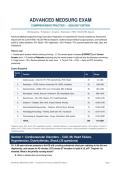
ADVANCED MEDSURG EXAM
COMPREHENSIVE PRACTICE — 2026/2027 EDITION
200 Questions • 9 Sections • Answers + Rationales • HESI / NCLEX-RN Aligned
Advanced Medical-Surgical Nursing Examination Preparation & Comprehensive Clinical Competency Assessment.
Aligned with the current HESI / NCLEX-RN test blueprint, evidence-based medical-surgical practice, and healthcare
quality & safety standards. 30% Recall • 50% Application • 20% Analysis. 75% scenario-based with vitals, labs, and
medications.
How to use
1. Answer each question without looking at the key. 2. The correct option is marked [CORRECT] with Correct
Answer and a 1–2 sentence Rationale explaining why the correct answer is right and why the distractors are wrong.
3. Target score ≥ 75%. Review rationales for every miss. 4. To print: File → Print → Save as PDF (formatting
preserved).
Exam Blueprint
Sectio
Content Qs Range
n
1 Cardiovascular – CAD, MI, HF, HTN, Dysrhythmias, PVD, Shock 35 Q1–Q35
2 Respiratory – COPD, Asthma, Pneumonia, PE, ARDS, Ventilation 25 Q36–Q60
3 Gastrointestinal – GERD, PUD, Liver, Pancreatitis, IBD, GI Bleeds 25 Q61–Q85
4 Neurological – Stroke, Seizures, Parkinson's, MS, Head/Spinal Injury 20 Q86–Q105
5 Renal/Urinary – AKI, CKD, Dialysis, UTI, Fluids/Electrolytes 20 Q106–Q125
6 Endocrine – Diabetes, DKA, HHS, Thyroid, Adrenal, Pituitary 20 Q126–Q145
7 Musculoskeletal/Integumentary – Fractures, Arthritis, Burns, Wounds 15 Q146–Q160
8 Hematology/Immunology – Anemia, Sickle Cell, HIV, Transfusion 15 Q161–Q175
9 Pharmacology & Integrated Cases – Drugs, Calculations, Multi-system 25 Q176–Q200
TOTAL 200 Q1–Q200
Cognitive levels: 30% recall • 50% application (priority / immediate follow-up / most appropriate action) • 20% analysis. Format: 4
options (A–D), ONE correct. Distractors reflect plausible but incorrect interventions, wrong prioritization, misapplied guidelines, or
outdated practice.
Section 1: Cardiovascular Disorders – CAD, MI, Heart Failure,
Hypertension, Dysrhythmias, Shock (35 questions)
Q1: A 58-year-old man presents to the ED with crushing substernal chest pain radiating to the left arm,
diaphoresis, and nausea for 45 minutes. ECG shows ST elevation in leads II, III, aVF. Troponin I is
elevated. What is the priority nursing action?
A. Obtain a detailed diet and smoking history
ADVANCED MEDSURG EXAM — Comprehensive Practice (2026/2027 Edition) Page 1
, B. Prepare the patient for emergent cardiac catheterization [CORRECT]
C. Administer a PRN antacid and reassess in 1 hour
D. Schedule an outpatient stress test
Correct Answer: B
Rationale: ST-elevation inferior MI requires emergent reperfusion via PCI; B is correct. A delays care, C misattributes cardiac
pain to GI cause, D is unsafe for acute MI.
Q2: A patient with acute MI receives alteplase (tPA). One hour later the nurse notes sudden epistaxis,
hypotension (88/50), and oozing from IV sites. Labs show fibrinogen 90 mg/dL. What is the priority
action?
A. Continue to monitor; bleeding is expected and self-limited
B. Stop the infusion and notify the provider immediately [CORRECT]
C. Increase IV fluids and encourage ambulation
D. Administer aspirin 325 mg to prevent reocclusion
Correct Answer: B
Rationale: Signs indicate major bleeding/fibrinolysis complication; stop tPA and notify provider. A ignores life-threatening
bleed, C is unsafe, D worsens bleeding.
Q3: A 67-year-old with heart failure presents with dyspnea, bibasilar crackles, S3 gallop, weight gain 2.5
kg in 2 days, and JVD. BNP is 1,240 pg/mL. Which finding requires immediate follow-up?
A. Trace pedal edema
B. Potassium 5.8 mEq/L with peaked T waves [CORRECT]
C. Blood pressure 138/82 mmHg
D. Mild thirst
Correct Answer: B
Rationale: Hyperkalemia with ECG changes risks fatal dysrhythmia and needs immediate treatment. A, C, D are expected or
non-urgent in HF.
Q4: The nurse is teaching a patient with newly diagnosed hypertension prescribed lisinopril. Which
statement by the patient indicates need for further teaching?
A. 'I will report a persistent dry cough to my doctor.'
B. 'I will avoid salt substitutes containing potassium.'
C. 'It is safe to take ibuprofen daily for arthritis while on this drug.' [CORRECT]
D. 'I will rise slowly to prevent dizziness.'
Correct Answer: C
Rationale: NSAIDs reduce ACE-inhibitor efficacy, worsen renal function and raise K+; C needs correction. A, B, D show
correct understanding (cough, hyperkalemia risk, orthostasis).
Q5: A cardiac monitor shows a rhythm with no discernible P waves, irregularly irregular QRS complexes
at 130 bpm. The patient is hypotensive (82/48) and confused. What is the most appropriate immediate
action?
A. Administer adenosine 6 mg rapid IV push
B. Perform synchronized cardioversion [CORRECT]
C. Encourage vagal maneuvers
D. Observe and recheck in 30 minutes
Correct Answer: B
Rationale: Unstable atrial fibrillation with rapid response and hypotension/altered mentation requires synchronized
cardioversion. Adenosine/vagal maneuvers suit stable SVT, observation is unsafe.
ADVANCED MEDSURG EXAM — Comprehensive Practice (2026/2027 Edition) Page 2
,Q6: A patient with chronic stable angina asks when to take sublingual nitroglycerin. Which teaching is
correct?
A. 'Take one tablet at first chest pain, rest, and call 911 if pain persists after 5 minutes.' [CORRECT]
B. 'Take three tablets at once then drive to the hospital.'
C. 'Take with food to avoid headache.'
D. 'Store tablets in a clear pill organizer in sunlight.'
Correct Answer: A
Rationale: Standard teaching: 1 dose, rest, seek emergency care if not relieved in 5 min, max 3 doses. B is unsafe, C is
incorrect, D degrades nitroglycerin (store dark, airtight).
Q7: A nurse assesses a patient 24 hours post anterior MI. The patient develops sudden dyspnea, pink
frothy sputum, crackles throughout, and SpO2 86%. What complication should the nurse suspect first?
A. Acute left-sided heart failure / pulmonary edema [CORRECT]
B. Gastroesophageal reflux
C. Right-sided heart failure with systemic congestion
D. Stable angina
Correct Answer: A
Rationale: Anterior MI impairs LV function causing pulmonary edema (dyspnea, frothy sputum, crackles, hypoxia). B and D do
not explain findings; right-sided failure causes peripheral edema/JVD, not pulmonary edema.
Q8: A patient on warfarin for atrial fibrillation has INR 5.8 with gum bleeding and hematuria. No active
major hemorrhage. What is the expected intervention?
A. Hold warfarin and administer vitamin K per protocol [CORRECT]
B. Double the next warfarin dose to stabilize levels
C. Start heparin infusion immediately
D. Encourage high intake of leafy green vegetables
Correct Answer: A
Rationale: Supratherapeutic INR with minor bleeding: hold warfarin, give vitamin K. B and C worsen bleeding, D inconsistently
alters INR and is not acute treatment.
Q9: A 72-year-old with heart failure is prescribed furosemide 40 mg daily. Which laboratory value best
indicates therapeutic effectiveness over 48 hours?
A. Serum sodium 140 mEq/L
B. Weight loss of 2 kg with decreased crackles and edema [CORRECT]
C. Serum creatinine unchanged
D. Blood glucose 110 mg/dL
Correct Answer: B
Rationale: Diuresis in HF reduces fluid overload: weight loss with improved lung sounds/edema shows effectiveness. A, C, D
do not measure decongestion.
Q10: A patient presents with tearing chest pain radiating to the back, BP 190/110 in right arm and 150/90
in left arm, and a widened mediastinum on X-ray. What is the priority action?
A. Administer IM morphine and discharge home
B. Initiate esmolol infusion to control heart rate and blood pressure per protocol [CORRECT]
C. Place the patient in Trendelenburg position
D. Encourage coughing and deep breathing
Correct Answer: B
ADVANCED MEDSURG EXAM — Comprehensive Practice (2026/2027 Edition) Page 3
, Rationale: Findings suggest aortic dissection; reduce shear stress with IV beta-blocker and urgent surgical consult. A, C, D
delay life-saving care.
Q11: Telemetry shows sustained ventricular tachycardia at 180 bpm. Patient is pulseless and
unresponsive. What is the first intervention?
A. Defibrillate immediately and resume CPR [CORRECT]
B. Administer oral metoprolol
C. Perform synchronized cardioversion at 50 Joules while awake
D. Check blood pressure in both arms
Correct Answer: A
Rationale: Pulseless VT is a shockable arrest rhythm: immediate defibrillation + CPR. Oral beta-blocker, awake cardioversion,
and BP checks delay resuscitation.
Q12: A patient with peripheral artery disease reports calf pain with walking that resolves with rest.
Ankle-brachial index is 0.65. Which nursing education is most appropriate?
A. 'Walk until claudication pain, rest, then resume walking to build collateral circulation.' [CORRECT]
B. 'Avoid all exercise to prevent pain.'
C. 'Keep legs dangling off the bed continuously.'
D. 'Apply heating pad directly to calves daily.'
Correct Answer: A
Rationale: Supervised walking programs with rest intervals improve claudication distance. B causes deconditioning, C is for
acute arterial occlusion positioning confusion, D risks burns with poor perfusion.
Q13: A nurse cares for a patient in cardiogenic shock after massive MI: BP 78/40, cold clammy skin, urine
output 15 mL/hr, lactate 5.2 mmol/L. Which prescription should the nurse anticipate first?
A. Norepinephrine infusion to maintain perfusion [CORRECT]
B. Oral hydrochlorothiazide
C. Rapid infusion of 2 L hypotonic fluid
D. Outpatient cardiac rehab referral
Correct Answer: A
Rationale: Cardiogenic shock needs vasopressor/inotrope support to maintain MAP and organ perfusion. Diuretics and large
hypotonic fluids worsen hypotension; rehab is not acute care.
Q14: A patient taking atorvastatin reports new muscle pain, dark urine, and fatigue. CK is 8,500 U/L. What
is the priority nursing action?
A. Reassure that muscle aches are normal and continue the statin
B. Hold the statin and notify the provider for suspected rhabdomyolysis [CORRECT]
C. Advise to double the dose to lower cholesterol faster
D. Suggest strenuous exercise to relieve pain
Correct Answer: B
Rationale: Muscle pain + dark urine + markedly elevated CK suggests rhabdomyolysis; hold statin and escalate. A, C, D risk
renal failure.
Q15: ECG shows ST depression and T-wave inversion in a patient with chest pain. Troponin is mildly
elevated. Blood pressure 150/90, HR 98. Which diagnosis fits best?
A. Non–ST-elevation MI (NSTEMI) [CORRECT]
B. Benign early repolarization
C. Acute pericarditis with diffuse ST elevation
D. Normal variant
ADVANCED MEDSURG EXAM — Comprehensive Practice (2026/2027 Edition) Page 4
COMPREHENSIVE PRACTICE — 2026/2027 EDITION
200 Questions • 9 Sections • Answers + Rationales • HESI / NCLEX-RN Aligned
Advanced Medical-Surgical Nursing Examination Preparation & Comprehensive Clinical Competency Assessment.
Aligned with the current HESI / NCLEX-RN test blueprint, evidence-based medical-surgical practice, and healthcare
quality & safety standards. 30% Recall • 50% Application • 20% Analysis. 75% scenario-based with vitals, labs, and
medications.
How to use
1. Answer each question without looking at the key. 2. The correct option is marked [CORRECT] with Correct
Answer and a 1–2 sentence Rationale explaining why the correct answer is right and why the distractors are wrong.
3. Target score ≥ 75%. Review rationales for every miss. 4. To print: File → Print → Save as PDF (formatting
preserved).
Exam Blueprint
Sectio
Content Qs Range
n
1 Cardiovascular – CAD, MI, HF, HTN, Dysrhythmias, PVD, Shock 35 Q1–Q35
2 Respiratory – COPD, Asthma, Pneumonia, PE, ARDS, Ventilation 25 Q36–Q60
3 Gastrointestinal – GERD, PUD, Liver, Pancreatitis, IBD, GI Bleeds 25 Q61–Q85
4 Neurological – Stroke, Seizures, Parkinson's, MS, Head/Spinal Injury 20 Q86–Q105
5 Renal/Urinary – AKI, CKD, Dialysis, UTI, Fluids/Electrolytes 20 Q106–Q125
6 Endocrine – Diabetes, DKA, HHS, Thyroid, Adrenal, Pituitary 20 Q126–Q145
7 Musculoskeletal/Integumentary – Fractures, Arthritis, Burns, Wounds 15 Q146–Q160
8 Hematology/Immunology – Anemia, Sickle Cell, HIV, Transfusion 15 Q161–Q175
9 Pharmacology & Integrated Cases – Drugs, Calculations, Multi-system 25 Q176–Q200
TOTAL 200 Q1–Q200
Cognitive levels: 30% recall • 50% application (priority / immediate follow-up / most appropriate action) • 20% analysis. Format: 4
options (A–D), ONE correct. Distractors reflect plausible but incorrect interventions, wrong prioritization, misapplied guidelines, or
outdated practice.
Section 1: Cardiovascular Disorders – CAD, MI, Heart Failure,
Hypertension, Dysrhythmias, Shock (35 questions)
Q1: A 58-year-old man presents to the ED with crushing substernal chest pain radiating to the left arm,
diaphoresis, and nausea for 45 minutes. ECG shows ST elevation in leads II, III, aVF. Troponin I is
elevated. What is the priority nursing action?
A. Obtain a detailed diet and smoking history
ADVANCED MEDSURG EXAM — Comprehensive Practice (2026/2027 Edition) Page 1
, B. Prepare the patient for emergent cardiac catheterization [CORRECT]
C. Administer a PRN antacid and reassess in 1 hour
D. Schedule an outpatient stress test
Correct Answer: B
Rationale: ST-elevation inferior MI requires emergent reperfusion via PCI; B is correct. A delays care, C misattributes cardiac
pain to GI cause, D is unsafe for acute MI.
Q2: A patient with acute MI receives alteplase (tPA). One hour later the nurse notes sudden epistaxis,
hypotension (88/50), and oozing from IV sites. Labs show fibrinogen 90 mg/dL. What is the priority
action?
A. Continue to monitor; bleeding is expected and self-limited
B. Stop the infusion and notify the provider immediately [CORRECT]
C. Increase IV fluids and encourage ambulation
D. Administer aspirin 325 mg to prevent reocclusion
Correct Answer: B
Rationale: Signs indicate major bleeding/fibrinolysis complication; stop tPA and notify provider. A ignores life-threatening
bleed, C is unsafe, D worsens bleeding.
Q3: A 67-year-old with heart failure presents with dyspnea, bibasilar crackles, S3 gallop, weight gain 2.5
kg in 2 days, and JVD. BNP is 1,240 pg/mL. Which finding requires immediate follow-up?
A. Trace pedal edema
B. Potassium 5.8 mEq/L with peaked T waves [CORRECT]
C. Blood pressure 138/82 mmHg
D. Mild thirst
Correct Answer: B
Rationale: Hyperkalemia with ECG changes risks fatal dysrhythmia and needs immediate treatment. A, C, D are expected or
non-urgent in HF.
Q4: The nurse is teaching a patient with newly diagnosed hypertension prescribed lisinopril. Which
statement by the patient indicates need for further teaching?
A. 'I will report a persistent dry cough to my doctor.'
B. 'I will avoid salt substitutes containing potassium.'
C. 'It is safe to take ibuprofen daily for arthritis while on this drug.' [CORRECT]
D. 'I will rise slowly to prevent dizziness.'
Correct Answer: C
Rationale: NSAIDs reduce ACE-inhibitor efficacy, worsen renal function and raise K+; C needs correction. A, B, D show
correct understanding (cough, hyperkalemia risk, orthostasis).
Q5: A cardiac monitor shows a rhythm with no discernible P waves, irregularly irregular QRS complexes
at 130 bpm. The patient is hypotensive (82/48) and confused. What is the most appropriate immediate
action?
A. Administer adenosine 6 mg rapid IV push
B. Perform synchronized cardioversion [CORRECT]
C. Encourage vagal maneuvers
D. Observe and recheck in 30 minutes
Correct Answer: B
Rationale: Unstable atrial fibrillation with rapid response and hypotension/altered mentation requires synchronized
cardioversion. Adenosine/vagal maneuvers suit stable SVT, observation is unsafe.
ADVANCED MEDSURG EXAM — Comprehensive Practice (2026/2027 Edition) Page 2
,Q6: A patient with chronic stable angina asks when to take sublingual nitroglycerin. Which teaching is
correct?
A. 'Take one tablet at first chest pain, rest, and call 911 if pain persists after 5 minutes.' [CORRECT]
B. 'Take three tablets at once then drive to the hospital.'
C. 'Take with food to avoid headache.'
D. 'Store tablets in a clear pill organizer in sunlight.'
Correct Answer: A
Rationale: Standard teaching: 1 dose, rest, seek emergency care if not relieved in 5 min, max 3 doses. B is unsafe, C is
incorrect, D degrades nitroglycerin (store dark, airtight).
Q7: A nurse assesses a patient 24 hours post anterior MI. The patient develops sudden dyspnea, pink
frothy sputum, crackles throughout, and SpO2 86%. What complication should the nurse suspect first?
A. Acute left-sided heart failure / pulmonary edema [CORRECT]
B. Gastroesophageal reflux
C. Right-sided heart failure with systemic congestion
D. Stable angina
Correct Answer: A
Rationale: Anterior MI impairs LV function causing pulmonary edema (dyspnea, frothy sputum, crackles, hypoxia). B and D do
not explain findings; right-sided failure causes peripheral edema/JVD, not pulmonary edema.
Q8: A patient on warfarin for atrial fibrillation has INR 5.8 with gum bleeding and hematuria. No active
major hemorrhage. What is the expected intervention?
A. Hold warfarin and administer vitamin K per protocol [CORRECT]
B. Double the next warfarin dose to stabilize levels
C. Start heparin infusion immediately
D. Encourage high intake of leafy green vegetables
Correct Answer: A
Rationale: Supratherapeutic INR with minor bleeding: hold warfarin, give vitamin K. B and C worsen bleeding, D inconsistently
alters INR and is not acute treatment.
Q9: A 72-year-old with heart failure is prescribed furosemide 40 mg daily. Which laboratory value best
indicates therapeutic effectiveness over 48 hours?
A. Serum sodium 140 mEq/L
B. Weight loss of 2 kg with decreased crackles and edema [CORRECT]
C. Serum creatinine unchanged
D. Blood glucose 110 mg/dL
Correct Answer: B
Rationale: Diuresis in HF reduces fluid overload: weight loss with improved lung sounds/edema shows effectiveness. A, C, D
do not measure decongestion.
Q10: A patient presents with tearing chest pain radiating to the back, BP 190/110 in right arm and 150/90
in left arm, and a widened mediastinum on X-ray. What is the priority action?
A. Administer IM morphine and discharge home
B. Initiate esmolol infusion to control heart rate and blood pressure per protocol [CORRECT]
C. Place the patient in Trendelenburg position
D. Encourage coughing and deep breathing
Correct Answer: B
ADVANCED MEDSURG EXAM — Comprehensive Practice (2026/2027 Edition) Page 3
, Rationale: Findings suggest aortic dissection; reduce shear stress with IV beta-blocker and urgent surgical consult. A, C, D
delay life-saving care.
Q11: Telemetry shows sustained ventricular tachycardia at 180 bpm. Patient is pulseless and
unresponsive. What is the first intervention?
A. Defibrillate immediately and resume CPR [CORRECT]
B. Administer oral metoprolol
C. Perform synchronized cardioversion at 50 Joules while awake
D. Check blood pressure in both arms
Correct Answer: A
Rationale: Pulseless VT is a shockable arrest rhythm: immediate defibrillation + CPR. Oral beta-blocker, awake cardioversion,
and BP checks delay resuscitation.
Q12: A patient with peripheral artery disease reports calf pain with walking that resolves with rest.
Ankle-brachial index is 0.65. Which nursing education is most appropriate?
A. 'Walk until claudication pain, rest, then resume walking to build collateral circulation.' [CORRECT]
B. 'Avoid all exercise to prevent pain.'
C. 'Keep legs dangling off the bed continuously.'
D. 'Apply heating pad directly to calves daily.'
Correct Answer: A
Rationale: Supervised walking programs with rest intervals improve claudication distance. B causes deconditioning, C is for
acute arterial occlusion positioning confusion, D risks burns with poor perfusion.
Q13: A nurse cares for a patient in cardiogenic shock after massive MI: BP 78/40, cold clammy skin, urine
output 15 mL/hr, lactate 5.2 mmol/L. Which prescription should the nurse anticipate first?
A. Norepinephrine infusion to maintain perfusion [CORRECT]
B. Oral hydrochlorothiazide
C. Rapid infusion of 2 L hypotonic fluid
D. Outpatient cardiac rehab referral
Correct Answer: A
Rationale: Cardiogenic shock needs vasopressor/inotrope support to maintain MAP and organ perfusion. Diuretics and large
hypotonic fluids worsen hypotension; rehab is not acute care.
Q14: A patient taking atorvastatin reports new muscle pain, dark urine, and fatigue. CK is 8,500 U/L. What
is the priority nursing action?
A. Reassure that muscle aches are normal and continue the statin
B. Hold the statin and notify the provider for suspected rhabdomyolysis [CORRECT]
C. Advise to double the dose to lower cholesterol faster
D. Suggest strenuous exercise to relieve pain
Correct Answer: B
Rationale: Muscle pain + dark urine + markedly elevated CK suggests rhabdomyolysis; hold statin and escalate. A, C, D risk
renal failure.
Q15: ECG shows ST depression and T-wave inversion in a patient with chest pain. Troponin is mildly
elevated. Blood pressure 150/90, HR 98. Which diagnosis fits best?
A. Non–ST-elevation MI (NSTEMI) [CORRECT]
B. Benign early repolarization
C. Acute pericarditis with diffuse ST elevation
D. Normal variant
ADVANCED MEDSURG EXAM — Comprehensive Practice (2026/2027 Edition) Page 4


