

CP-FS Food Safety Manager Certification | Complete Practice Questions & Verified Answers | NEHA Exam
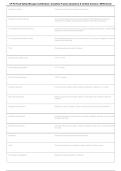
Foodborne illness A disease transmitted to people through food.
Foodborne-illness outbreak Two or more people have the same symptoms after eating the same food,
authorities investigate, and laboratory analysis confirms the outbreak.
Five foodborne-illness risk factors Unsafe sources, improper cooking, incorrect holding temperatures, contaminated
equipment, and poor personal hygiene.
Four ways food becomes unsafe Time-temperature abuse, cross-contamination, poor personal hygiene, and poor
cleaning and sanitizing.
TCS Time/Temperature Control for Safety.
Temperature danger zone 41°F to 135°F.
Cold-holding temperature 41°F or lower.
Hot-holding temperature 135°F or higher.
Ready-to-eat food Food that can be eaten without further preparation, washing, or cooking.
High-risk populations Elderly people, preschool-age children, and people with weakened immune
systems.
Biological contaminant Bacteria, viruses, parasites, fungi, or toxins produced by living organisms.
Chemical contaminant A harmful chemical such as cleaner, sanitizer, pesticide, lubricant, or toxic metal
that gets into food.
Physical contaminant A foreign object such as glass, metal, bandages, jewelry, dirt, or bones that gets
into food.
Pathogen A harmful microorganism that causes illness.
Toxin A poison produced by a pathogen, plant, animal, or other source.
Four types of pathogens Bacteria, viruses, parasites, and fungi.
, CP-FS Food Safety Manager Certification | Complete Practice Questions & Verified Answers | NEHA Exam
FAT TOM Food, Acidity, Temperature, Time, Oxygen, and Moisture.
Controllable FAT TOM conditions Time and temperature.
Bacterial detection Bacteria usually cannot be seen, smelled, or tasted.
Virus growth Viruses require a living host and do not grow in food.
Virus transmission Commonly through fecal-oral routes, food, water, and contaminated surfaces.
Parasite prevention Buy from approved suppliers, cook correctly, and freeze food when required.
Salmonella Typhi source People.
Salmonella Typhi linked foods Ready-to-eat food and beverages.
Shigella source Human feces.
Shigella linked foods Food contaminated by hands, TCS food, and produce.
Shiga toxin-producing E. coli source Intestines of cattle.
Shiga toxin-producing E. coli linked foods Ground beef and produce.
Hepatitis A source Human feces.
Hepatitis A linked foods Ready-to-eat food and shellfish.
Norovirus source Human feces.
Norovirus linked foods Ready-to-eat food and shellfish.
Foodborne illness A disease transmitted to people through food.
Foodborne-illness outbreak Two or more people have the same symptoms after eating the same food,
authorities investigate, and laboratory analysis confirms the outbreak.
Five foodborne-illness risk factors Unsafe sources, improper cooking, incorrect holding temperatures, contaminated
equipment, and poor personal hygiene.
Four ways food becomes unsafe Time-temperature abuse, cross-contamination, poor personal hygiene, and poor
cleaning and sanitizing.
TCS Time/Temperature Control for Safety.
Temperature danger zone 41°F to 135°F.
Cold-holding temperature 41°F or lower.
Hot-holding temperature 135°F or higher.
Ready-to-eat food Food that can be eaten without further preparation, washing, or cooking.
High-risk populations Elderly people, preschool-age children, and people with weakened immune
systems.
Biological contaminant Bacteria, viruses, parasites, fungi, or toxins produced by living organisms.
Chemical contaminant A harmful chemical such as cleaner, sanitizer, pesticide, lubricant, or toxic metal
that gets into food.
Physical contaminant A foreign object such as glass, metal, bandages, jewelry, dirt, or bones that gets
into food.
Pathogen A harmful microorganism that causes illness.
Toxin A poison produced by a pathogen, plant, animal, or other source.
Four types of pathogens Bacteria, viruses, parasites, and fungi.
, CP-FS Food Safety Manager Certification | Complete Practice Questions & Verified Answers | NEHA Exam
FAT TOM Food, Acidity, Temperature, Time, Oxygen, and Moisture.
Controllable FAT TOM conditions Time and temperature.
Bacterial detection Bacteria usually cannot be seen, smelled, or tasted.
Virus growth Viruses require a living host and do not grow in food.
Virus transmission Commonly through fecal-oral routes, food, water, and contaminated surfaces.
Parasite prevention Buy from approved suppliers, cook correctly, and freeze food when required.
Salmonella Typhi source People.
Salmonella Typhi linked foods Ready-to-eat food and beverages.
Shigella source Human feces.
Shigella linked foods Food contaminated by hands, TCS food, and produce.
Shiga toxin-producing E. coli source Intestines of cattle.
Shiga toxin-producing E. coli linked foods Ground beef and produce.
Hepatitis A source Human feces.
Hepatitis A linked foods Ready-to-eat food and shellfish.
Norovirus source Human feces.
Norovirus linked foods Ready-to-eat food and shellfish.


