

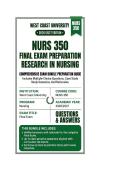
,NURS 350 final exam Research in Nursing Questions And Answers
2026/2027 West Coast University
Q1. What is the primary purpose of nursing research?
A. To replace clinical judgment
B. To generate and validate knowledge that improves nursing practice and
patient outcomes
C. To eliminate the need for nursing education
D. To standardize every patient intervention
Correct Answer: B
Rationale: Nursing research develops scientific knowledge that can improve
care, safety, quality, and patient outcomes.
Q2. Which statement best distinguishes research from evidence-
based practice (EBP)?
A. Research generates new evidence; EBP integrates available evidence into
clinical decisions.
B. EBP generates all new evidence.
C. Research is based only on clinical experience.
D. Research and EBP are identical.
Correct Answer: A
Rationale: Research systematically generates evidence, while EBP applies
the best available evidence along with clinical expertise and patient
preferences.
Q3. Which activity is an example of nursing research?
A. Conducting a study to determine whether hourly rounding reduces falls
B. Following a hospital's existing fall-prevention policy
C. Asking a coworker how to prevent falls
D. Using personal experience to choose an intervention
Correct Answer: A
Rationale: A systematic investigation designed to answer a clinical question
is research.
**Q4. Which activity is an example of evidence-based practice?
A. Implementing a fall-prevention protocol supported by research and clinical
expertise
, B. Continuing an intervention solely because it is traditional
C. Choosing treatment only because the nurse prefers it
D. Ignoring patient preferences
Correct Answer: A
Rationale: EBP integrates the best available evidence with clinical expertise
and patient values.
**Q5. What is often called "Step Zero" in the EBP process?
A. Searching databases
B. Critically appraising evidence
C. Cultivating a spirit of inquiry
D. Evaluating outcomes
Correct Answer: C
Rationale: A spirit of inquiry is the starting point of EBP and involves
questioning current practices and assumptions. Recent WCU final-review
material specifically identifies this as the first step.
**Q6. Which sequence best represents the EBP process after cultivating a
spirit of inquiry?
A. Ask → acquire evidence → appraise evidence → apply evidence → assess
outcomes
B. Diagnose → prescribe → implement → discharge
C. Search → publish → randomize → diagnose
D. Appraise → ask → apply → search
Correct Answer: A
Rationale: EBP generally progresses from asking a focused question
through acquiring, appraising, applying, and evaluating evidence.
**Q7. Which framework is commonly used to develop a focused clinical
question?
A. PICOT
B. SOAP
C. SBAR
D. APGAR
Correct Answer: A
2026/2027 West Coast University
Q1. What is the primary purpose of nursing research?
A. To replace clinical judgment
B. To generate and validate knowledge that improves nursing practice and
patient outcomes
C. To eliminate the need for nursing education
D. To standardize every patient intervention
Correct Answer: B
Rationale: Nursing research develops scientific knowledge that can improve
care, safety, quality, and patient outcomes.
Q2. Which statement best distinguishes research from evidence-
based practice (EBP)?
A. Research generates new evidence; EBP integrates available evidence into
clinical decisions.
B. EBP generates all new evidence.
C. Research is based only on clinical experience.
D. Research and EBP are identical.
Correct Answer: A
Rationale: Research systematically generates evidence, while EBP applies
the best available evidence along with clinical expertise and patient
preferences.
Q3. Which activity is an example of nursing research?
A. Conducting a study to determine whether hourly rounding reduces falls
B. Following a hospital's existing fall-prevention policy
C. Asking a coworker how to prevent falls
D. Using personal experience to choose an intervention
Correct Answer: A
Rationale: A systematic investigation designed to answer a clinical question
is research.
**Q4. Which activity is an example of evidence-based practice?
A. Implementing a fall-prevention protocol supported by research and clinical
expertise
, B. Continuing an intervention solely because it is traditional
C. Choosing treatment only because the nurse prefers it
D. Ignoring patient preferences
Correct Answer: A
Rationale: EBP integrates the best available evidence with clinical expertise
and patient values.
**Q5. What is often called "Step Zero" in the EBP process?
A. Searching databases
B. Critically appraising evidence
C. Cultivating a spirit of inquiry
D. Evaluating outcomes
Correct Answer: C
Rationale: A spirit of inquiry is the starting point of EBP and involves
questioning current practices and assumptions. Recent WCU final-review
material specifically identifies this as the first step.
**Q6. Which sequence best represents the EBP process after cultivating a
spirit of inquiry?
A. Ask → acquire evidence → appraise evidence → apply evidence → assess
outcomes
B. Diagnose → prescribe → implement → discharge
C. Search → publish → randomize → diagnose
D. Appraise → ask → apply → search
Correct Answer: A
Rationale: EBP generally progresses from asking a focused question
through acquiring, appraising, applying, and evaluating evidence.
**Q7. Which framework is commonly used to develop a focused clinical
question?
A. PICOT
B. SOAP
C. SBAR
D. APGAR
Correct Answer: A


