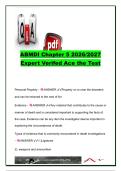
This ABMDI Chapter 5 2026/2027 study document provides focused questions and verified answers covering the handling of evidence and personal property in medicolegal death investigations. Across 9 pages, the material reviews the distinction between personal property and evidence, common forms of evidence encountered during death investigations, and the four critical evidence-management processes: recognition, collection, packaging, and storage. It also explains how evidence that cannot be removed without alteration should be documented through methods such as photography and sketching.
A major portion of the material concentrates on chain of custody and evidence preservation. Students review how possession and transfer of evidence should be documented, what information belongs on a chain-of-custody form, why transfers should be minimized, and how evidence should be secured against tampering or substitution. The questions also cover inventorying personal property, documenting money and jewelry, using biohazard markings, protecting evidence on a decedent during transportation, and safeguarding the hands of gunshot victims with paper bags.
The later sections address physical and trace evidence, laboratory analysis, packaging, shipping, and interagency evidence transfer. Topics include selecting appropriate examinations, delivering evidence to the correct expert, maintaining evidence integrity during transportation, individually wrapping and sealing items, using evidence security tape, documenting delivery, prioritizing laboratory examinations, and communicating with analysts. The document additionally reviews exemplars, transference of evidence, trace evidence, evidence recovered during autopsy, and the respective roles of law enforcement and the medical examiner in handling evidence from the scene and body.
The material is especially useful as a concise ABMDI certification and death investigation review resource because it presents key Chapter 5 concepts in direct question-and-answer format. It emphasizes practical procedures that medicolegal death investigators need to understand when protecting a scene, documenting evidence, preserving trace material, maintaining accountability, and coordinating evidence transfers. The final question reinforces the document's central investigative principle by identifying the body as the most valuable piece of evidence at a death scene.
Relevant students: ABMDI certification candidates, medicolegal death investigation students, medical examiner investigator trainees, coroner investigator trainees, forensic science students, criminal justice students studying death investigation, forensic pathology trainees, crime scene investigation students, and professionals preparing for continuing education or competency examinations involving evidence handling and chain of custody.
Document details: The uploaded material identifies itself as ABMDI Chapter 5 2026/2027 and contains 9 pages. No separate university name or conventional course code is stated in the document. The PDF also does not provide an explicit total number of questions, so an unsupported question count has not been added to the title.
Keywords: ABMDI Chapter 5, ABMDI , ABMDI questions and answers, ABMDI exam preparation, medicolegal death investigation, death investigation questions, evidence collection, evidence preservation, chain of custody, personal property, physical evidence, trace evidence, evidence packaging, evidence storage, evidence documentation, crime scene evidence, forensic evidence, medical examiner investigation, coroner investigation, autopsy evidence, evidence transfer, evidence security, forensic science study guide, death investigator certification, ABMDI study guide, ABMDI test preparation
Content preview
ABMDI Chapter 5 2026/2027
Expert Verifed Ace the Test
Personal Property - ANSWER ✔✔Property on or near the decedent
and can be returned to the next of kin
Evidence - ANSWER ✔✔Any material that contributes to the cause or
manner of death and is considered important to supporting the facts of
the case. Evidence can be any item the investigator deems important in
explaining the circumstances of death.
Types of evidence that is commonly encountered in death investigations
- ANSWER ✔✔1.)Ligatures
2). weapons and ammunition
, 3). medication
4). suicide notes
True/False - Personal property may or may not be evidence -
ANSWER ✔✔True
Four issues that are critical in regard to evidence : - ANSWER ✔✔1).
Recognition
2). Collection
3). Packaging
4). Storage
Evidence such as ligatures and drug containers should be : -
ANSWER ✔✔Logged on a chain of custody form
Some evidence , such as the "context of the scene" and the relationship
of evidence to the body or vehicles, cannot be removed from the scene.
It should be: - ANSWER ✔✔Documented visually by photography,
sketching, and so on.
Evidence cannot be removed from the scene without: - ANSWER
✔✔it being altered