

Written by students who passed Immediately available after payment Read online or as PDF Wrong document? Swap it for free 4.6 TrustPilot
logo-home
Document preview thumbnail
Preview 1 out of 4 pages
Exam (elaborations)

NURS 106 - MIDTERM EXAM QUESTIONS WITH VERIFIED SOLUTIONS LATEST UPDATE 2026

Document preview thumbnail
Preview 1 out of 4 pages

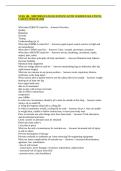
NURS 106 - MIDTERM EXAM QUESTIONS WITH VERIFIED SOLUTIONS LATEST UPDATE 2026 What does PQRSTU stand for - Answers Provokes Quality Radiation Severity Timing Understanding (pt.'s) What does PERRLA stand for? - Answers pupils equal, round, reactive to light and accommodation What does CWMS stand for - Answers Color, warmth, movement, sensation What does ABCIOPS stand for - Answers airway, breathing, circulation, intake, output, pain, safety What are the three principles of body mechanics - Answers Maintain body balance Increase Stability Maintain body alignment What are wedge pillows used for - Answers maintaining legs in abduction after hip replacement surgery What are two reasons to use prone position - Answers acute respiratory distress syndrome, acute lung injury What criteria must a patient meet to use the sabina lift (sit-to-stand) - Answers weight bearing on at least one leg have upper body tone able to sit unassisted able to grip with at least one hand able to follow instructions cooperative max 440lbs In what two circumstance should a pt/'s arms be outside of the sling - Answers when using a sit-to-stand lift or using the hygiene sling with a ceiling lift In what circumstance would a ceiling lift be used - Answers for pt.'s who are unable to weight bear, unable to follow instructions, or have poor body tone Prior to restraint use what things must have been done - Answers Tried alternative and documented outcomes Client consent or alternate must be obtained Physician must order it Care plan in place What are the only circumstances for restraint use - Answers Increased risk of injury to self or others Prevent interruption of therapy Prevent confused or combative pt. from removing life-supporting equipment What are some complications of restraint use - Answers - increased disorientation, agitation, fear, humiliation. - loss of self-esteem - contractures, nerve damage, circulatory impairment, asphyxiation - increased risk of injury from falls - pressure ulcers, skin breakdown - constipation - pneumonia - urinary and fecal incontinence - urinary retention * all complications of being immobile What must be done while a restraint is in use - Answers - ensure you can fit 2 fingers between the pt. and restraint - proper placement, skin integrity, pulses, temp, skin color, and sensation of restrained body part should be assessed at least every hour or according to agencies policy - regular assessment of pt.'s need for continued use of the restraint with the intent of discontinuing the restraint at the earliest time possible What is a mitten restrain used for - Answers to prevent itching, removing dressings, removing IV or other invasive equipment. allows greater movement than a wrist restraint What is an elbow restrain (freedom arm splint) used for - Answers prevents flexion of the elbow, commonly used in children/infants to keep an IV line in place What is a mummy restraint used for - Answers maintains short term restraint of torso and extremities in small children, used for exams or treatments involving the head or neck What is a pelvic soft belt used for - Answers helps for anatomical positioning in chair, if used for this reasoning it is not a restraint What is a belt restraint (segufix/pinel) used for - Answers restrains centre of gravity and prevents the pt. from rolling off the stretcher or sitting up What is an extremity restraint used for - Answers maintain immobilization of the extremity to protect the patient from injury from a fall or accidental removal of a therapeutic device What are two purposes of infection control - Answers protect pt.'s from infection protect HCW's from infection what are some common sites fro nosocomial infections - Answers surgical/traumatic wounds urinary tract respiratory tract bloodstream What are critical items - Answers devices that enter sterile tissue or the vascular system What are semi critical items - Answers Items that have contact with non intact skin or mucus membranes but do not penetrate.

Content preview

NURS 106 - MIDTERM EXAM QUESTIONS WITH VERIFIED SOLUTIONS
LATEST UPDATE 2026


What does PQRSTU stand for - Answers Provokes
Quality
Radiation
Severity
Timing
Understanding (pt.'s)
What does PERRLA stand for? - Answers pupils equal, round, reactive to light and
accommodation
What does CWMS stand for - Answers Color, warmth, movement, sensation
What does ABCIOPS stand for - Answers airway, breathing, circulation, intake,
output, pain, safety
What are the three principles of body mechanics - Answers Maintain body balance
Increase Stability
Maintain body alignment
What are wedge pillows used for - Answers maintaining legs in abduction after hip
replacement surgery
What are two reasons to use prone position - Answers acute respiratory distress
syndrome, acute lung injury
What criteria must a patient meet to use the sabina lift (sit-to-stand) - Answers weight
bearing on at least one leg
have upper body tone
able to sit unassisted
able to grip with at least one hand
able to follow instructions
cooperative
max 440lbs
In what two circumstance should a pt/'s arms be outside of the sling - Answers when
using a sit-to-stand lift
or using the hygiene sling with a ceiling lift
In what circumstance would a ceiling lift be used - Answers for pt.'s who are unable
to weight bear, unable to follow instructions, or have poor body tone
Prior to restraint use what things must have been done - Answers Tried alternative
and documented outcomes
Client consent or alternate must be obtained
Physician must order it
Care plan in place
What are the only circumstances for restraint use - Answers Increased risk of injury
to self or others
Prevent interruption of therapy
Prevent confused or combative pt. from removing life-supporting equipment
What are some complications of restraint use - Answers - increased disorientation,
agitation, fear, humiliation.
- loss of self-esteem
- contractures, nerve damage, circulatory impairment, asphyxiation
- increased risk of injury from falls
- pressure ulcers, skin breakdown


Document information

Uploaded on
September 5, 2026
Number of pages
4
Written in
2026/2027
Type
Exam (elaborations)
Contains
Questions & answers
$11.99

Wrong document? Swap it for free Within 14 days of purchase and before downloading, you can choose a different document. You can simply spend the amount again.
Written by students who passed
Immediately available after payment
Read online or as PDF

Seller avatar
Reputation scores are based on the amount of documents a seller has sold for a fee and the reviews they have received for those documents. There are three levels: Bronze, Silver and Gold. The better the reputation, the more your can rely on the quality of the sellers work.
joshuawesonga22
3.5
(14)
Sold
121
Followers
2
Items
15148
Last sold
1 day ago


Why students choose Stuvia

Created by fellow students, verified by reviews

Quality you can trust: written by students who passed their tests and reviewed by others who've used these notes.

Didn't get what you expected? Choose another document

No worries! You can instantly pick a different document that better fits what you're looking for.

Pay as you like, start learning right away

No subscription, no commitments. Pay the way you're used to via credit card and download your PDF document instantly.

Student with book image

“Bought, downloaded, and aced it. It really can be that simple.”

Alisha Student

Working on your references?

Create accurate citations in APA, MLA and Harvard with our free citation generator.

Working on your references?

Frequently asked questions
