
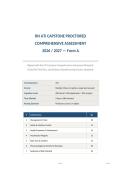
RN ATI CAPSTONE PROCTORED
COMPREHENSIVE ASSESSMENT
— Form A
Aligned with the ATI Capstone Comprehensive Assessment Blueprint,
NCLEX-RN Test Plan, and Evidence-Based Nursing Practice Standards
Total Questions 150
Format Multiple Choice (4 options, single best answer)
Cognitive Levels 20% Recall / 50% Application / 30% Analysis
Time Allotted 3 hours (180 minutes)
Passing Standard Proficiency Level 2 or higher
# Content Area Qs
1 Management of Care 20
2 Safety & Infection Control 15
3 Health Promotion & Maintenance 15
4 Psychosocial Integrity 15
5 Basic Care & Comfort 15
6 Pharmacological & Parenteral Therapies 20
7 Reduction of Risk Potential 20
Page 1 Form A
,RN ATI Capstone Proctored Comprehensive Assessment 2026/2027 A — Form A 150 Questions
8 Physiological Adaptation 30
TOTAL 150
Special Inclusions: 25 priority-setting questions • 20 pharmacology questions • 15 delegation questions
Scenario-based: 75% | Direct knowledge: 25%
Page 2 Form A
,RN ATI Capstone Proctored Comprehensive Assessment 2026/2027 A — Form A 150 Questions
Examination Instructions
• This examination consists of 150 multiple-choice questions divided into 8 content areas aligned with the ATI
Capstone Comprehensive Assessment Blueprint.
• Each question has four options (A, B, C, D). Select the SINGLE BEST answer. There is no penalty for incorrect
answers; answer every question.
• Cognitive complexity is distributed as follows: 20% recall, 50% application, and 30% analysis (including prioritization,
clinical reasoning, and NCLEX-style items).
• Priority-setting questions require application of the ABC framework, Maslow's hierarchy, the acute-vs-chronic
principle, and the 5 Rights of Delegation.
• Pharmacology items assess side effects, contraindications, patient teaching, and dosage calculations. Delegation
items test RN vs. LPN vs. UAP scope of practice.
• Each question includes a rationale with ATI Capstone curriculum and NCLEX standards reference. Review rationales
carefully to reinforce clinical reasoning.
Begin examination on the next page.
Page 3 Form A
, RN ATI Capstone Proctored Comprehensive Assessment 2026/2027 A — Form A 150 Questions
Section 1: Management of Care (20 questions)
Q1: A registered nurse (RN) on a medical-surgical unit is planning care for four assigned clients. Which of the
following tasks is most appropriate to delegate to a licensed practical nurse (LPN)?
A. Administering the first dose of IV push metoclopramide to a nauseated postoperative client
B. Reinforcing teaching about a newly placed colostomy for a client who is being discharged tomorrow
*[CORRECT]*
C. Performing an initial admission assessment on a client transferred from the emergency department
D. Evaluating the effectiveness of IV morphine given 30 minutes ago for a client with chest pain
Correct Answer: B
Rationale: The LPN scope of practice includes reinforcing established teaching, monitoring stable clients, and
performing routine bedside care. Initial assessments, IV push of first-dose medications, and evaluation of analgesia
effectiveness require RN-level judgment per the ATI Capstone 5 Rights of Delegation and state Nurse Practice Acts.
Q2: An RN is assigned to care for four clients. Which task can be safely delegated to an unlicensed assistive
personnel (UAP)?
A. Measuring intake and output for a client who was just started on a continuous IV heparin infusion
B. Ambulating a client 24 hours after a total hip replacement with a new order for weight-bearing as
tolerated
C. Obtaining a stool specimen from a client suspected of having Clostridioides difficile infection
*[CORRECT]*
D. Feeding a client who has dysphagia and is on aspiration precautions after a stroke
Correct Answer: C
Rationale: UAP may perform basic, routine tasks on stable clients, including specimen collection. Measuring I&O;
on an actively titrated heparin infusion, ambulating a fresh postop hip, and feeding a dysphagic client all require
nursing judgment and pose safety risks beyond UAP scope per NCLEX-RN delegation principles.
Q3: The charge nurse is making assignments for the shift. Which client should be assigned to the most
experienced RN?
A. A client with chronic kidney disease scheduled for hemodialysis this morning
B. A client admitted 2 hours ago with acute exacerbation of heart failure receiving IV nitroglycerin
*[CORRECT]*
C. A client who is postoperative day 3 from an open cholecystectomy preparing for discharge
D. A client with type 2 diabetes mellitus requiring reinforcement of insulin injection technique
Correct Answer: B
Rationale: The client with acute heart failure on titrated IV nitroglycerin is hemodynamically unstable and requires
frequent assessment and advanced clinical judgment, matching the ATI Capstone principle of assigning the most
complex, unstable client to the most experienced RN.
Q4: An RN delegates measuring vital signs to a UAP. Which statement by the RN reflects appropriate
delegation communication?
Page 4 Form A
COMPREHENSIVE ASSESSMENT
— Form A
Aligned with the ATI Capstone Comprehensive Assessment Blueprint,
NCLEX-RN Test Plan, and Evidence-Based Nursing Practice Standards
Total Questions 150
Format Multiple Choice (4 options, single best answer)
Cognitive Levels 20% Recall / 50% Application / 30% Analysis
Time Allotted 3 hours (180 minutes)
Passing Standard Proficiency Level 2 or higher
# Content Area Qs
1 Management of Care 20
2 Safety & Infection Control 15
3 Health Promotion & Maintenance 15
4 Psychosocial Integrity 15
5 Basic Care & Comfort 15
6 Pharmacological & Parenteral Therapies 20
7 Reduction of Risk Potential 20
Page 1 Form A
,RN ATI Capstone Proctored Comprehensive Assessment 2026/2027 A — Form A 150 Questions
8 Physiological Adaptation 30
TOTAL 150
Special Inclusions: 25 priority-setting questions • 20 pharmacology questions • 15 delegation questions
Scenario-based: 75% | Direct knowledge: 25%
Page 2 Form A
,RN ATI Capstone Proctored Comprehensive Assessment 2026/2027 A — Form A 150 Questions
Examination Instructions
• This examination consists of 150 multiple-choice questions divided into 8 content areas aligned with the ATI
Capstone Comprehensive Assessment Blueprint.
• Each question has four options (A, B, C, D). Select the SINGLE BEST answer. There is no penalty for incorrect
answers; answer every question.
• Cognitive complexity is distributed as follows: 20% recall, 50% application, and 30% analysis (including prioritization,
clinical reasoning, and NCLEX-style items).
• Priority-setting questions require application of the ABC framework, Maslow's hierarchy, the acute-vs-chronic
principle, and the 5 Rights of Delegation.
• Pharmacology items assess side effects, contraindications, patient teaching, and dosage calculations. Delegation
items test RN vs. LPN vs. UAP scope of practice.
• Each question includes a rationale with ATI Capstone curriculum and NCLEX standards reference. Review rationales
carefully to reinforce clinical reasoning.
Begin examination on the next page.
Page 3 Form A
, RN ATI Capstone Proctored Comprehensive Assessment 2026/2027 A — Form A 150 Questions
Section 1: Management of Care (20 questions)
Q1: A registered nurse (RN) on a medical-surgical unit is planning care for four assigned clients. Which of the
following tasks is most appropriate to delegate to a licensed practical nurse (LPN)?
A. Administering the first dose of IV push metoclopramide to a nauseated postoperative client
B. Reinforcing teaching about a newly placed colostomy for a client who is being discharged tomorrow
*[CORRECT]*
C. Performing an initial admission assessment on a client transferred from the emergency department
D. Evaluating the effectiveness of IV morphine given 30 minutes ago for a client with chest pain
Correct Answer: B
Rationale: The LPN scope of practice includes reinforcing established teaching, monitoring stable clients, and
performing routine bedside care. Initial assessments, IV push of first-dose medications, and evaluation of analgesia
effectiveness require RN-level judgment per the ATI Capstone 5 Rights of Delegation and state Nurse Practice Acts.
Q2: An RN is assigned to care for four clients. Which task can be safely delegated to an unlicensed assistive
personnel (UAP)?
A. Measuring intake and output for a client who was just started on a continuous IV heparin infusion
B. Ambulating a client 24 hours after a total hip replacement with a new order for weight-bearing as
tolerated
C. Obtaining a stool specimen from a client suspected of having Clostridioides difficile infection
*[CORRECT]*
D. Feeding a client who has dysphagia and is on aspiration precautions after a stroke
Correct Answer: C
Rationale: UAP may perform basic, routine tasks on stable clients, including specimen collection. Measuring I&O;
on an actively titrated heparin infusion, ambulating a fresh postop hip, and feeding a dysphagic client all require
nursing judgment and pose safety risks beyond UAP scope per NCLEX-RN delegation principles.
Q3: The charge nurse is making assignments for the shift. Which client should be assigned to the most
experienced RN?
A. A client with chronic kidney disease scheduled for hemodialysis this morning
B. A client admitted 2 hours ago with acute exacerbation of heart failure receiving IV nitroglycerin
*[CORRECT]*
C. A client who is postoperative day 3 from an open cholecystectomy preparing for discharge
D. A client with type 2 diabetes mellitus requiring reinforcement of insulin injection technique
Correct Answer: B
Rationale: The client with acute heart failure on titrated IV nitroglycerin is hemodynamically unstable and requires
frequent assessment and advanced clinical judgment, matching the ATI Capstone principle of assigning the most
complex, unstable client to the most experienced RN.
Q4: An RN delegates measuring vital signs to a UAP. Which statement by the RN reflects appropriate
delegation communication?
Page 4 Form A


