
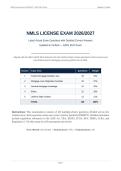
NMLS License Exam 2026/2027 | SAFE MLO Exam Updated & Verified
NMLS LICENSE EXAM 2026/2027
Latest Actual Exam Questions with Detailed Correct Answers
Updated & Verified — SAFE MLO Exam
Aligned with the NMLS SAFE MLO National Test with Uniform State Content standards and the Secure and
Fair Enforcement for Mortgage Licensing (SAFE) Act of 2008.
Section Topic Area Questions Weight
1 Federal Mortgage-Related Laws 29 24%
2 Mortgage Loan Origination Activities 32 27%
3 General Mortgage Knowledge 24 20%
4 Ethics 22 18%
5 Uniform State Content 13 11%
TOTAL 120 100%
Instructions: This examination consists of 120 multiple-choice questions divided across five
content areas. Each question carries one correct answer marked [CORRECT]. Detailed rationales
include regulatory references to the SAFE Act, TILA, RESPA, ECOA, HPA, HMDA, FCRA, and
Regulation Z. Use this exam for self-assessment and review.
Time Allowed: 180 minutes | Passing Score: 75% | Total Questions: 120
Page 1
,NMLS License Exam 2026/2027 | SAFE MLO Exam Updated & Verified
Section 1: Federal Mortgage-Related Laws
Q1: Under RESPA and the TILA-RESPA Integrated Disclosure (TRID) rule, a Loan Estimate
(LE) must be delivered to the applicant no later than:
A. The end of the third business day after the creditor receives the consumer's loan application
[CORRECT]
B. Three business days after the consumer receives the application
C. Seven calendar days before consummation
D. One business day after the application is submitted
Correct Answer: A
Rationale: RESPA and TILA, as integrated by the TRID rule (12 CFR § 1026.19(e)(1)(iii)), require that
the creditor deliver or place in the mail the Loan Estimate no later than the third business day after
the creditor receives the consumer's loan application. "Application" is defined as the submission of
the six pieces of information: name, income, Social Security number, property address, estimated
value, and mortgage loan amount sought. Business days are general business days (all days except
Sundays and legal public holidays).
Q2: A borrower receives a Loan Estimate disclosing a $1,200 origination fee. Before
consummation, a valid changed circumstance occurs. Which statement best describes the
lender's tolerance obligations for the origination fee on the revised LE and Closing
Disclosure (CD)?
A. The origination fee is subject to the 10% cumulative tolerance bucket
B. The origination fee is a zero-tolerance charge that cannot increase from the amount
disclosed on the original LE [CORRECT]
C. The origination fee may increase without limit because a changed circumstance has occurred
D. The origination fee is excluded from tolerance calculations entirely
Correct Answer: B
Rationale: Under 12 CFR § 1026.19(e)(3)(i), fees paid to the creditor, mortgage broker, or an affiliate
of either are subject to zero tolerance. Even when a valid changed circumstance permits a revised LE,
the origination fee cannot increase from the originally disclosed amount unless the changed
circumstance directly affects the origination fee itself. Zero-tolerance items also include fees paid to
the creditor's affiliate and charges for services the consumer is not permitted to shop for.
Q3: Which of the following fees falls into the 10% cumulative tolerance bucket under TRID?
A. Recording fees
B. Title insurance premium for the lender's policy [CORRECT]
C. Services required by the creditor if the creditor permits the consumer to shop
D. Government recording taxes
Correct Answer: B
Page 2
,NMLS License Exam 2026/2027 | SAFE MLO Exam Updated & Verified
Rationale: Under 12 CFR § 1026.19(e)(3)(ii), the 10% cumulative tolerance category includes: (1)
recording fees, (2) charges for third-party services where the consumer is permitted to shop but
selects a provider on the creditor's written list, and (3) charges paid to an unaffiliated third party for a
service the creditor does not require. Title insurance premiums paid to an unaffiliated third-party
provider fall under the 10% bucket. Government recording taxes and fees paid to the creditor are
zero-tolerance or unlimited depending on nature, not 10%.
Q4: A lender discovers after consummation that a fee subject to the 10% cumulative
tolerance was understated on the Closing Disclosure by 14% of the amount disclosed on the
Loan Estimate. What is the appropriate course of action?
A. The lender must refund the excess amount to the consumer within 60 days of consummation
[CORRECT]
B. The lender must refund the full fee to the consumer within 30 calendar days
C. No cure is required because the variance is below 15%
D. The lender must issue a corrected CD but is not required to refund the consumer
Correct Answer: A
Rationale: Under 12 CFR § 1026.19(f)(2)(v) and § 1026.19(e)(3)(ii), if the aggregate of charges subject
to the 10% tolerance exceeds the disclosed amounts by more than 10%, the creditor must refund the
excess to the consumer no later than 60 calendar days after consummation. The 10% tolerance is
computed by aggregating all such fees, not individually. A 14% variance exceeds the tolerance and
triggers a cure.
Q5: Under TILA, the finance charge on a mortgage loan includes which of the following?
A. Title insurance premiums paid to an unaffiliated third party
B. Optional credit life insurance premiums
C. Charges imposed by a third-party closing agent for documentary stamp taxes
D. Points, origination fees, and mortgage broker fees [CORRECT]
Correct Answer: D
Rationale: The finance charge under 12 CFR § 1026.4 includes charges payable directly or indirectly
by the consumer as a condition of credit. Points, origination fees, mortgage broker fees, and certain
premiums are included. Excluded items include: title insurance (when bona fide, reasonable, and
paid to an unaffiliated third party), optional credit insurance (if disclosed and not required as a
condition of credit), and certain government-imposed taxes and fees (12 CFR § 1026.4(a) and (c)).
Q6: A consumer refinances their primary residence with a new lender. The loan is secured
by the primary dwelling and is not a purchase or residential mortgage transaction. Under
TILA's right of rescission, how long is the rescission period, and when does the loan fund?
A. Three business days after consummation; funds are disbursed on day four [CORRECT]
B. Three calendar days after consummation; funds are disbursed on day four
C. Immediately upon signing; rescission expires in three business days
Page 3
, NMLS License Exam 2026/2027 | SAFE MLO Exam Updated & Verified
D. 24 hours after the right to rescind notice is delivered
Correct Answer: A
Rationale: Under 12 CFR § 1026.23(a) and (b), the consumer has the right to rescind a non-purchase,
non-residential mortgage transaction secured by the consumer's principal dwelling until midnight of
the third business day following consummation, delivery of the notice of right to cancel, or delivery
of all material disclosures, whichever occurs last. "Business day" for rescission purposes means all
calendar days except Sundays and legal public holidays. Funds are not disbursed until the rescission
period expires.
Q7: A mortgage loan applicant refuses to provide their race, ethnicity, and sex on the
application. Under ECOA and Regulation B, what is the correct procedure for the loan
originator?
A. The loan originator must note the refusal on the application and proceed; in a face-to-face
interview, the MLO may visually observe and record ethnicity, race, and sex based on surname
[CORRECT]
B. The application cannot be processed until the applicant provides the information
C. The loan originator must refuse to take the application
D. The MLO must require the applicant to provide the information as a condition of credit
Correct Answer: A
Rationale: Under Regulation B, 12 CFR § 1002.12(a) and 1002.13, a creditor may not discriminate on
the basis of race, color, religion, national origin, sex, marital status, age, or receipt of public
assistance. If the applicant refuses to voluntarily provide government monitoring information
(ethnicity, race, sex), the MLO must note the refusal. For dwelling-secured loans taken in a
face-to-face interview, the MLO should visually observe and record the information based on visual
observation and surname; if the application is taken by mail, telephone, or internet, no visual
observation is required.
Q8: Under the Homeowners Protection Act (HPA) of 1998, for a borrower with a standard
PMI policy on a residential mortgage transaction closed in 2024, when is automatic
termination of PMI required?
A. When the loan-to-value (LTV) ratio reaches 78% of the original value, based on the
amortization schedule, provided the borrower is current on payments [CORRECT]
B. When the LTV ratio reaches 80% of the original value
C. Five years after consummation regardless of LTV
D. When the borrower requests cancellation in writing
Correct Answer: A
Page 4
NMLS LICENSE EXAM 2026/2027
Latest Actual Exam Questions with Detailed Correct Answers
Updated & Verified — SAFE MLO Exam
Aligned with the NMLS SAFE MLO National Test with Uniform State Content standards and the Secure and
Fair Enforcement for Mortgage Licensing (SAFE) Act of 2008.
Section Topic Area Questions Weight
1 Federal Mortgage-Related Laws 29 24%
2 Mortgage Loan Origination Activities 32 27%
3 General Mortgage Knowledge 24 20%
4 Ethics 22 18%
5 Uniform State Content 13 11%
TOTAL 120 100%
Instructions: This examination consists of 120 multiple-choice questions divided across five
content areas. Each question carries one correct answer marked [CORRECT]. Detailed rationales
include regulatory references to the SAFE Act, TILA, RESPA, ECOA, HPA, HMDA, FCRA, and
Regulation Z. Use this exam for self-assessment and review.
Time Allowed: 180 minutes | Passing Score: 75% | Total Questions: 120
Page 1
,NMLS License Exam 2026/2027 | SAFE MLO Exam Updated & Verified
Section 1: Federal Mortgage-Related Laws
Q1: Under RESPA and the TILA-RESPA Integrated Disclosure (TRID) rule, a Loan Estimate
(LE) must be delivered to the applicant no later than:
A. The end of the third business day after the creditor receives the consumer's loan application
[CORRECT]
B. Three business days after the consumer receives the application
C. Seven calendar days before consummation
D. One business day after the application is submitted
Correct Answer: A
Rationale: RESPA and TILA, as integrated by the TRID rule (12 CFR § 1026.19(e)(1)(iii)), require that
the creditor deliver or place in the mail the Loan Estimate no later than the third business day after
the creditor receives the consumer's loan application. "Application" is defined as the submission of
the six pieces of information: name, income, Social Security number, property address, estimated
value, and mortgage loan amount sought. Business days are general business days (all days except
Sundays and legal public holidays).
Q2: A borrower receives a Loan Estimate disclosing a $1,200 origination fee. Before
consummation, a valid changed circumstance occurs. Which statement best describes the
lender's tolerance obligations for the origination fee on the revised LE and Closing
Disclosure (CD)?
A. The origination fee is subject to the 10% cumulative tolerance bucket
B. The origination fee is a zero-tolerance charge that cannot increase from the amount
disclosed on the original LE [CORRECT]
C. The origination fee may increase without limit because a changed circumstance has occurred
D. The origination fee is excluded from tolerance calculations entirely
Correct Answer: B
Rationale: Under 12 CFR § 1026.19(e)(3)(i), fees paid to the creditor, mortgage broker, or an affiliate
of either are subject to zero tolerance. Even when a valid changed circumstance permits a revised LE,
the origination fee cannot increase from the originally disclosed amount unless the changed
circumstance directly affects the origination fee itself. Zero-tolerance items also include fees paid to
the creditor's affiliate and charges for services the consumer is not permitted to shop for.
Q3: Which of the following fees falls into the 10% cumulative tolerance bucket under TRID?
A. Recording fees
B. Title insurance premium for the lender's policy [CORRECT]
C. Services required by the creditor if the creditor permits the consumer to shop
D. Government recording taxes
Correct Answer: B
Page 2
,NMLS License Exam 2026/2027 | SAFE MLO Exam Updated & Verified
Rationale: Under 12 CFR § 1026.19(e)(3)(ii), the 10% cumulative tolerance category includes: (1)
recording fees, (2) charges for third-party services where the consumer is permitted to shop but
selects a provider on the creditor's written list, and (3) charges paid to an unaffiliated third party for a
service the creditor does not require. Title insurance premiums paid to an unaffiliated third-party
provider fall under the 10% bucket. Government recording taxes and fees paid to the creditor are
zero-tolerance or unlimited depending on nature, not 10%.
Q4: A lender discovers after consummation that a fee subject to the 10% cumulative
tolerance was understated on the Closing Disclosure by 14% of the amount disclosed on the
Loan Estimate. What is the appropriate course of action?
A. The lender must refund the excess amount to the consumer within 60 days of consummation
[CORRECT]
B. The lender must refund the full fee to the consumer within 30 calendar days
C. No cure is required because the variance is below 15%
D. The lender must issue a corrected CD but is not required to refund the consumer
Correct Answer: A
Rationale: Under 12 CFR § 1026.19(f)(2)(v) and § 1026.19(e)(3)(ii), if the aggregate of charges subject
to the 10% tolerance exceeds the disclosed amounts by more than 10%, the creditor must refund the
excess to the consumer no later than 60 calendar days after consummation. The 10% tolerance is
computed by aggregating all such fees, not individually. A 14% variance exceeds the tolerance and
triggers a cure.
Q5: Under TILA, the finance charge on a mortgage loan includes which of the following?
A. Title insurance premiums paid to an unaffiliated third party
B. Optional credit life insurance premiums
C. Charges imposed by a third-party closing agent for documentary stamp taxes
D. Points, origination fees, and mortgage broker fees [CORRECT]
Correct Answer: D
Rationale: The finance charge under 12 CFR § 1026.4 includes charges payable directly or indirectly
by the consumer as a condition of credit. Points, origination fees, mortgage broker fees, and certain
premiums are included. Excluded items include: title insurance (when bona fide, reasonable, and
paid to an unaffiliated third party), optional credit insurance (if disclosed and not required as a
condition of credit), and certain government-imposed taxes and fees (12 CFR § 1026.4(a) and (c)).
Q6: A consumer refinances their primary residence with a new lender. The loan is secured
by the primary dwelling and is not a purchase or residential mortgage transaction. Under
TILA's right of rescission, how long is the rescission period, and when does the loan fund?
A. Three business days after consummation; funds are disbursed on day four [CORRECT]
B. Three calendar days after consummation; funds are disbursed on day four
C. Immediately upon signing; rescission expires in three business days
Page 3
, NMLS License Exam 2026/2027 | SAFE MLO Exam Updated & Verified
D. 24 hours after the right to rescind notice is delivered
Correct Answer: A
Rationale: Under 12 CFR § 1026.23(a) and (b), the consumer has the right to rescind a non-purchase,
non-residential mortgage transaction secured by the consumer's principal dwelling until midnight of
the third business day following consummation, delivery of the notice of right to cancel, or delivery
of all material disclosures, whichever occurs last. "Business day" for rescission purposes means all
calendar days except Sundays and legal public holidays. Funds are not disbursed until the rescission
period expires.
Q7: A mortgage loan applicant refuses to provide their race, ethnicity, and sex on the
application. Under ECOA and Regulation B, what is the correct procedure for the loan
originator?
A. The loan originator must note the refusal on the application and proceed; in a face-to-face
interview, the MLO may visually observe and record ethnicity, race, and sex based on surname
[CORRECT]
B. The application cannot be processed until the applicant provides the information
C. The loan originator must refuse to take the application
D. The MLO must require the applicant to provide the information as a condition of credit
Correct Answer: A
Rationale: Under Regulation B, 12 CFR § 1002.12(a) and 1002.13, a creditor may not discriminate on
the basis of race, color, religion, national origin, sex, marital status, age, or receipt of public
assistance. If the applicant refuses to voluntarily provide government monitoring information
(ethnicity, race, sex), the MLO must note the refusal. For dwelling-secured loans taken in a
face-to-face interview, the MLO should visually observe and record the information based on visual
observation and surname; if the application is taken by mail, telephone, or internet, no visual
observation is required.
Q8: Under the Homeowners Protection Act (HPA) of 1998, for a borrower with a standard
PMI policy on a residential mortgage transaction closed in 2024, when is automatic
termination of PMI required?
A. When the loan-to-value (LTV) ratio reaches 78% of the original value, based on the
amortization schedule, provided the borrower is current on payments [CORRECT]
B. When the LTV ratio reaches 80% of the original value
C. Five years after consummation regardless of LTV
D. When the borrower requests cancellation in writing
Correct Answer: A
Page 4


