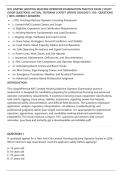
NYC LIMITED HOISTING MACHINE OPERATOR EXAMINATION PRACTICE EXAM | STUDY
GUIDE QUESTIONS | ACTUAL TESTBANK | LATEST UPDATE 2026/2027 | 150+ QUESTIONS
| 100% CORRECT ANSWERS
i. NYC Hoisting Machine Operator Licensing Framework
ii. Limited HMO License Classes and Scope
iii. Eligibility, Experience, and Certification Requirements
iv. Hoisting Machine Fundamentals and Load Dynamics
v. Rigging, Slings, Hardware, and Load Control
vi. Crane Setup, Outriggers, Ground Conditions, and Stability
vii. Load Charts, Rated Capacity, Radius, and Configuration
viii. Safe Operating Procedures and Signal Communication
ix. Power Lines, Work Zones, and Site Hazards
x. Inspection, Maintenance, Deficiencies, and Documentation
xi. NYC Construction-Site Compliance and Operator Responsibilities
xii. Articulating Boom Cranes and Boom Trucks
xiii. Mini Cranes, Sign-Hanging Cranes, and Telehandlers
xiv. Emergency Procedures, Weather, and Accident Prevention
xv. Advanced Scenario-Based Professional Judgment
INTRODUCTION
This comprehensive NYC Limited Hoisting Machine Operator Examination practice
assessment is designed for candidates preparing for professional licensing and advanced
operator competency requirements. It examines licensing scope, equipment classifications,
load charts, rigging, crane setup, stability, inspections, signaling, power-line hazards,
operational safety, documentation, and difficult field decisions. The questions emphasize
application, analysis, regulatory interpretation, calculations, troubleshooting, and
professional judgment rather than simple memorization. It is appropriate for experienced
operators, apprentices, supervisors, and candidates seeking advanced examination
preparation. This study resource contains 150+ questions and answers with concise
rationales. (purchase and instantly get a downloadable and editable pdf)
QUESTION 1
A candidate applies for a New York City Limited Hoisting Machine Operator license in 2026.
Which minimum age requirement must the applicant satisfy before applying?
A. 16 years old
B. 18 years old
C. 19 years old
D. 21 years old
, Correct Answer: B
Explanation: NYC HMO applicants must be at least 18 years old before applying for the
license.
QUESTION 2
A candidate has completed extensive crane operating experience but has not completed
the required Department-approved HMO course applicable to a current Limited HMO
application. What is the most appropriate conclusion?
A. Experience automatically substitutes for the course
B. The course is unnecessary if the candidate holds a driver's license
C. The applicant must satisfy the applicable Department-approved course requirement
D. The employer may waive the course requirement
Correct Answer: C
Explanation: Qualifying experience does not independently eliminate the applicable NYC-
approved training requirement.
QUESTION 3
A newly applying candidate wants to operate an articulating boom crane in NYC in 2026.
Which statement best reflects the post-November 7, 2024 framework?
A. No HMO license is necessary if the crane is truck mounted
B. Only a New York State driver's license is required
C. An appropriate NYC HMO license is required
D. Only an employer-issued operator card is required
Correct Answer: C
Explanation: Beginning November 7, 2024, NYC requires an HMO license for operation of
articulating boom cranes, mini cranes, and rotating telehandlers within the applicable
scope.
QUESTION 4
A candidate seeks a Limited HMO license for a boom truck. Which NCCCO certification is
specifically relevant to that limited license?
A. Tower Crane
B. Lattice Boom Crane
C. Telescopic Boom Crane—Fixed Cab
D. Articulating Boom Crane only
, Correct Answer: C
Explanation: The Limited Boom Truck HMO pathway requires the applicable Telescopic
Boom Crane fixed-cab certification.
QUESTION 5
An operator possesses an NCCCO certification covering only one type of articulating boom
crane. What is the appropriate limitation?
A. The operator may operate every articulating boom crane in NYC
B. The operator's authorization is limited to equipment within the scope of the certification
C. The certification automatically becomes a Class B license
D. The certification permits tower-crane operation as well
Correct Answer: B
Explanation: Limited articulating-boom authorization is constrained by the specific
equipment scope of the certification held.
QUESTION 6
Which NYC agency administers the Hoisting Machine Operator licensing program?
A. New York State Department of Transportation
B. New York City Department of Buildings
C. Federal Motor Carrier Safety Administration
D. New York City Fire Department
Correct Answer: B
Explanation: The NYC Department of Buildings administers the HMO licensing framework.
QUESTION 7
A person operates a power-operated hoisting machine used for hoisting purposes within
NYC jurisdiction without holding an applicable license or qualifying exception. Which
principle applies?
A. Operation is automatically permitted if supervised by a foreman
B. Licensing requirements generally apply unless an applicable exception exists
C. Licensing is required only for tower cranes
D. Licensing applies only when the machine exceeds 50 tons
Correct Answer: B
Explanation: NYC law generally requires an appropriately authorized HMO license unless
, a specific statutory or regulatory exception applies.
QUESTION 8
A candidate's driver's license contains a restriction that the Department determines could
affect safe operation of hoisting machinery. What is the principal concern?
A. The HMO license must automatically become Class B
B. The driver's license qualification may not satisfy the HMO requirement
C. The operator may ignore the restriction on private property
D. The restriction affects only insurance premiums
Correct Answer: B
Explanation: NYC HMO applicants must possess a valid driver's license without conditions
or restrictions determined by the Department to affect safe operation.
QUESTION 9
Why is the distinction between a machine's physical configuration and its manufacturer's
rated capacity important when determining limited-license scope?
A. Only physical appearance determines license scope
B. Both equipment configuration and capacity can define authorization boundaries
C. Rated capacity has no licensing significance
D. Capacity matters only for insurance
Correct Answer: B
Explanation: NYC limited classifications distinguish equipment by configuration, boom
characteristics, and manufacturer-rated capacity.
QUESTION 10
A supervisor tells an operator, "Your NCCCO card is enough; you do not need to verify NYC
HMO authorization." What is the best response?
A. Accept the instruction because NCCCO certification is equivalent to an NYC license
B. Operate only if the crane is under 10 tons
C. Verify that the NYC HMO licensing and equipment-scope requirements are satisfied
D. Operate because supervisor authorization supersedes licensing
Correct Answer: C
Explanation: NCCCO certification is a licensing component, not a substitute for required
NYC HMO authorization.