
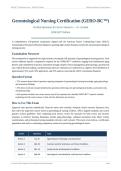
GERO-BC™ Certification Exam — 2026/2027 Edition Verified Questions & Correct Answers
Gerontological Nursing Certification (GERO-BC™)
Verified Questions & Correct Answers — A+ Graded
2026/2027 Edition
A comprehensive 150-question examination aligned with the American Nurses Credentialing Center (ANCC)
Gerontological Nursing Certification blueprint, spanning eight content domains essential for advanced gerontological
nursing practice.
Examination Structure
This examination is organized into eight sections covering the full spectrum of gerontological nursing practice. Each
section addresses specific competencies required for the GERO-BC™ credential, ranging from foundational aging
theories and comprehensive geriatric assessment through complex clinical management, pharmacology, psychosocial
care, ethical decision-making, and professional advocacy. Questions are calibrated to a cognitive level distribution of
approximately 25% recall, 50% application, and 25% analysis, mirroring the ANCC examination blueprint.
Question Format
• 75% scenario-based clinical questions requiring integration of gerontological nursing knowledge, aging physiology,
and assessment findings.
• 25% direct recall and concept identification questions reinforcing core gerontological principles, assessment tools,
and pharmacology.
• Each question includes one correct answer (out of four options) and a detailed GERO-BC™-specific rationale
explaining why the correct answer is best and why distractors are incorrect.
How to Use This Exam
Approach each question methodically. Read the entire stem carefully, eliminate clearly incorrect distractors first,
then select the single best answer based on gerontological nursing evidence, ANCC-aligned standards, and current
geriatric clinical guidelines. After completing each section, review the rationales for both correct and incorrect
responses to reinforce learning. Rationales include aging physiology, validated assessment tools, Beers Criteria
considerations, and professional nursing standards relevant to each scenario. This exam serves both as a certification
preparation tool and as a continuing competency resource for practicing gerontological nurses.
Section Questions Topic
Section 1 Q1–25 Aging Theories, Physiology, and Assessment
Section 2 Q26–50 Common Geriatric Syndromes and Chronic Conditions
Section 3 Q51–65 Cardiovascular and Respiratory Conditions
Section 4 Q66–80 Neurological, Musculoskeletal, and Endocrine Conditions
A+ Graded • ANCC-Aligned • Gerontological Nursing Certification Page 1
,GERO-BC™ Certification Exam — 2026/2027 Edition Verified Questions & Correct Answers
Section 5 Q81–95 Pharmacology and Polypharmacy in Aging
Section 6 Q96–110 Psychosocial, Mental Health, and Cognitive Health
Section 7 Q111–125 Palliative, End-of-Life, and Ethical Care
Section 8 Q126–150 Professional Practice, QI, and Advocacy
Total Q1–150 150 Questions — 8 Domains
A+ Graded • ANCC-Aligned • Gerontological Nursing Certification Page 2
,GERO-BC™ Certification Exam — 2026/2027 Edition Verified Questions & Correct Answers
Section 1: Aging Theories, Physiology, and Assessment
Aging Theories, Normal/Pathological Aging, Comprehensive Geriatric Assessment, & Functional
Assessment
Q1: An 82-year-old female presents to the gerontology clinic for a routine wellness visit. She states she has been
researching aging theories and asks the nurse which biological theory best explains why her cells gradually lose their
ability to divide and repair over time. Which response by the nurse is most accurate?
A. Wear-and-tear theory, which proposes that the body accumulates damage from repeated use and environmental insults
over the lifespan.
B. Free radical theory, which postulates that accumulated oxidative damage from unstable molecules progressively
injures cellular components and DNA.
C. Hayflick limit theory (cellular senescence), which states that somatic cells have a finite number of divisions
(approximately 50) before programmed cessation occurs. [CORRECT]
D. Activity theory, which suggests that continued social and physical engagement prolongs cellular regeneration capacity.
Correct Answer: C
Rationale: The Hayflick limit, demonstrated by Leonard Hayflick in the 1960s, establishes that normal somatic cells
undergo a finite number of divisions (around 40-60) before entering replicative senescence. This cellular senescence theory
directly explains the loss of mitotic capacity with aging. The wear-and-tear and free radical theories describe damage
accumulation rather than intrinsic division limits, while activity theory is a psychosocial (not biological) theory addressing
engagement and life satisfaction.
Q2: A gerontological nurse is teaching a community health class on psychosocial aging theories. Which statement by
an older adult participant indicates correct understanding of Erikson's developmental stage for older adults?
A. "I should focus on generativity by mentoring younger coworkers to achieve fulfillment in old age."
B. "I need to reflect on my life's accomplishments and accept them to achieve ego integrity." [CORRECT]
C. "I should maintain intimacy through close relationships to prevent despair in my later years."
D. "I must continue building my identity through career achievements to age successfully."
Correct Answer: B
Rationale: Erikson's eighth and final psychosocial stage is Ego Integrity vs. Despair, occurring in late adulthood
(approximately 65+ years). The healthy resolution involves reflecting on one's life, accepting past choices, and finding
meaning to achieve ego integrity. Generativity vs. Stagnation is stage 7 (middle adulthood), Intimacy vs. Isolation is stage 6
(young adulthood), and Identity vs. Role Confusion is stage 5 (adolescence). Misidentifying the stage leads to inappropriate
intervention selection.
Q3: A 78-year-old male is undergoing comprehensive geriatric assessment (CGA). The nurse understands that which
component is unique to CGA compared to a standard medical examination?
A. Comprehensive review of past medical history and current medications.
B. Detailed physical examination of all major body systems.
C. Multidimensional evaluation of functional status, cognition, mood, social support, and environment.
[CORRECT]
D. Laboratory diagnostic testing including complete blood count and metabolic panel.
Correct Answer: C
A+ Graded • ANCC-Aligned • Gerontological Nursing Certification Page 3
, GERO-BC™ Certification Exam — 2026/2027 Edition Verified Questions & Correct Answers
Rationale: Comprehensive geriatric assessment (CGA) is a multidimensional, interdisciplinary diagnostic process that goes
beyond standard medical examination by incorporating functional status (ADLs/IADLs), cognitive assessment, mood
screening, social support evaluation, and environmental assessment. Standard examinations include history, physical, and
labs but typically omit these domains. CGA has been demonstrated to reduce mortality, improve function, and reduce
nursing home admissions in older adults.
Q4: A nurse is assessing a 76-year-old patient's ability to live independently. Which assessment tool best evaluates
instrumental activities of daily living (IADLs)?
A. Katz Index of Independence in ADLs
B. Lawton Instrumental Activities of Daily Living Scale [CORRECT]
C. Mini-Mental State Examination (MMSE)
D. Geriatric Depression Scale (GDS-15)
Correct Answer: B
Rationale: The Lawton IADL Scale assesses eight higher-level functions necessary for independent community living:
telephone use, shopping, food preparation, housekeeping, laundry, transportation, medication management, and financial
management. The Katz Index evaluates basic ADLs (bathing, dressing, toileting, transfers, continence, feeding). MMSE
screens cognition, and GDS-15 screens depression. Using the wrong tool leads to inaccurate assessment of independence
level and inappropriate care planning.
Q5: An 80-year-old female is admitted for a fall evaluation. The nurse uses the Timed Up and Go (TUG) test. The
patient completes the test in 16 seconds. How should the nurse interpret this finding?
A. Normal mobility; no fall prevention intervention needed.
B. Borderline; recommend gentle exercise but no formal intervention.
C. Increased fall risk; further evaluation and intervention warranted. [CORRECT]
D. Severe mobility impairment; immediate physical therapy consult and assistive device.
Correct Answer: C
Rationale: The Timed Up and Go (TUG) test requires the patient to rise from a chair, walk 3 meters, turn, walk back, and
sit. Completion in less than 10 seconds indicates normal mobility, 10-19 seconds indicates increased fall risk with
intervention warranted, and 20+ seconds suggests significant mobility impairment requiring comprehensive evaluation and
intervention. A 16-second result places this patient in the moderate risk category requiring fall prevention strategies.
Q6: A 68-year-old male presents with new fatigue and decreased appetite. The nurse understands that with normal
aging, which cardiovascular change is expected and should NOT be attributed to pathology?
A. Increased resting heart rate due to decreased baroreceptor sensitivity.
B. Decreased left ventricular compliance leading to dependent edema at rest.
C. Slight prolonged PR interval and decreased maximal heart rate response to exercise. [CORRECT]
D. Significant orthostatic hypotension with systolic drop greater than 30 mmHg.
Correct Answer: C
Rationale: Normal cardiovascular aging includes arterial stiffening, decreased beta-adrenergic responsiveness (lowering
maximal heart rate), prolonged PR interval, and reduced left ventricular compliance. Resting heart rate remains relatively
stable; significant tachycardia suggests pathology. Dependent edema at rest is pathological. Orthostatic drop >20 mmHg
systolic or >10 mmHg diastolic is abnormal and warrants evaluation. Distinguishing normal from pathological changes
prevents over- and under-treatment.
A+ Graded • ANCC-Aligned • Gerontological Nursing Certification Page 4
Gerontological Nursing Certification (GERO-BC™)
Verified Questions & Correct Answers — A+ Graded
2026/2027 Edition
A comprehensive 150-question examination aligned with the American Nurses Credentialing Center (ANCC)
Gerontological Nursing Certification blueprint, spanning eight content domains essential for advanced gerontological
nursing practice.
Examination Structure
This examination is organized into eight sections covering the full spectrum of gerontological nursing practice. Each
section addresses specific competencies required for the GERO-BC™ credential, ranging from foundational aging
theories and comprehensive geriatric assessment through complex clinical management, pharmacology, psychosocial
care, ethical decision-making, and professional advocacy. Questions are calibrated to a cognitive level distribution of
approximately 25% recall, 50% application, and 25% analysis, mirroring the ANCC examination blueprint.
Question Format
• 75% scenario-based clinical questions requiring integration of gerontological nursing knowledge, aging physiology,
and assessment findings.
• 25% direct recall and concept identification questions reinforcing core gerontological principles, assessment tools,
and pharmacology.
• Each question includes one correct answer (out of four options) and a detailed GERO-BC™-specific rationale
explaining why the correct answer is best and why distractors are incorrect.
How to Use This Exam
Approach each question methodically. Read the entire stem carefully, eliminate clearly incorrect distractors first,
then select the single best answer based on gerontological nursing evidence, ANCC-aligned standards, and current
geriatric clinical guidelines. After completing each section, review the rationales for both correct and incorrect
responses to reinforce learning. Rationales include aging physiology, validated assessment tools, Beers Criteria
considerations, and professional nursing standards relevant to each scenario. This exam serves both as a certification
preparation tool and as a continuing competency resource for practicing gerontological nurses.
Section Questions Topic
Section 1 Q1–25 Aging Theories, Physiology, and Assessment
Section 2 Q26–50 Common Geriatric Syndromes and Chronic Conditions
Section 3 Q51–65 Cardiovascular and Respiratory Conditions
Section 4 Q66–80 Neurological, Musculoskeletal, and Endocrine Conditions
A+ Graded • ANCC-Aligned • Gerontological Nursing Certification Page 1
,GERO-BC™ Certification Exam — 2026/2027 Edition Verified Questions & Correct Answers
Section 5 Q81–95 Pharmacology and Polypharmacy in Aging
Section 6 Q96–110 Psychosocial, Mental Health, and Cognitive Health
Section 7 Q111–125 Palliative, End-of-Life, and Ethical Care
Section 8 Q126–150 Professional Practice, QI, and Advocacy
Total Q1–150 150 Questions — 8 Domains
A+ Graded • ANCC-Aligned • Gerontological Nursing Certification Page 2
,GERO-BC™ Certification Exam — 2026/2027 Edition Verified Questions & Correct Answers
Section 1: Aging Theories, Physiology, and Assessment
Aging Theories, Normal/Pathological Aging, Comprehensive Geriatric Assessment, & Functional
Assessment
Q1: An 82-year-old female presents to the gerontology clinic for a routine wellness visit. She states she has been
researching aging theories and asks the nurse which biological theory best explains why her cells gradually lose their
ability to divide and repair over time. Which response by the nurse is most accurate?
A. Wear-and-tear theory, which proposes that the body accumulates damage from repeated use and environmental insults
over the lifespan.
B. Free radical theory, which postulates that accumulated oxidative damage from unstable molecules progressively
injures cellular components and DNA.
C. Hayflick limit theory (cellular senescence), which states that somatic cells have a finite number of divisions
(approximately 50) before programmed cessation occurs. [CORRECT]
D. Activity theory, which suggests that continued social and physical engagement prolongs cellular regeneration capacity.
Correct Answer: C
Rationale: The Hayflick limit, demonstrated by Leonard Hayflick in the 1960s, establishes that normal somatic cells
undergo a finite number of divisions (around 40-60) before entering replicative senescence. This cellular senescence theory
directly explains the loss of mitotic capacity with aging. The wear-and-tear and free radical theories describe damage
accumulation rather than intrinsic division limits, while activity theory is a psychosocial (not biological) theory addressing
engagement and life satisfaction.
Q2: A gerontological nurse is teaching a community health class on psychosocial aging theories. Which statement by
an older adult participant indicates correct understanding of Erikson's developmental stage for older adults?
A. "I should focus on generativity by mentoring younger coworkers to achieve fulfillment in old age."
B. "I need to reflect on my life's accomplishments and accept them to achieve ego integrity." [CORRECT]
C. "I should maintain intimacy through close relationships to prevent despair in my later years."
D. "I must continue building my identity through career achievements to age successfully."
Correct Answer: B
Rationale: Erikson's eighth and final psychosocial stage is Ego Integrity vs. Despair, occurring in late adulthood
(approximately 65+ years). The healthy resolution involves reflecting on one's life, accepting past choices, and finding
meaning to achieve ego integrity. Generativity vs. Stagnation is stage 7 (middle adulthood), Intimacy vs. Isolation is stage 6
(young adulthood), and Identity vs. Role Confusion is stage 5 (adolescence). Misidentifying the stage leads to inappropriate
intervention selection.
Q3: A 78-year-old male is undergoing comprehensive geriatric assessment (CGA). The nurse understands that which
component is unique to CGA compared to a standard medical examination?
A. Comprehensive review of past medical history and current medications.
B. Detailed physical examination of all major body systems.
C. Multidimensional evaluation of functional status, cognition, mood, social support, and environment.
[CORRECT]
D. Laboratory diagnostic testing including complete blood count and metabolic panel.
Correct Answer: C
A+ Graded • ANCC-Aligned • Gerontological Nursing Certification Page 3
, GERO-BC™ Certification Exam — 2026/2027 Edition Verified Questions & Correct Answers
Rationale: Comprehensive geriatric assessment (CGA) is a multidimensional, interdisciplinary diagnostic process that goes
beyond standard medical examination by incorporating functional status (ADLs/IADLs), cognitive assessment, mood
screening, social support evaluation, and environmental assessment. Standard examinations include history, physical, and
labs but typically omit these domains. CGA has been demonstrated to reduce mortality, improve function, and reduce
nursing home admissions in older adults.
Q4: A nurse is assessing a 76-year-old patient's ability to live independently. Which assessment tool best evaluates
instrumental activities of daily living (IADLs)?
A. Katz Index of Independence in ADLs
B. Lawton Instrumental Activities of Daily Living Scale [CORRECT]
C. Mini-Mental State Examination (MMSE)
D. Geriatric Depression Scale (GDS-15)
Correct Answer: B
Rationale: The Lawton IADL Scale assesses eight higher-level functions necessary for independent community living:
telephone use, shopping, food preparation, housekeeping, laundry, transportation, medication management, and financial
management. The Katz Index evaluates basic ADLs (bathing, dressing, toileting, transfers, continence, feeding). MMSE
screens cognition, and GDS-15 screens depression. Using the wrong tool leads to inaccurate assessment of independence
level and inappropriate care planning.
Q5: An 80-year-old female is admitted for a fall evaluation. The nurse uses the Timed Up and Go (TUG) test. The
patient completes the test in 16 seconds. How should the nurse interpret this finding?
A. Normal mobility; no fall prevention intervention needed.
B. Borderline; recommend gentle exercise but no formal intervention.
C. Increased fall risk; further evaluation and intervention warranted. [CORRECT]
D. Severe mobility impairment; immediate physical therapy consult and assistive device.
Correct Answer: C
Rationale: The Timed Up and Go (TUG) test requires the patient to rise from a chair, walk 3 meters, turn, walk back, and
sit. Completion in less than 10 seconds indicates normal mobility, 10-19 seconds indicates increased fall risk with
intervention warranted, and 20+ seconds suggests significant mobility impairment requiring comprehensive evaluation and
intervention. A 16-second result places this patient in the moderate risk category requiring fall prevention strategies.
Q6: A 68-year-old male presents with new fatigue and decreased appetite. The nurse understands that with normal
aging, which cardiovascular change is expected and should NOT be attributed to pathology?
A. Increased resting heart rate due to decreased baroreceptor sensitivity.
B. Decreased left ventricular compliance leading to dependent edema at rest.
C. Slight prolonged PR interval and decreased maximal heart rate response to exercise. [CORRECT]
D. Significant orthostatic hypotension with systolic drop greater than 30 mmHg.
Correct Answer: C
Rationale: Normal cardiovascular aging includes arterial stiffening, decreased beta-adrenergic responsiveness (lowering
maximal heart rate), prolonged PR interval, and reduced left ventricular compliance. Resting heart rate remains relatively
stable; significant tachycardia suggests pathology. Dependent edema at rest is pathological. Orthostatic drop >20 mmHg
systolic or >10 mmHg diastolic is abnormal and warrants evaluation. Distinguishing normal from pathological changes
prevents over- and under-treatment.
A+ Graded • ANCC-Aligned • Gerontological Nursing Certification Page 4


