

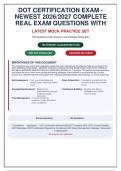
DOT CERTIFICATION EXAM -
NEWEST 2026/2027 COMPLETE
REAL EXAM QUESTIONS WITH
LATEST MOCK PRACTICE SET
150 Questions with Answers and Detailed Rationales
100 PERCENT GUARANTEED PASS
INSTANT DOWNLOAD ANSWERS INCLUDED
IMPORTANCE OF THIS DOCUMENT
This comprehensive examination preparation guide has been meticulously developed to help you succeed in the
DOT CERTIFICATION EXAM - NEWEST 2026/2027 COMPLETE REAL EXAM QUESTIONS WITH CORRECT
DETAILED ANSWERS AND RATIONALES (VERIFIED) GRADED A+. It contains 150 carefully selected questions
that reflect the most current exam content and testing strategies. Each question is accompanied by a correct
answer and a detailed rationale that explains the underlying pathophysiology, pharmacology, or clinical reasoning.
Self-Assessment – Test your knowledge and Exam Preparation – Familiarize yourself with the
identify areas requiring further question format and content
study areas
Concept Reinforcement – Deepen your Confidence Building – Develop test-taking
understanding through strategies and reduce
evidence-based exam anxiety
rationales
Time Management – Practice answering
questions under simulated
exam conditions
Review Summary 150 Questions
Foundations - Application - DOT Certification Newest 2026/2027 Complete REAL WITH Correct Detailed
AND Rationales A DOT Certification Regulations Compliance AND Safety Management Graduate / Advanced
Undergraduate
All answers with rationales
,Table of Contents
Content Area Questions Key Topics
DOT Certification Newest 1-25 Driver, Carrier, Motor, Certification, Hours
2026/2027 Complete REAL
WITH Correct Detailed AND
Rationales A DOT
Certification Regulations
Compliance AND Safety
Management Graduate /
Advanced Undergraduate
Fmcsa 26-50 Driver, Required, Vehicle, Regulations, Motor Carrier
Regulations 51-75 Driver, Certification, Commercial, Fmcsa, Appropriate
Motor 76-100 Driver, Testing, Regulations, Carrier, Alcohol
Carrier 101-125 Driver, Fmcsa, Vehicle, Motor, Regulations
Commercial 126-150 Driver, Fmcsa, Regulations, Hours, Vehicle
TOTAL 150 All questions include answers and detailed rationales
,Section A - DOT Certification Newest 2026/2027 Complete
REAL WITH Correct Detailed AND Rationales A DOT
Certification Regulations Compliance AND Safety
Management Graduate / Advanced Undergraduate
Q1.
A commercial motor vehicle (CMV) is found to have a brake defect that results in the
vehicle being placed out of service. The carrier has a history of violations. Which of the
following actions is the carrier required to take before returning the vehicle to service?
A. Submit a written corrective action plan to B. Perform a full inspection of the brake
the FMCSA within 24 hours. system and document the repair in the
vehicle maintenance records.
C. Obtain a temporary waiver from the D. Notify the state enforcement agency
FMCSA to operate the vehicle to a repair within 72 hours and await approval.
facility.
Correct: B - Perform a full inspection of the brake system and document the repair in the
vehicle maintenance records.
Rationale:Under FMCSR 396.11, a motor carrier must ensure that a vehicle with an
out-of-service defect is repaired and the repair documented before the vehicle is used again.
A corrective action plan is not required for a single vehicle defect; a waiver is not for safety
defects; state notification is not a standard requirement.
Q2.
A driver's record of duty status (RODS) shows that he drove 9 hours on Monday, 10 hours
on Tuesday, 11 hours on Wednesday, and 12 hours on Thursday. He then took 34
consecutive hours off. How many hours of driving time does he have available on the next
day?
A. 11 hours B. 10 hours
C. 12 hours D. 14 hours
Correct: A - 11 hours
Rationale:Under the 34-hour restart rule, a driver who has reached the 60/70-hour limit may
restart after 34 consecutive hours off duty. However, the daily driving limit is 11 hours after 10
consecutive hours off duty. Since he took 34 hours off (which includes the required 10-hour
rest), he is eligible for a full 11-hour driving window.
Page 3
, Section A - DOT Certification Newest 2026/2027 Complete REAL WITH Correct Detailed AND Rationales A DOT Certification Regulations
Compliance AND Safety Management Graduate / Advanced Undergraduate
Q3.
A shipment of lithium-ion batteries is being transported by highway. The batteries are
packed in a fiberboard box with a gross mass of 5 kg. Which of the following is required
on the shipping paper?
A. The UN number, proper shipping name, B. Only the emergency response telephone
and hazard class. number.
C. The name of the manufacturer and the D. A statement of exemption from the HMR.
date of manufacture.
Correct: A - The UN number, proper shipping name, and hazard class.
Rationale:Lithium-ion batteries are regulated as Class 9 hazardous materials. Shipping
papers must include the UN number, proper shipping name, hazard class, packing group, and
quantity. An emergency response number is required, but not the only item. Manufacturer
details and exemption statements are not required.
Q4.
A motor carrier is selected for a compliance review. During the review, the FMCSA
investigator requests the driver qualification files. Which of the following documents must
be present in each driver's file?
A. A copy of the driver's license, medical B. A copy of the driver's birth certificate and
examiner's certificate, and road test social security card.
certificate.
C. A record of the driver's previous D. A certificate of completion from a driver
employment for the last 10 years. training school.
Correct: A - A copy of the driver's license, medical examiner's certificate, and road test
certificate.
Rationale:Per 49 CFR 391.51, driver qualification files must contain the driver's application,
license, medical examiner's certificate, road test certificate, and annual review. Birth
certificates and social security cards are not required. Employment history is required for 3
years, not 10, and training certificates are not mandated.
Q5.
A driver is involved in a fatal accident while operating a CMV. Which of the following
post-accident drug and alcohol tests must be performed?
A. Both drug and alcohol tests within 32 B. Only an alcohol test within 8 hours.
hours.
C. Both drug and alcohol tests within 8 D. Only a drug test within 32 hours.
hours.
Page 4
NEWEST 2026/2027 COMPLETE
REAL EXAM QUESTIONS WITH
LATEST MOCK PRACTICE SET
150 Questions with Answers and Detailed Rationales
100 PERCENT GUARANTEED PASS
INSTANT DOWNLOAD ANSWERS INCLUDED
IMPORTANCE OF THIS DOCUMENT
This comprehensive examination preparation guide has been meticulously developed to help you succeed in the
DOT CERTIFICATION EXAM - NEWEST 2026/2027 COMPLETE REAL EXAM QUESTIONS WITH CORRECT
DETAILED ANSWERS AND RATIONALES (VERIFIED) GRADED A+. It contains 150 carefully selected questions
that reflect the most current exam content and testing strategies. Each question is accompanied by a correct
answer and a detailed rationale that explains the underlying pathophysiology, pharmacology, or clinical reasoning.
Self-Assessment – Test your knowledge and Exam Preparation – Familiarize yourself with the
identify areas requiring further question format and content
study areas
Concept Reinforcement – Deepen your Confidence Building – Develop test-taking
understanding through strategies and reduce
evidence-based exam anxiety
rationales
Time Management – Practice answering
questions under simulated
exam conditions
Review Summary 150 Questions
Foundations - Application - DOT Certification Newest 2026/2027 Complete REAL WITH Correct Detailed
AND Rationales A DOT Certification Regulations Compliance AND Safety Management Graduate / Advanced
Undergraduate
All answers with rationales
,Table of Contents
Content Area Questions Key Topics
DOT Certification Newest 1-25 Driver, Carrier, Motor, Certification, Hours
2026/2027 Complete REAL
WITH Correct Detailed AND
Rationales A DOT
Certification Regulations
Compliance AND Safety
Management Graduate /
Advanced Undergraduate
Fmcsa 26-50 Driver, Required, Vehicle, Regulations, Motor Carrier
Regulations 51-75 Driver, Certification, Commercial, Fmcsa, Appropriate
Motor 76-100 Driver, Testing, Regulations, Carrier, Alcohol
Carrier 101-125 Driver, Fmcsa, Vehicle, Motor, Regulations
Commercial 126-150 Driver, Fmcsa, Regulations, Hours, Vehicle
TOTAL 150 All questions include answers and detailed rationales
,Section A - DOT Certification Newest 2026/2027 Complete
REAL WITH Correct Detailed AND Rationales A DOT
Certification Regulations Compliance AND Safety
Management Graduate / Advanced Undergraduate
Q1.
A commercial motor vehicle (CMV) is found to have a brake defect that results in the
vehicle being placed out of service. The carrier has a history of violations. Which of the
following actions is the carrier required to take before returning the vehicle to service?
A. Submit a written corrective action plan to B. Perform a full inspection of the brake
the FMCSA within 24 hours. system and document the repair in the
vehicle maintenance records.
C. Obtain a temporary waiver from the D. Notify the state enforcement agency
FMCSA to operate the vehicle to a repair within 72 hours and await approval.
facility.
Correct: B - Perform a full inspection of the brake system and document the repair in the
vehicle maintenance records.
Rationale:Under FMCSR 396.11, a motor carrier must ensure that a vehicle with an
out-of-service defect is repaired and the repair documented before the vehicle is used again.
A corrective action plan is not required for a single vehicle defect; a waiver is not for safety
defects; state notification is not a standard requirement.
Q2.
A driver's record of duty status (RODS) shows that he drove 9 hours on Monday, 10 hours
on Tuesday, 11 hours on Wednesday, and 12 hours on Thursday. He then took 34
consecutive hours off. How many hours of driving time does he have available on the next
day?
A. 11 hours B. 10 hours
C. 12 hours D. 14 hours
Correct: A - 11 hours
Rationale:Under the 34-hour restart rule, a driver who has reached the 60/70-hour limit may
restart after 34 consecutive hours off duty. However, the daily driving limit is 11 hours after 10
consecutive hours off duty. Since he took 34 hours off (which includes the required 10-hour
rest), he is eligible for a full 11-hour driving window.
Page 3
, Section A - DOT Certification Newest 2026/2027 Complete REAL WITH Correct Detailed AND Rationales A DOT Certification Regulations
Compliance AND Safety Management Graduate / Advanced Undergraduate
Q3.
A shipment of lithium-ion batteries is being transported by highway. The batteries are
packed in a fiberboard box with a gross mass of 5 kg. Which of the following is required
on the shipping paper?
A. The UN number, proper shipping name, B. Only the emergency response telephone
and hazard class. number.
C. The name of the manufacturer and the D. A statement of exemption from the HMR.
date of manufacture.
Correct: A - The UN number, proper shipping name, and hazard class.
Rationale:Lithium-ion batteries are regulated as Class 9 hazardous materials. Shipping
papers must include the UN number, proper shipping name, hazard class, packing group, and
quantity. An emergency response number is required, but not the only item. Manufacturer
details and exemption statements are not required.
Q4.
A motor carrier is selected for a compliance review. During the review, the FMCSA
investigator requests the driver qualification files. Which of the following documents must
be present in each driver's file?
A. A copy of the driver's license, medical B. A copy of the driver's birth certificate and
examiner's certificate, and road test social security card.
certificate.
C. A record of the driver's previous D. A certificate of completion from a driver
employment for the last 10 years. training school.
Correct: A - A copy of the driver's license, medical examiner's certificate, and road test
certificate.
Rationale:Per 49 CFR 391.51, driver qualification files must contain the driver's application,
license, medical examiner's certificate, road test certificate, and annual review. Birth
certificates and social security cards are not required. Employment history is required for 3
years, not 10, and training certificates are not mandated.
Q5.
A driver is involved in a fatal accident while operating a CMV. Which of the following
post-accident drug and alcohol tests must be performed?
A. Both drug and alcohol tests within 32 B. Only an alcohol test within 8 hours.
hours.
C. Both drug and alcohol tests within 8 D. Only a drug test within 32 hours.
hours.
Page 4


