

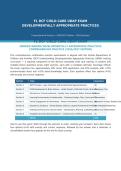
FL DCF CHILD CARE UDAP EXAM
DEVELOPMENTALLY APPROPRIATE PRACTICES
Comprehensive Practice • 2026/2027 Edition • 200 Questions
FL DCF CHILD CARE UDAP EXAM
UNDERSTANDING DEVELOPMENTALLY APPROPRIATE PRACTICES
COMPREHENSIVE PRACTICE (2026/2027 EDITION)
This comprehensive certification practice examination is aligned with the Florida Department of
Children and Families (DCF) Understanding Developmentally Appropriate Practices (UDAP) training
curriculum — a required component of the 40-hour mandated child care training. It contains 200
multiple-choice questions across eight sections, each with a complete rationale. Coverage reflects
the exam cognitive mix: approximately 30% recall, 50% application, and 20% analysis, with ≈75%
scenario-based items and ≈25% direct-knowledge items. Each question offers four options (A–D)
with exactly one correct response.
Section Topic Questions
Section 1 DAP Principles – Age, Individual, and Social/Cultural Appropriateness 30
Section 2 Child Development & Brain Science – Limbic System, Prefrontal Cortex, Stress25
Response, Play
Section 3 Structural vs. Process Indicators – Quality Care, Licensure, Ratios, Process Measures
25
Section 4 Learning Environments & Intentionality – Classroom Design, Play, Curriculum Connections
25
Section 5 Family Engagement & Partnerships – Parent Involvement, Cultural Diversity, Separation
30 Anxiety, Quality Care
Section 6 Discipline & Guidance – Florida Statute 1002.42, Corporal Punishment Prohibition,
20 Mandated Reporting
Section 7 Professional Practices & Teacher Roles – Intentionality, Planning, Scaffolding, Reciprocal
20 Relationships
Section 8 Integrated Scenario-Based Questions – Complex Early Childhood Scenarios 25
TOTAL 200
How to use this exam: Work through the sections in order, marking your answers. Each item shows
four options (A–D) with exactly one correct response, followed by the answer and a rationale. A
consolidated answer key appears at the end for quick scoring.
,FL DCF CHILD CARE UDAP EXAM — COMPREHENSIVE PRACTICE 2026/2027 Edition
Section 1: DAP Principles – Age, Individual, and Social/Cultural Appropriateness
Q1: Developmentally Appropriate Practice (DAP) focuses on children from:
A. birth through age eight [CORRECT]
B. age six through twelve
C. adolescence only
D. adulthood
Correct Answer: A
Rationale: DAP applies to children birth through age eight.
Q2: The three principal components of DAP are:
A. age appropriateness, individual appropriateness, and social/cultural appropriateness [CORRECT]
B. cost, location, and hours
C. staff, materials, and budget
D. curriculum, discipline, and meals
Correct Answer: A
Rationale: DAP has three components: age, individual, and social/cultural appropriateness.
Q3: Age appropriateness means considering:
A. what is typical for a child within a given age group [CORRECT]
B. each child's unique temperament only
C. the family's income
D. the program's schedule
Correct Answer: A
Rationale: Age appropriateness considers typical development for an age group.
Q4: Individual appropriateness means considering:
A. the unique needs, temperament, personality, and family history of each child [CORRECT]
B. only the child's age
C. the group size
D. the classroom budget
Correct Answer: A
Rationale: Individual appropriateness addresses each child's uniqueness.
Q5: Social/cultural appropriateness means considering:
A. the social and cultural contexts in which children grow and live [CORRECT]
B. only the teacher's culture
C. the program's location only
D. the meal menu
Correct Answer: A
Rationale: Social/cultural appropriateness honors each child's cultural context.
Q6: DAP emphasizes that teachers should become more:
A. intentional about what they do [CORRECT]
B. casual about planning
C. distant from children
D. focused on paperwork only
Correct Answer: A
Rationale: DAP calls for intentional, purposeful teaching.
Page 2 of 37
,FL DCF CHILD CARE UDAP EXAM — COMPREHENSIVE PRACTICE 2026/2027 Edition
Q7: Intentional planning creates learning experiences that are:
A. purposeful, challenging, and achievable [CORRECT]
B. random and unplanned
C. too difficult for all
D. passive and boring
Correct Answer: A
Rationale: Intentional experiences are purposeful, challenging, and achievable.
Q8: A teacher plans a counting activity with blocks for 4-year-olds. This reflects:
A. age appropriateness [CORRECT]
B. structural indicators only
C. licensure
D. a disciplinary policy
Correct Answer: A
Rationale: Planning for typical 4-year-old abilities is age-appropriate.
Q9: A teacher learns that a child recently immigrated and adjusts circle time to include songs from the
child's culture. This reflects:
A. social/cultural appropriateness [CORRECT]
B. age appropriateness only
C. a structural indicator
D. a licensing violation
Correct Answer: A
Rationale: Honoring cultural context is social/cultural appropriateness.
Q10: A teacher adapts an activity for a child who is not yet ready to hold scissors. This reflects:
A. individual appropriateness [CORRECT]
B. age appropriateness only
C. social/cultural appropriateness only
D. a ratio requirement
Correct Answer: A
Rationale: Adapting to a child's unique readiness is individual appropriateness.
Q11: DAP is grounded in knowledge of:
A. child development and how children learn [CORRECT]
B. adult learning theory only
C. facility marketing
D. budget management
Correct Answer: A
Rationale: DAP is based on child development knowledge.
Q12: Which is the BEST example of an intentional teacher decision?
A. Selecting materials that match the children's developmental levels [CORRECT]
B. Choosing activities at random
C. Ignoring individual differences
D. Using the same activity for every age
Correct Answer: A
Rationale: Intentional decisions match materials to development.
Page 3 of 37
, FL DCF CHILD CARE UDAP EXAM — COMPREHENSIVE PRACTICE 2026/2027 Edition
Q13: Developmentally appropriate activities should be:
A. challenging but achievable with support [CORRECT]
B. so easy that no effort is needed
C. impossible without adult completion
D. unrelated to children's interests
Correct Answer: A
Rationale: Activities should challenge children within reach of success.
Q14: Which is a hallmark of DAP?
A. Play as a central vehicle for learning [CORRECT]
B. Worksheets as the only method
C. Rote memorization only
D. Silent, seated work all day
Correct Answer: A
Rationale: Play is central to DAP learning.
Q15: A DAP classroom typically offers children:
A. opportunities to make choices and explore [CORRECT]
B. no choices
C. only teacher-directed tasks
D. no free play
Correct Answer: A
Rationale: Choice and exploration are DAP hallmarks.
Q16: The foundation of DAP decision-making is:
A. knowledge of child development and individual children [CORRECT]
B. personal preference only
C. tradition only
D. cost
Correct Answer: A
Rationale: DAP decisions rest on developmental knowledge.
Q17: A teacher who knows each child's temperament, interests, and family background is applying:
A. individual appropriateness [CORRECT]
B. age appropriateness only
C. structural quality only
D. a licensing rule
Correct Answer: A
Rationale: Knowing each child supports individual appropriateness.
Q18: Which statement reflects DAP?
A. "I plan activities based on how children of this age learn best." [CORRECT]
B. "I use the same lesson for all ages."
C. "Children should sit still and listen all day."
D. "Play is a waste of learning time."
Correct Answer: A
Rationale: Planning by developmental knowledge is DAP.
Page 4 of 37
DEVELOPMENTALLY APPROPRIATE PRACTICES
Comprehensive Practice • 2026/2027 Edition • 200 Questions
FL DCF CHILD CARE UDAP EXAM
UNDERSTANDING DEVELOPMENTALLY APPROPRIATE PRACTICES
COMPREHENSIVE PRACTICE (2026/2027 EDITION)
This comprehensive certification practice examination is aligned with the Florida Department of
Children and Families (DCF) Understanding Developmentally Appropriate Practices (UDAP) training
curriculum — a required component of the 40-hour mandated child care training. It contains 200
multiple-choice questions across eight sections, each with a complete rationale. Coverage reflects
the exam cognitive mix: approximately 30% recall, 50% application, and 20% analysis, with ≈75%
scenario-based items and ≈25% direct-knowledge items. Each question offers four options (A–D)
with exactly one correct response.
Section Topic Questions
Section 1 DAP Principles – Age, Individual, and Social/Cultural Appropriateness 30
Section 2 Child Development & Brain Science – Limbic System, Prefrontal Cortex, Stress25
Response, Play
Section 3 Structural vs. Process Indicators – Quality Care, Licensure, Ratios, Process Measures
25
Section 4 Learning Environments & Intentionality – Classroom Design, Play, Curriculum Connections
25
Section 5 Family Engagement & Partnerships – Parent Involvement, Cultural Diversity, Separation
30 Anxiety, Quality Care
Section 6 Discipline & Guidance – Florida Statute 1002.42, Corporal Punishment Prohibition,
20 Mandated Reporting
Section 7 Professional Practices & Teacher Roles – Intentionality, Planning, Scaffolding, Reciprocal
20 Relationships
Section 8 Integrated Scenario-Based Questions – Complex Early Childhood Scenarios 25
TOTAL 200
How to use this exam: Work through the sections in order, marking your answers. Each item shows
four options (A–D) with exactly one correct response, followed by the answer and a rationale. A
consolidated answer key appears at the end for quick scoring.
,FL DCF CHILD CARE UDAP EXAM — COMPREHENSIVE PRACTICE 2026/2027 Edition
Section 1: DAP Principles – Age, Individual, and Social/Cultural Appropriateness
Q1: Developmentally Appropriate Practice (DAP) focuses on children from:
A. birth through age eight [CORRECT]
B. age six through twelve
C. adolescence only
D. adulthood
Correct Answer: A
Rationale: DAP applies to children birth through age eight.
Q2: The three principal components of DAP are:
A. age appropriateness, individual appropriateness, and social/cultural appropriateness [CORRECT]
B. cost, location, and hours
C. staff, materials, and budget
D. curriculum, discipline, and meals
Correct Answer: A
Rationale: DAP has three components: age, individual, and social/cultural appropriateness.
Q3: Age appropriateness means considering:
A. what is typical for a child within a given age group [CORRECT]
B. each child's unique temperament only
C. the family's income
D. the program's schedule
Correct Answer: A
Rationale: Age appropriateness considers typical development for an age group.
Q4: Individual appropriateness means considering:
A. the unique needs, temperament, personality, and family history of each child [CORRECT]
B. only the child's age
C. the group size
D. the classroom budget
Correct Answer: A
Rationale: Individual appropriateness addresses each child's uniqueness.
Q5: Social/cultural appropriateness means considering:
A. the social and cultural contexts in which children grow and live [CORRECT]
B. only the teacher's culture
C. the program's location only
D. the meal menu
Correct Answer: A
Rationale: Social/cultural appropriateness honors each child's cultural context.
Q6: DAP emphasizes that teachers should become more:
A. intentional about what they do [CORRECT]
B. casual about planning
C. distant from children
D. focused on paperwork only
Correct Answer: A
Rationale: DAP calls for intentional, purposeful teaching.
Page 2 of 37
,FL DCF CHILD CARE UDAP EXAM — COMPREHENSIVE PRACTICE 2026/2027 Edition
Q7: Intentional planning creates learning experiences that are:
A. purposeful, challenging, and achievable [CORRECT]
B. random and unplanned
C. too difficult for all
D. passive and boring
Correct Answer: A
Rationale: Intentional experiences are purposeful, challenging, and achievable.
Q8: A teacher plans a counting activity with blocks for 4-year-olds. This reflects:
A. age appropriateness [CORRECT]
B. structural indicators only
C. licensure
D. a disciplinary policy
Correct Answer: A
Rationale: Planning for typical 4-year-old abilities is age-appropriate.
Q9: A teacher learns that a child recently immigrated and adjusts circle time to include songs from the
child's culture. This reflects:
A. social/cultural appropriateness [CORRECT]
B. age appropriateness only
C. a structural indicator
D. a licensing violation
Correct Answer: A
Rationale: Honoring cultural context is social/cultural appropriateness.
Q10: A teacher adapts an activity for a child who is not yet ready to hold scissors. This reflects:
A. individual appropriateness [CORRECT]
B. age appropriateness only
C. social/cultural appropriateness only
D. a ratio requirement
Correct Answer: A
Rationale: Adapting to a child's unique readiness is individual appropriateness.
Q11: DAP is grounded in knowledge of:
A. child development and how children learn [CORRECT]
B. adult learning theory only
C. facility marketing
D. budget management
Correct Answer: A
Rationale: DAP is based on child development knowledge.
Q12: Which is the BEST example of an intentional teacher decision?
A. Selecting materials that match the children's developmental levels [CORRECT]
B. Choosing activities at random
C. Ignoring individual differences
D. Using the same activity for every age
Correct Answer: A
Rationale: Intentional decisions match materials to development.
Page 3 of 37
, FL DCF CHILD CARE UDAP EXAM — COMPREHENSIVE PRACTICE 2026/2027 Edition
Q13: Developmentally appropriate activities should be:
A. challenging but achievable with support [CORRECT]
B. so easy that no effort is needed
C. impossible without adult completion
D. unrelated to children's interests
Correct Answer: A
Rationale: Activities should challenge children within reach of success.
Q14: Which is a hallmark of DAP?
A. Play as a central vehicle for learning [CORRECT]
B. Worksheets as the only method
C. Rote memorization only
D. Silent, seated work all day
Correct Answer: A
Rationale: Play is central to DAP learning.
Q15: A DAP classroom typically offers children:
A. opportunities to make choices and explore [CORRECT]
B. no choices
C. only teacher-directed tasks
D. no free play
Correct Answer: A
Rationale: Choice and exploration are DAP hallmarks.
Q16: The foundation of DAP decision-making is:
A. knowledge of child development and individual children [CORRECT]
B. personal preference only
C. tradition only
D. cost
Correct Answer: A
Rationale: DAP decisions rest on developmental knowledge.
Q17: A teacher who knows each child's temperament, interests, and family background is applying:
A. individual appropriateness [CORRECT]
B. age appropriateness only
C. structural quality only
D. a licensing rule
Correct Answer: A
Rationale: Knowing each child supports individual appropriateness.
Q18: Which statement reflects DAP?
A. "I plan activities based on how children of this age learn best." [CORRECT]
B. "I use the same lesson for all ages."
C. "Children should sit still and listen all day."
D. "Play is a waste of learning time."
Correct Answer: A
Rationale: Planning by developmental knowledge is DAP.
Page 4 of 37


