

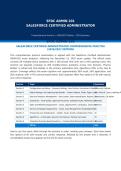
SFDC ADMIN 201
SALESFORCE CERTIFIED ADMINISTRATOR
Comprehensive Practice • 2026/2027 Edition • 200 Questions
SFDC ADMIN 201
SALESFORCE CERTIFIED ADMINISTRATOR COMPREHENSIVE PRACTICE
(2026/2027 EDITION)
This comprehensive practice examination is aligned with the Salesforce Certified Administrator
(ADM-201) exam blueprint, reflecting the December 15, 2025 exam update. The official exam
contains 60 multiple-choice questions with a 105-minute time limit and a 65% passing score; this
practice set expands coverage to 200 multiple-choice questions across nine domains. Process
Builder is retired and Flow Builder is the primary automation tool; Agentforce (8%) is the new AI
section. Coverage reflects the exam cognitive mix: approximately 30% recall, 50% application, and
20% analysis, with ≈75% scenario-based items. Each question offers four options (A–D) with exactly
one correct response.
Section Topic Questions
Section 1 Configuration and Setup – Company Settings, User Profiles, Permissions, Roles,
30Security Controls
Section 2 Object Manager and Lightning App Builder – Custom Objects, Fields, Page Layouts,
30 Record Types, Lightning Pa
Section 3 Data and Analytics Management – Data Loader, Data Import/Export, Reports, 25
Dashboards, List Views
Section 4 Automation – Flow Builder, Approval Processes, Validation Rules, Workflow Automation
25
Section 5 Sales and Marketing Applications – Leads, Opportunities, Campaigns, Lead Conversion
15
Section 6 Service and Support Applications – Cases, Case Management, Knowledge Base
15
Section 7 Productivity and Collaboration – Chatter, Tasks, Events, Collaboration Tools 15
Section 8 Agentforce – AI Concepts, Security, Permissions, Testing, Use Cases 15
Section 9 Integrated Scenario-Based Questions – Complex Multi-Domain Administration 30
Scenarios
TOTAL 200
How to use this exam: Work through the sections in order, marking your answers. Each item shows
four options (A–D) with exactly one correct response, followed by the answer and a rationale. A
consolidated answer key appears at the end for quick scoring.
,SFDC ADMIN 201 — SALESFORCE CERTIFIED ADMINISTRATOR Comprehensive Practice (2026/2027)
Section 1: Configuration and Setup – Company Settings, User Profiles, Permissions,
Roles, Security Controls
Q1: Where are login hours and login IP ranges configured in Salesforce?
A. On the user's Profile [CORRECT]
B. On the user's Role
C. In the Sharing Settings
D. In Company Information
Correct Answer: A
Rationale: Login hours and IP ranges are security controls configured at the profile level.
Q2: Which feature grants additional permissions to a user without changing their profile?
A. Permission set [CORRECT]
B. Role
C. Public group
D. Queue
Correct Answer: A
Rationale: Permission sets extend user access beyond the single profile assigned to each user.
Q3: What does a user's Role control in Salesforce?
A. The level of record access through the role hierarchy [CORRECT]
B. Object-level CRUD permissions
C. Field-level security
D. Login hours
Correct Answer: A
Rationale: Roles control record visibility via the role hierarchy; profiles control object/field permissions.
Q4: An organization-wide default (OWD) of 'Private' means records are accessible by default to:
A. only the record owner and users above them in the role hierarchy [CORRECT]
B. all internal users
C. all users including external
D. only system administrators
Correct Answer: A
Rationale: Private restricts access to the owner; the role hierarchy and sharing rules can extend it.
Q5: Which OWD access level allows users to transfer record ownership and is available for Cases and
Leads?
A. Public Read/Write/Transfer [CORRECT]
B. Public Read/Write
C. Public Read Only
D. Private
Correct Answer: A
Rationale: Public Read/Write/Transfer (available for cases and leads) lets users view, edit, and transfer
ownership.
Page 2 of 37
,SFDC ADMIN 201 — SALESFORCE CERTIFIED ADMINISTRATOR Comprehensive Practice (2026/2027)
Q6: A user needs temporary access to read and edit a custom object for a 3-month project. The BEST
approach is:
A. Assign a permission set for the duration of the project [CORRECT]
B. Create a new profile for the user
C. Promote the user's role
D. Change the OWD to Public Read/Write
Correct Answer: A
Rationale: Permission sets provide granular, temporary access without cloning or modifying profiles.
Q7: Where is the organization's fiscal year defined?
A. Company Information settings [CORRECT]
B. User profile
C. Record type
D. Sharing settings
Correct Answer: A
Rationale: Fiscal year, currency, locale, and language are set in Company Information.
Q8: When multicurrency is enabled, the currency used for the organization as a whole is the:
A. Corporate currency [CORRECT]
B. Personal currency
C. Opportunity currency
D. Converted currency
Correct Answer: A
Rationale: The corporate currency is the default organizational currency; users can have personal currencies.
Q9: What happens when a user is deactivated in Salesforce?
A. The user can no longer log in, the license is freed, and records can be transferred [CORRECT]
B. The user is permanently deleted
C. All their records are deleted
D. Their profile is deleted
Correct Answer: A
Rationale: Deactivation prevents login and frees the license; records remain and can be transferred.
Q10: A Queue is used to:
A. assign a group of users to own records such as leads, cases, and custom objects [CORRECT]
B. control object permissions
C. restrict IP addresses
D. set fiscal year
Correct Answer: A
Rationale: Queues let multiple users share ownership of records for workload distribution.
Q11: A Public Group is used to:
A. group users for sharing rules, list views, and folder access [CORRECT]
B. assign record ownership
C. set login hours
D. define field-level security
Correct Answer: A
Rationale: Public groups bundle users, roles, and other groups for sharing and visibility purposes.
Page 3 of 37
, SFDC ADMIN 201 — SALESFORCE CERTIFIED ADMINISTRATOR Comprehensive Practice (2026/2027)
Q12: Delegated administration allows a user to:
A. manage specified users and their profiles/roles without full admin rights [CORRECT]
B. modify all org settings
C. access all data
D. create new Salesforce editions
Correct Answer: A
Rationale: Delegated admins handle limited user administration tasks in a defined scope.
Q13: Which statement best distinguishes Profiles from Roles?
A. Profiles control what a user can do; Roles control which records a user can see [CORRECT]
B. Roles control object permissions; Profiles control record visibility
C. Both control record visibility only
D. Profiles are optional; roles are required for login
Correct Answer: A
Rationale: Profiles define object/field/feature access; roles define record-level visibility.
Q14: Sharing rules are used to:
A. extend record access to groups of users based on criteria or ownership [CORRECT]
B. set login hours
C. create custom objects
D. define fiscal year
Correct Answer: A
Rationale: Sharing rules grant additional access beyond OWD for specific groups.
Q15: Manual sharing allows:
A. the record owner to share an individual record with a user or group [CORRECT]
B. any user to share any record
C. changing the OWD for one record
D. deleting a record
Correct Answer: A
Rationale: Record owners can manually share individual records to grant one-off access.
Q16: In the role hierarchy, a user automatically gains access to records owned by:
A. users below them in the hierarchy [CORRECT]
B. users above them in the hierarchy
C. all users in the org
D. users in other roles only
Correct Answer: A
Rationale: Managers see records owned by subordinates (subject to OWD and sharing rules).
Q17: How many profiles can be assigned to a single user?
A. One [CORRECT]
B. Two
C. Three
D. Unlimited
Correct Answer: A
Rationale: Each user has exactly one profile; permission sets provide additional access.
Page 4 of 37
SALESFORCE CERTIFIED ADMINISTRATOR
Comprehensive Practice • 2026/2027 Edition • 200 Questions
SFDC ADMIN 201
SALESFORCE CERTIFIED ADMINISTRATOR COMPREHENSIVE PRACTICE
(2026/2027 EDITION)
This comprehensive practice examination is aligned with the Salesforce Certified Administrator
(ADM-201) exam blueprint, reflecting the December 15, 2025 exam update. The official exam
contains 60 multiple-choice questions with a 105-minute time limit and a 65% passing score; this
practice set expands coverage to 200 multiple-choice questions across nine domains. Process
Builder is retired and Flow Builder is the primary automation tool; Agentforce (8%) is the new AI
section. Coverage reflects the exam cognitive mix: approximately 30% recall, 50% application, and
20% analysis, with ≈75% scenario-based items. Each question offers four options (A–D) with exactly
one correct response.
Section Topic Questions
Section 1 Configuration and Setup – Company Settings, User Profiles, Permissions, Roles,
30Security Controls
Section 2 Object Manager and Lightning App Builder – Custom Objects, Fields, Page Layouts,
30 Record Types, Lightning Pa
Section 3 Data and Analytics Management – Data Loader, Data Import/Export, Reports, 25
Dashboards, List Views
Section 4 Automation – Flow Builder, Approval Processes, Validation Rules, Workflow Automation
25
Section 5 Sales and Marketing Applications – Leads, Opportunities, Campaigns, Lead Conversion
15
Section 6 Service and Support Applications – Cases, Case Management, Knowledge Base
15
Section 7 Productivity and Collaboration – Chatter, Tasks, Events, Collaboration Tools 15
Section 8 Agentforce – AI Concepts, Security, Permissions, Testing, Use Cases 15
Section 9 Integrated Scenario-Based Questions – Complex Multi-Domain Administration 30
Scenarios
TOTAL 200
How to use this exam: Work through the sections in order, marking your answers. Each item shows
four options (A–D) with exactly one correct response, followed by the answer and a rationale. A
consolidated answer key appears at the end for quick scoring.
,SFDC ADMIN 201 — SALESFORCE CERTIFIED ADMINISTRATOR Comprehensive Practice (2026/2027)
Section 1: Configuration and Setup – Company Settings, User Profiles, Permissions,
Roles, Security Controls
Q1: Where are login hours and login IP ranges configured in Salesforce?
A. On the user's Profile [CORRECT]
B. On the user's Role
C. In the Sharing Settings
D. In Company Information
Correct Answer: A
Rationale: Login hours and IP ranges are security controls configured at the profile level.
Q2: Which feature grants additional permissions to a user without changing their profile?
A. Permission set [CORRECT]
B. Role
C. Public group
D. Queue
Correct Answer: A
Rationale: Permission sets extend user access beyond the single profile assigned to each user.
Q3: What does a user's Role control in Salesforce?
A. The level of record access through the role hierarchy [CORRECT]
B. Object-level CRUD permissions
C. Field-level security
D. Login hours
Correct Answer: A
Rationale: Roles control record visibility via the role hierarchy; profiles control object/field permissions.
Q4: An organization-wide default (OWD) of 'Private' means records are accessible by default to:
A. only the record owner and users above them in the role hierarchy [CORRECT]
B. all internal users
C. all users including external
D. only system administrators
Correct Answer: A
Rationale: Private restricts access to the owner; the role hierarchy and sharing rules can extend it.
Q5: Which OWD access level allows users to transfer record ownership and is available for Cases and
Leads?
A. Public Read/Write/Transfer [CORRECT]
B. Public Read/Write
C. Public Read Only
D. Private
Correct Answer: A
Rationale: Public Read/Write/Transfer (available for cases and leads) lets users view, edit, and transfer
ownership.
Page 2 of 37
,SFDC ADMIN 201 — SALESFORCE CERTIFIED ADMINISTRATOR Comprehensive Practice (2026/2027)
Q6: A user needs temporary access to read and edit a custom object for a 3-month project. The BEST
approach is:
A. Assign a permission set for the duration of the project [CORRECT]
B. Create a new profile for the user
C. Promote the user's role
D. Change the OWD to Public Read/Write
Correct Answer: A
Rationale: Permission sets provide granular, temporary access without cloning or modifying profiles.
Q7: Where is the organization's fiscal year defined?
A. Company Information settings [CORRECT]
B. User profile
C. Record type
D. Sharing settings
Correct Answer: A
Rationale: Fiscal year, currency, locale, and language are set in Company Information.
Q8: When multicurrency is enabled, the currency used for the organization as a whole is the:
A. Corporate currency [CORRECT]
B. Personal currency
C. Opportunity currency
D. Converted currency
Correct Answer: A
Rationale: The corporate currency is the default organizational currency; users can have personal currencies.
Q9: What happens when a user is deactivated in Salesforce?
A. The user can no longer log in, the license is freed, and records can be transferred [CORRECT]
B. The user is permanently deleted
C. All their records are deleted
D. Their profile is deleted
Correct Answer: A
Rationale: Deactivation prevents login and frees the license; records remain and can be transferred.
Q10: A Queue is used to:
A. assign a group of users to own records such as leads, cases, and custom objects [CORRECT]
B. control object permissions
C. restrict IP addresses
D. set fiscal year
Correct Answer: A
Rationale: Queues let multiple users share ownership of records for workload distribution.
Q11: A Public Group is used to:
A. group users for sharing rules, list views, and folder access [CORRECT]
B. assign record ownership
C. set login hours
D. define field-level security
Correct Answer: A
Rationale: Public groups bundle users, roles, and other groups for sharing and visibility purposes.
Page 3 of 37
, SFDC ADMIN 201 — SALESFORCE CERTIFIED ADMINISTRATOR Comprehensive Practice (2026/2027)
Q12: Delegated administration allows a user to:
A. manage specified users and their profiles/roles without full admin rights [CORRECT]
B. modify all org settings
C. access all data
D. create new Salesforce editions
Correct Answer: A
Rationale: Delegated admins handle limited user administration tasks in a defined scope.
Q13: Which statement best distinguishes Profiles from Roles?
A. Profiles control what a user can do; Roles control which records a user can see [CORRECT]
B. Roles control object permissions; Profiles control record visibility
C. Both control record visibility only
D. Profiles are optional; roles are required for login
Correct Answer: A
Rationale: Profiles define object/field/feature access; roles define record-level visibility.
Q14: Sharing rules are used to:
A. extend record access to groups of users based on criteria or ownership [CORRECT]
B. set login hours
C. create custom objects
D. define fiscal year
Correct Answer: A
Rationale: Sharing rules grant additional access beyond OWD for specific groups.
Q15: Manual sharing allows:
A. the record owner to share an individual record with a user or group [CORRECT]
B. any user to share any record
C. changing the OWD for one record
D. deleting a record
Correct Answer: A
Rationale: Record owners can manually share individual records to grant one-off access.
Q16: In the role hierarchy, a user automatically gains access to records owned by:
A. users below them in the hierarchy [CORRECT]
B. users above them in the hierarchy
C. all users in the org
D. users in other roles only
Correct Answer: A
Rationale: Managers see records owned by subordinates (subject to OWD and sharing rules).
Q17: How many profiles can be assigned to a single user?
A. One [CORRECT]
B. Two
C. Three
D. Unlimited
Correct Answer: A
Rationale: Each user has exactly one profile; permission sets provide additional access.
Page 4 of 37


