

WORKDAY PRO HCM CORE
CERTIFICATION EXAM
Human Capital Management • 2026/2027 Edition • 200 Questions
WORKDAY PRO HCM CORE CERTIFICATION EXAM
COMPREHENSIVE PRACTICE (2026/2027 EDITION)
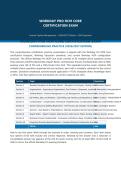
This comprehensive certification practice examination is aligned with the Workday Pro HCM Core
certification blueprint, Workday Education standards, and current Workday HCM configuration
practices. The official Workday Pro HCM Core exam consists of 50 multiple-choice questions across
three domains (HCM Fundamentals, Report Writer, and Business Process Fundamentals) with an 80%
passing score (40 of 50) and a 100-minute time limit. This expanded practice exam contains 200
multiple-choice questions organized into ten sections, each with a complete rationale for the correct
answer. Questions emphasize scenario-based application (≈75%) alongside direct knowledge items
(≈25%), with four options (A–D) and exactly one correct response per item.
Section Topic Questions
Section 1 Workday Navigation & Business Objects – Navigation Techniques, Finding Data,
20Business Objects
Section 2 Organizations – Supervisory Organizations, Cost Centers, Companies, Locations,
35 Hierarchies, Reorganization E
Section 3 Staffing Models – Position Management vs. Job Management, Position Restrictions,
20 Hiring Restrictions
Section 4 Job Profiles, Jobs, and Positions – Job Profiles, Job Families, Job Requisitions, Position
20 Creation, Filled/Unfilled Po
Section 5 Compensation – Compensation Framework, Eligibility Rules, Compensation Packages,
20 Grade Profiles, Salary P
Section 6 Worker Lifecycle & Staffing Movements – Hire Process, Job Changes, Terminations,
15 Contingent Workers
Section 7 Security – User-Based vs. Role-Based vs. Workday Assigned, Domain Security,20
Business Process Security
Section 8 Report Writer – Report Creation, Data Sources, Data Source Filters, Sorting, Sharing,
15 Security Access
Section 9 Business Process Fundamentals – Framework, Definitions, Steps, Condition Rules,
20 Advanced Routing, Notificat
Section 10 Integrated Scenario-Based Questions – Complex Workday Configuration Scenarios
15
TOTAL 200
How to use this exam: Work through the sections in order, marking your answers. Each item shows
four options (A–D) with exactly one correct response, followed by the answer and a rationale. A
consolidated answer key appears at the end for quick scoring. Aim for at least 80% correct (160 of
200) to mirror the official Workday Pro passing standard.
,WORKDAY PRO HCM CORE CERTIFICATION EXAM Comprehensive Practice (2026/2027)
Section 1: Workday Navigation & Business Objects – Navigation Techniques, Finding
Data, Business Objects
Q1: In Workday, a business object is:
A. a data entity such as Worker, Supervisory Organization, or Job Profile [CORRECT]
B. a report type only
C. a security group only
D. a business process step only
Correct Answer: A
Rationale: Business objects are the data entities Workday manages (Worker, Position, Job Profile, etc.).
Q2: A specific instance of a business object refers to:
A. one particular occurrence, such as 'John Smith' as a Worker [CORRECT]
B. the object's data model
C. a security group
D. a report definition
Correct Answer: A
Rationale: An instance is a single occurrence of a business object, e.g., a specific worker.
Q3: Worklets on the home page provide:
A. quick access to tasks and reports relevant to the user [CORRECT]
B. only company news
C. system logs
D. programming interfaces
Correct Answer: A
Rationale: Worklets surface tasks, reports, and information relevant to the user's role.
Q4: The related actions (gear) icon on a business object page is used to:
A. view actions available for that business object [CORRECT]
B. delete the object
C. log out
D. open the printer settings
Correct Answer: A
Rationale: The related actions menu lists actions the user can perform on that object.
Q5: To quickly locate a specific worker, position, or organization, an administrator typically uses:
A. the global search box [CORRECT]
B. the system log
C. the sandbox environment
D. the proxy console
Correct Answer: A
Rationale: Global search locates business objects by name or keyword.
Q6: Which statement about the Worker business object is correct?
A. It represents a person's employment relationship with the organization [CORRECT]
B. It represents only contractors
C. It is a report-only object
D. It cannot have related actions
Correct Answer: A
Rationale: The Worker business object represents the employment relationship.
Page 2 of 37
,WORKDAY PRO HCM CORE CERTIFICATION EXAM Comprehensive Practice (2026/2027)
Q7: A business object field such as 'Employee ID' or 'Hire Date' holds:
A. attribute data about that object [CORRECT]
B. only security data
C. only report data
D. password information
Correct Answer: A
Rationale: Fields store the attributes describing a business object.
Q8: The 'View All' or 'More' options on a Workday page allow the user to:
A. see additional columns or records beyond the default display [CORRECT]
B. delete records
C. edit security
D. open the code editor
Correct Answer: A
Rationale: View All/More expands the displayed data beyond the default view.
Q9: Favorites in Workday are used to:
A. bookmark frequently used tasks and reports [CORRECT]
B. store passwords
C. tag employees for review
D. create security groups
Correct Answer: A
Rationale: Favorites bookmark frequently accessed tasks and reports.
Q10: Which object is the foundation of the staffing structure in Workday HCM?
A. Supervisory Organization [CORRECT]
B. Cost Center
C. Location
D. Company
Correct Answer: A
Rationale: The supervisory organization is the foundation of the management/staffing structure.
Q11: The 'Announcements' area on the Workday home page is typically used to:
A. communicate company-wide messages to employees [CORRECT]
B. store security policies
C. schedule integrations
D. define business processes
Correct Answer: A
Rationale: Announcements broadcast messages across the organization.
Q12: A user cannot find a report they need. The most likely reason is:
A. they lack security access to the report or its data source [CORRECT]
B. the report does not exist anywhere
C. reports are never shared
D. their language setting
Correct Answer: A
Rationale: Report visibility depends on security access to the report and its data source.
Page 3 of 37
, WORKDAY PRO HCM CORE CERTIFICATION EXAM Comprehensive Practice (2026/2027)
Q13: Related actions visibility for a user is determined by:
A. the user's security group membership and domain access [CORRECT]
B. the user's favorite color
C. the user's hire date
D. the user's location only
Correct Answer: A
Rationale: Security groups and domain policies control which related actions appear.
Q14: The primary way to navigate between tasks, reports, and business objects in Workday is:
A. via worklets, search, and related actions [CORRECT]
B. only via the keyboard
C. only via email links
D. only via API calls
Correct Answer: A
Rationale: Worklets, search, and related actions are the main navigation paths.
Q15: A 'Task' in Workday is:
A. an action a user can perform, such as Hire or Create Position [CORRECT]
B. a report
C. a security group
D. a business object
Correct Answer: A
Rationale: Tasks are user actions (e.g., Hire, Change Job) performed on business objects.
Q16: Which is an example of a business object (not a task)?
A. Job Profile [CORRECT]
B. Hire
C. Change Job
D. Terminate Employee
Correct Answer: A
Rationale: Job Profile is a business object; Hire and Change Job are tasks/business processes.
Q17: The Workday home page layout a user sees is driven by:
A. their role and security access [CORRECT]
B. their browser only
C. their department's name
D. their manager's preferences only
Correct Answer: A
Rationale: Home page worklets and content are driven by role and security.
Q18: When viewing an organization, clicking on its name typically:
A. opens the organization's details and related actions [CORRECT]
B. deletes the organization
C. logs the user out
D. runs an integration
Correct Answer: A
Rationale: Clicking a link opens that business object's details and actions.
Page 4 of 37
CERTIFICATION EXAM
Human Capital Management • 2026/2027 Edition • 200 Questions
WORKDAY PRO HCM CORE CERTIFICATION EXAM
COMPREHENSIVE PRACTICE (2026/2027 EDITION)
This comprehensive certification practice examination is aligned with the Workday Pro HCM Core
certification blueprint, Workday Education standards, and current Workday HCM configuration
practices. The official Workday Pro HCM Core exam consists of 50 multiple-choice questions across
three domains (HCM Fundamentals, Report Writer, and Business Process Fundamentals) with an 80%
passing score (40 of 50) and a 100-minute time limit. This expanded practice exam contains 200
multiple-choice questions organized into ten sections, each with a complete rationale for the correct
answer. Questions emphasize scenario-based application (≈75%) alongside direct knowledge items
(≈25%), with four options (A–D) and exactly one correct response per item.
Section Topic Questions
Section 1 Workday Navigation & Business Objects – Navigation Techniques, Finding Data,
20Business Objects
Section 2 Organizations – Supervisory Organizations, Cost Centers, Companies, Locations,
35 Hierarchies, Reorganization E
Section 3 Staffing Models – Position Management vs. Job Management, Position Restrictions,
20 Hiring Restrictions
Section 4 Job Profiles, Jobs, and Positions – Job Profiles, Job Families, Job Requisitions, Position
20 Creation, Filled/Unfilled Po
Section 5 Compensation – Compensation Framework, Eligibility Rules, Compensation Packages,
20 Grade Profiles, Salary P
Section 6 Worker Lifecycle & Staffing Movements – Hire Process, Job Changes, Terminations,
15 Contingent Workers
Section 7 Security – User-Based vs. Role-Based vs. Workday Assigned, Domain Security,20
Business Process Security
Section 8 Report Writer – Report Creation, Data Sources, Data Source Filters, Sorting, Sharing,
15 Security Access
Section 9 Business Process Fundamentals – Framework, Definitions, Steps, Condition Rules,
20 Advanced Routing, Notificat
Section 10 Integrated Scenario-Based Questions – Complex Workday Configuration Scenarios
15
TOTAL 200
How to use this exam: Work through the sections in order, marking your answers. Each item shows
four options (A–D) with exactly one correct response, followed by the answer and a rationale. A
consolidated answer key appears at the end for quick scoring. Aim for at least 80% correct (160 of
200) to mirror the official Workday Pro passing standard.
,WORKDAY PRO HCM CORE CERTIFICATION EXAM Comprehensive Practice (2026/2027)
Section 1: Workday Navigation & Business Objects – Navigation Techniques, Finding
Data, Business Objects
Q1: In Workday, a business object is:
A. a data entity such as Worker, Supervisory Organization, or Job Profile [CORRECT]
B. a report type only
C. a security group only
D. a business process step only
Correct Answer: A
Rationale: Business objects are the data entities Workday manages (Worker, Position, Job Profile, etc.).
Q2: A specific instance of a business object refers to:
A. one particular occurrence, such as 'John Smith' as a Worker [CORRECT]
B. the object's data model
C. a security group
D. a report definition
Correct Answer: A
Rationale: An instance is a single occurrence of a business object, e.g., a specific worker.
Q3: Worklets on the home page provide:
A. quick access to tasks and reports relevant to the user [CORRECT]
B. only company news
C. system logs
D. programming interfaces
Correct Answer: A
Rationale: Worklets surface tasks, reports, and information relevant to the user's role.
Q4: The related actions (gear) icon on a business object page is used to:
A. view actions available for that business object [CORRECT]
B. delete the object
C. log out
D. open the printer settings
Correct Answer: A
Rationale: The related actions menu lists actions the user can perform on that object.
Q5: To quickly locate a specific worker, position, or organization, an administrator typically uses:
A. the global search box [CORRECT]
B. the system log
C. the sandbox environment
D. the proxy console
Correct Answer: A
Rationale: Global search locates business objects by name or keyword.
Q6: Which statement about the Worker business object is correct?
A. It represents a person's employment relationship with the organization [CORRECT]
B. It represents only contractors
C. It is a report-only object
D. It cannot have related actions
Correct Answer: A
Rationale: The Worker business object represents the employment relationship.
Page 2 of 37
,WORKDAY PRO HCM CORE CERTIFICATION EXAM Comprehensive Practice (2026/2027)
Q7: A business object field such as 'Employee ID' or 'Hire Date' holds:
A. attribute data about that object [CORRECT]
B. only security data
C. only report data
D. password information
Correct Answer: A
Rationale: Fields store the attributes describing a business object.
Q8: The 'View All' or 'More' options on a Workday page allow the user to:
A. see additional columns or records beyond the default display [CORRECT]
B. delete records
C. edit security
D. open the code editor
Correct Answer: A
Rationale: View All/More expands the displayed data beyond the default view.
Q9: Favorites in Workday are used to:
A. bookmark frequently used tasks and reports [CORRECT]
B. store passwords
C. tag employees for review
D. create security groups
Correct Answer: A
Rationale: Favorites bookmark frequently accessed tasks and reports.
Q10: Which object is the foundation of the staffing structure in Workday HCM?
A. Supervisory Organization [CORRECT]
B. Cost Center
C. Location
D. Company
Correct Answer: A
Rationale: The supervisory organization is the foundation of the management/staffing structure.
Q11: The 'Announcements' area on the Workday home page is typically used to:
A. communicate company-wide messages to employees [CORRECT]
B. store security policies
C. schedule integrations
D. define business processes
Correct Answer: A
Rationale: Announcements broadcast messages across the organization.
Q12: A user cannot find a report they need. The most likely reason is:
A. they lack security access to the report or its data source [CORRECT]
B. the report does not exist anywhere
C. reports are never shared
D. their language setting
Correct Answer: A
Rationale: Report visibility depends on security access to the report and its data source.
Page 3 of 37
, WORKDAY PRO HCM CORE CERTIFICATION EXAM Comprehensive Practice (2026/2027)
Q13: Related actions visibility for a user is determined by:
A. the user's security group membership and domain access [CORRECT]
B. the user's favorite color
C. the user's hire date
D. the user's location only
Correct Answer: A
Rationale: Security groups and domain policies control which related actions appear.
Q14: The primary way to navigate between tasks, reports, and business objects in Workday is:
A. via worklets, search, and related actions [CORRECT]
B. only via the keyboard
C. only via email links
D. only via API calls
Correct Answer: A
Rationale: Worklets, search, and related actions are the main navigation paths.
Q15: A 'Task' in Workday is:
A. an action a user can perform, such as Hire or Create Position [CORRECT]
B. a report
C. a security group
D. a business object
Correct Answer: A
Rationale: Tasks are user actions (e.g., Hire, Change Job) performed on business objects.
Q16: Which is an example of a business object (not a task)?
A. Job Profile [CORRECT]
B. Hire
C. Change Job
D. Terminate Employee
Correct Answer: A
Rationale: Job Profile is a business object; Hire and Change Job are tasks/business processes.
Q17: The Workday home page layout a user sees is driven by:
A. their role and security access [CORRECT]
B. their browser only
C. their department's name
D. their manager's preferences only
Correct Answer: A
Rationale: Home page worklets and content are driven by role and security.
Q18: When viewing an organization, clicking on its name typically:
A. opens the organization's details and related actions [CORRECT]
B. deletes the organization
C. logs the user out
D. runs an integration
Correct Answer: A
Rationale: Clicking a link opens that business object's details and actions.
Page 4 of 37


