
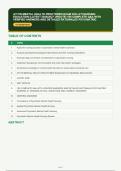
,This study document brings together 150 carefully worded exam questions drawn from ATI PN
MENTAL HEALTH PROCTORED EXAM 2023 ATI NURSING EDUCATION (LATEST 2026/2027
UPDATE) 180 COMPLETE Q&A WITH VERIFIED ANSWERS AND DETAILED RATIONALES
PSYCHIATRIC NURSING A+ GRADED] ACTUAL QUESTIONS AND CORRECT ANSWERS
(VERIFIED ANSWERS) PL, with the strongest emphasis placed on Apply the nursing process to
psychiatric mental health scenarios, Analyze psychopharmacological interventions and their
nursing implications and Evaluate legal and ethical considerations in psychiatric nursing. Every
item follows the wording style and level of reasoning you meet in the real paper, and each one is
paired with a clear rationale so the correct choice is never a guess. Work through the set at your
own pace, mark the questions that slow you down, then come back to them until the reasoning
feels automatic. Learners who revise this way walk into the exam room recognising the pattern
behind the questions instead of meeting them for the first time. Keep going - steady, honest
practice is what turns a difficult paper into a comfortable pass.
Q1 APPLY THE NURSING PROCESS TO PSYCHIATRIC MENTAL HEALTH SCENARIOS
A client with schizophrenia is prescribed clozapine. The nurse reviews laboratory
results: absolute neutrophil count (ANC) is 1,800/mm³. What is the nurse's priority
action?
A. Administer the next dose as prescribed.
B. Hold the dose and notify the provider immediately. CORRECT
C. Repeat the ANC in 24 hours.
D. Encourage fluids and monitor for infection.
RATIONALE: Clozapine can cause agranulocytosis; an ANC below 2,000/mm³ requires
withholding the drug and notifying the provider. Administering the dose (A) is unsafe. Repeating
labs (C) delays intervention. Fluids (D) do not address the critical lab value.
Page 2
,Q2 APPLY THE NURSING PROCESS TO PSYCHIATRIC MENTAL HEALTH SCENARIOS
A nurse is assessing a client who recently started taking fluoxetine. Which finding
indicates a need for immediate intervention?
A. Mild nausea and headache
B. Restlessness and pacing CORRECT
C. Complaints of dry mouth
D. Decreased libido
RATIONALE: Restlessness and pacing may indicate akathisia, a side effect of SSRIs that can
lead to nonadherence or worsening symptoms. Nausea (A), dry mouth (C), and decreased libido
(D) are common but not immediately dangerous.
Q3 APPLY THE NURSING PROCESS TO PSYCHIATRIC MENTAL HEALTH SCENARIOS
In a crisis intervention, which action by the nurse demonstrates the use of the
B-E-E-R model?
A. Encouraging the client to suppress emotions to maintain control.
B. Providing a quiet room and offering a blanket to a client who is escalating. CORRECT
C. Using restraints as a first-line intervention.
D. Asking the client to explain the crisis in detail immediately.
RATIONALE: B-E-E-R stands for Behavior, Emotion, Environment, and Relationship. Providing a
quiet room and a blanket addresses the environment and relationship, helping to de-escalate.
Suppressing emotions (A) is not therapeutic. Restraints (C) are last resort. Asking for details (D)
may escalate anxiety.
Page 3
, Q4 APPLY THE NURSING PROCESS TO PSYCHIATRIC MENTAL HEALTH SCENARIOS
A client with bipolar disorder is prescribed lithium. The nurse assesses a lithium
level of 1.0 mEq/L. Which interpretation is correct?
A. This level is toxic and requires immediate dialysis.
B. This level is subtherapeutic and requires a dose increase.
C. This level is within the therapeutic range. CORRECT
D. This level is borderline but acceptable for acute mania.
RATIONALE: Lithium therapeutic range is 0.6-1.2 mEq/L for maintenance; 1.0 mEq/L is within
that range. Toxic levels are typically >1.5 mEq/L (A). Subtherapeutic is <0.6 (B). For acute mania,
levels up to 1.2 may be used, but 1.0 is not borderline (D).
Q5 APPLY THE NURSING PROCESS TO PSYCHIATRIC MENTAL HEALTH SCENARIOS
Which statement by a nurse reflects a correct understanding of the confidentiality
requirements for a client with a mental health disorder under HIPAA?
A. Information can be shared with the client's family without consent if they are involved in care.
B. The nurse may discuss the client's condition with other healthcare providers involved in the
client's care. CORRECT
C. Confidentiality is waived if the client is admitted involuntarily.
D. The nurse can disclose information to law enforcement without a warrant if requested.
RATIONALE: HIPAA allows sharing of protected health information for treatment purposes
among healthcare providers involved in the client's care. Family involvement requires consent
unless the client is incapacitated. Involuntary admission does not waive confidentiality. Law
enforcement requires a court order or warrant.
Page 4


