
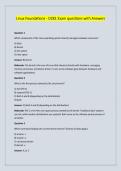
Linux Foundations - D281 Exam questions with Answers
Question 1
Which component of the Linux operating system directly manages hardware resources?
A) Shell
B) Kernel
C) Init system
D) User space
Answer: B) Kernel
Rationale: The kernel is the core of Linux that interacts directly with hardware, managing
memory, processes, and device drivers. It acts as the software glue between hardware and
software applications.
Question 2
What is the first process started by the Linux kernel?
A) init (PID 1)
B) systemd (PID 1)
C) Both A and B (depending on the distribution)
D) bash
Answer: C) Both A and B (depending on the distribution)
Rationale: PID 1 is the first user-space process started by the kernel. Traditional SysV systems
use init, while modern distributions use systemd. Both serve as the ultimate parent process of
all others.
Question 3
Which command displays the current kernel version? (Choose all that apply.)
A) uname -r
B) uname -a
C) cat /proc/version
D) kernel -v
Answer: A, B, C
,Rationale: uname -r shows the kernel release, uname -a displays all system info including the
kernel version, and /proc/version contains the kernel version string. kernel -v is not a valid
command.
Question 4
Which directory contains device files (e.g., /dev/sda, /dev/tty)?
A) /dev
B) /proc
C) /sys
D) /etc
Answer: A) /dev
Rationale: /dev contains device special files that represent hardware components. These files
allow user-space programs to interact with hardware via the kernel.
Question 5
Which directory is a virtual filesystem providing process and system information in real time?
A) /proc
B) /run
C) /dev/shm
D) /usr
Answer: A) /proc
Rationale: /proc is a virtual (procfs) filesystem created in memory at boot. It contains runtime
system information, including CPU, memory, and detailed process data (e.g., /proc/[PID]/).
Question 6
Which commands can display CPU information? (Choose all that apply.)
A) cat /proc/cpuinfo
B) lscpu
C) nproc
D) cpustat
Answer: A, B, C
Rationale: cat /proc/cpuinfo dumps raw CPU info, lscpu provides a formatted summary,
and nproc shows the number of processing units. cpustat is not a standard Linux utility.
,Question 7
Which commands display memory usage information? (Choose all that apply.)
A) free -h
B) cat /proc/meminfo
C) vmstat
D) meminfo
Answer: A, B, C
Rationale: free and vmstat display formatted memory data, while /proc/meminfo provides
detailed raw memory statistics. meminfo is not a standalone command.
Question 8
Which system call is used to create a new process in Linux?
A) fork()
B) exec()
C) clone()
D) wait()
Answer: A) fork()
Rationale: The fork() system call creates a new process by duplicating the calling process. The
child process is an exact copy of the parent, except for its PID. clone() is used for threading
but fork() is the classic process creation method.
Question 9
Which directory stores kernel modules for the running kernel?
A) /lib/modules/$(uname -r)
B) /usr/src/linux
C) /boot/modules
D) /etc/modules
Answer: A) /lib/modules/$(uname -r)
Rationale: Kernel modules are version-specific and stored in /lib/modules/ with a subdirectory
named after the kernel release. The uname -r command returns that version string.
Question 10
Which command loads a kernel module along with its dependencies?
, A) modprobe
B) insmod
C) Both A and B
D) loadmod
Answer: A) modprobe
Rationale: modprobe is the preferred tool because it automatically resolves and loads module
dependencies from /lib/modules/. insmod loads a single module file without dependency
handling.
Question 11
What is the default file system type used in most modern Linux installations?
A) ext3
B) ext4
C) FAT32
D) NTFS
Answer: B) ext4
Rationale: ext4 is the default and most widely used filesystem in modern Linux distributions,
offering robustness, large file support, and improved performance over ext3.
Question 12
What is the primary purpose of the /etc/fstab file?
A) To configure network interfaces
B) To store user account passwords
C) To automate filesystem mounting at boot
D) To define kernel boot parameters
Answer: C) To automate filesystem mounting at boot
Rationale: /etc/fstab contains entries that define how disk partitions, remote filesystems, and
block devices should be mounted, including mount points, options, and dump/pass flags.
Question 13
Which command lists all currently running processes in a detailed format?
A) ps -aux
B) lsproc
Question 1
Which component of the Linux operating system directly manages hardware resources?
A) Shell
B) Kernel
C) Init system
D) User space
Answer: B) Kernel
Rationale: The kernel is the core of Linux that interacts directly with hardware, managing
memory, processes, and device drivers. It acts as the software glue between hardware and
software applications.
Question 2
What is the first process started by the Linux kernel?
A) init (PID 1)
B) systemd (PID 1)
C) Both A and B (depending on the distribution)
D) bash
Answer: C) Both A and B (depending on the distribution)
Rationale: PID 1 is the first user-space process started by the kernel. Traditional SysV systems
use init, while modern distributions use systemd. Both serve as the ultimate parent process of
all others.
Question 3
Which command displays the current kernel version? (Choose all that apply.)
A) uname -r
B) uname -a
C) cat /proc/version
D) kernel -v
Answer: A, B, C
,Rationale: uname -r shows the kernel release, uname -a displays all system info including the
kernel version, and /proc/version contains the kernel version string. kernel -v is not a valid
command.
Question 4
Which directory contains device files (e.g., /dev/sda, /dev/tty)?
A) /dev
B) /proc
C) /sys
D) /etc
Answer: A) /dev
Rationale: /dev contains device special files that represent hardware components. These files
allow user-space programs to interact with hardware via the kernel.
Question 5
Which directory is a virtual filesystem providing process and system information in real time?
A) /proc
B) /run
C) /dev/shm
D) /usr
Answer: A) /proc
Rationale: /proc is a virtual (procfs) filesystem created in memory at boot. It contains runtime
system information, including CPU, memory, and detailed process data (e.g., /proc/[PID]/).
Question 6
Which commands can display CPU information? (Choose all that apply.)
A) cat /proc/cpuinfo
B) lscpu
C) nproc
D) cpustat
Answer: A, B, C
Rationale: cat /proc/cpuinfo dumps raw CPU info, lscpu provides a formatted summary,
and nproc shows the number of processing units. cpustat is not a standard Linux utility.
,Question 7
Which commands display memory usage information? (Choose all that apply.)
A) free -h
B) cat /proc/meminfo
C) vmstat
D) meminfo
Answer: A, B, C
Rationale: free and vmstat display formatted memory data, while /proc/meminfo provides
detailed raw memory statistics. meminfo is not a standalone command.
Question 8
Which system call is used to create a new process in Linux?
A) fork()
B) exec()
C) clone()
D) wait()
Answer: A) fork()
Rationale: The fork() system call creates a new process by duplicating the calling process. The
child process is an exact copy of the parent, except for its PID. clone() is used for threading
but fork() is the classic process creation method.
Question 9
Which directory stores kernel modules for the running kernel?
A) /lib/modules/$(uname -r)
B) /usr/src/linux
C) /boot/modules
D) /etc/modules
Answer: A) /lib/modules/$(uname -r)
Rationale: Kernel modules are version-specific and stored in /lib/modules/ with a subdirectory
named after the kernel release. The uname -r command returns that version string.
Question 10
Which command loads a kernel module along with its dependencies?
, A) modprobe
B) insmod
C) Both A and B
D) loadmod
Answer: A) modprobe
Rationale: modprobe is the preferred tool because it automatically resolves and loads module
dependencies from /lib/modules/. insmod loads a single module file without dependency
handling.
Question 11
What is the default file system type used in most modern Linux installations?
A) ext3
B) ext4
C) FAT32
D) NTFS
Answer: B) ext4
Rationale: ext4 is the default and most widely used filesystem in modern Linux distributions,
offering robustness, large file support, and improved performance over ext3.
Question 12
What is the primary purpose of the /etc/fstab file?
A) To configure network interfaces
B) To store user account passwords
C) To automate filesystem mounting at boot
D) To define kernel boot parameters
Answer: C) To automate filesystem mounting at boot
Rationale: /etc/fstab contains entries that define how disk partitions, remote filesystems, and
block devices should be mounted, including mount points, options, and dump/pass flags.
Question 13
Which command lists all currently running processes in a detailed format?
A) ps -aux
B) lsproc


