
HEARING INSTRUMENT SCIENCES
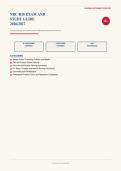
NBC-HIS EXAM AND
STUDY GUIDE A+
2026/2027
National Board for Certification in Hearing Instrument Sciences
A+ QUESTIONS 6 SECTIONS 100%
VERIFIED COVERED RATIONALES
CATEGORIES
Assess Patient Presenting Problem and Needs
Test and Analyze Patient Hearing
Prescribe and Analyze Hearing Instruments
Fit, Adjust, Program and Service Hearing Instruments
Counseling and Rehabilitation
Professional Practice, Ethics and Regulatory Compliance
STUVIAACTUALEXAM
,
, Section 1: Assess Patient Presenting Problem and Needs
Q1.
A 68-year-old patient reports gradual difficulty understanding speech in restaurants and family gatherings over the past
three years. The patient denies tinnitus, ear pain, or recent upper respiratory infection. Family history is positive for
age-related hearing loss in both parents. Which type and configuration of hearing loss is most consistent with this
presentation?
A. Bilateral high-frequency sensorineural hearing loss
B. Unilateral conductive loss with flat configuration
C. Sudden profound sensorineural loss in one ear
D. Bilateral low-frequency conductive loss
Correct Answer: A
Rationale: Gradual bilateral difficulty in noise with positive family history of age-related loss is classic for presbycusis, which
typically presents as bilateral high-frequency sensorineural hearing loss. Conductive and sudden unilateral patterns do not match
the history.
Q2.
During case history, a patient mentions long-term use of high-dose aspirin for arthritis and recent onset of bilateral
tinnitus with mild hearing difficulty. The specialist should first consider which potential contributing factor?
A. Noise-induced temporary threshold shift only
B. Congenital middle-ear malformation
C. Psychogenic hearing loss
D. Ototoxicity related to salicylate use
Correct Answer: D
Rationale: High-dose salicylates are a well-documented cause of reversible ototoxicity that can produce tinnitus and hearing
changes. The history points to this medication effect rather than congenital or purely psychogenic causes.
Q3.
A patient reports sudden unilateral hearing loss that began two days earlier, accompanied by aural fullness and mild
vertigo. The patient has no recent illness. What is the most appropriate immediate action?
A. Schedule a routine hearing test in two weeks
B. Recommend over-the-counter decongestants and recheck in one month
C. Refer promptly for medical evaluation of possible sudden sensorineural hearing loss
D. Fit a hearing instrument on the affected ear the same day
Correct Answer: C
Rationale: Sudden unilateral hearing loss with fullness and vertigo is a medical emergency until proven otherwise. Prompt medical
referral is required; routine scheduling or same-day fitting is inappropriate.
Q4.
A 45-year-old patient describes fluctuating hearing loss in one ear, episodic spinning vertigo lasting 20–60 minutes,
and roaring tinnitus. Which condition is most strongly suggested by this triad?
A. Otitis media with effusion
B. Otosclerosis
C. Acoustic neuroma without vestibular symptoms
D. Ménière’s disease
Correct Answer: D
Rationale: The classic triad of fluctuating hearing loss, episodic vertigo of intermediate duration, and tinnitus is characteristic of
Ménière’s disease. The other conditions present with different symptom patterns.
STUVIAACTUALEXAM | Page 3
NBC-HIS EXAM AND
STUDY GUIDE A+
2026/2027
National Board for Certification in Hearing Instrument Sciences
A+ QUESTIONS 6 SECTIONS 100%
VERIFIED COVERED RATIONALES
CATEGORIES
Assess Patient Presenting Problem and Needs
Test and Analyze Patient Hearing
Prescribe and Analyze Hearing Instruments
Fit, Adjust, Program and Service Hearing Instruments
Counseling and Rehabilitation
Professional Practice, Ethics and Regulatory Compliance
STUVIAACTUALEXAM
,
, Section 1: Assess Patient Presenting Problem and Needs
Q1.
A 68-year-old patient reports gradual difficulty understanding speech in restaurants and family gatherings over the past
three years. The patient denies tinnitus, ear pain, or recent upper respiratory infection. Family history is positive for
age-related hearing loss in both parents. Which type and configuration of hearing loss is most consistent with this
presentation?
A. Bilateral high-frequency sensorineural hearing loss
B. Unilateral conductive loss with flat configuration
C. Sudden profound sensorineural loss in one ear
D. Bilateral low-frequency conductive loss
Correct Answer: A
Rationale: Gradual bilateral difficulty in noise with positive family history of age-related loss is classic for presbycusis, which
typically presents as bilateral high-frequency sensorineural hearing loss. Conductive and sudden unilateral patterns do not match
the history.
Q2.
During case history, a patient mentions long-term use of high-dose aspirin for arthritis and recent onset of bilateral
tinnitus with mild hearing difficulty. The specialist should first consider which potential contributing factor?
A. Noise-induced temporary threshold shift only
B. Congenital middle-ear malformation
C. Psychogenic hearing loss
D. Ototoxicity related to salicylate use
Correct Answer: D
Rationale: High-dose salicylates are a well-documented cause of reversible ototoxicity that can produce tinnitus and hearing
changes. The history points to this medication effect rather than congenital or purely psychogenic causes.
Q3.
A patient reports sudden unilateral hearing loss that began two days earlier, accompanied by aural fullness and mild
vertigo. The patient has no recent illness. What is the most appropriate immediate action?
A. Schedule a routine hearing test in two weeks
B. Recommend over-the-counter decongestants and recheck in one month
C. Refer promptly for medical evaluation of possible sudden sensorineural hearing loss
D. Fit a hearing instrument on the affected ear the same day
Correct Answer: C
Rationale: Sudden unilateral hearing loss with fullness and vertigo is a medical emergency until proven otherwise. Prompt medical
referral is required; routine scheduling or same-day fitting is inappropriate.
Q4.
A 45-year-old patient describes fluctuating hearing loss in one ear, episodic spinning vertigo lasting 20–60 minutes,
and roaring tinnitus. Which condition is most strongly suggested by this triad?
A. Otitis media with effusion
B. Otosclerosis
C. Acoustic neuroma without vestibular symptoms
D. Ménière’s disease
Correct Answer: D
Rationale: The classic triad of fluctuating hearing loss, episodic vertigo of intermediate duration, and tinnitus is characteristic of
Ménière’s disease. The other conditions present with different symptom patterns.
STUVIAACTUALEXAM | Page 3


