

@ProfdocDigitalLibraries <Best Online Study Materials>
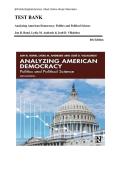
TEST BANK
Analyzing American Democracy: Politics and Political Science
Jon R. Bond, Lydia M. Andrade & José D. Villalobos
6th Edition
,@ProfdocDigitalLibraries <Best Online Study Materials>
Table of Contents
Chapter Outline
1. Basics of Democracy
Part I — The Constitutional Framework
2. The American Constitution
3. Federalism
4. Civil Liberties
5. Civil Rights
Part II — Connecting Citizens to Government
6. Interest Groups
7. Political Parties
8. The Mass Media and Politics
9. Public Opinion and Political Socialization
10. Elections
11. Political Participation and Voting Behavior
Part III — Official Decision Making
12. Congress
13. The Presidency
14. The Bureaucracy
15. The Federal Judiciary
Part IV — Conclusion
16. Core Democratic Principles and Public Policy
,@ProfdocDigitalLibraries <Best Online Study Materials>
Chapter 1
1 models are inspired by economics, and assume that political decisions involve weighing
costs and benefits. models are inspired by psychology and sociology, and assume that
political decisions are a product of factors such as upbringing by parents.
Answer: Rational choice
Behavioral
2 means each individual should receive the same amount of material goods
regardless of their contribution to society.
(A) Equality of opportunity
(B) Equality under the law
(C) Social equality
(D) Economic equality
Answer: (D) Economic equality
3 In a direct democracy, who is/are the principle political decision makers?
(A) Citizens
(B) The president
(C) Representatives
(D) None of the above
Answer: (A) Citizens
4 Fifty percent plus one of all members or all eligible voters is know as
(A) a simple majority.
(B) an absolute majority.
(C) a blowout.
(D) a plurality.
Answer: (B) an absolute majority.
5 The largest percentage of a vote, when no one has a majority, is known as
(A) a simple majority.
(B) a minority win.
(C) a plurality.
(D) an absolute majority.
Answer: (C) a plurality.
, @ProfdocDigitalLibraries <Best Online Study Materials>
6 In which form of government do all the citizens have the opportunity to participate in the
process of making authoritative decisions and allocating resources?
(A) Democracy
(B) Autocracy
(C) Oligarchy
(D) Constitutional monarchy
Answer: (A) Democracy
7 A form of government in which the power to make decisions and allocate resources is
vested in one person is called
(A) oligarchy.
(B) autocracy.
(C) democracy.
(D) constitutional monarchy.
Answer: (B) autocracy.
8 Which of the following is NOT considered a basic form of government?
(A) Autocracy
(B) Oligarchy
(C) Initiative
(D) Democracy
Answer: (C) Initiative
9 The idea that people should be free from discrimination and class or social barriers is called
(A) social equality.
(B) democracy.
(C) political freedom.
(D) popular sovereignty.
Answer: (A) social equality.
10 The idea that people believe their views are “normal” and “common sense” and therefore
shared by most people is known as
(A) limited government.
(B) democracy.
(C) false consensus.
(D) ideology.
Answer: (C) false consensus.
11 Harold D. Lasswell's definition of is “who gets what, when, and how.”
(A) power struggle
(B) democracy
TEST BANK
Analyzing American Democracy: Politics and Political Science
Jon R. Bond, Lydia M. Andrade & José D. Villalobos
6th Edition
,@ProfdocDigitalLibraries <Best Online Study Materials>
Table of Contents
Chapter Outline
1. Basics of Democracy
Part I — The Constitutional Framework
2. The American Constitution
3. Federalism
4. Civil Liberties
5. Civil Rights
Part II — Connecting Citizens to Government
6. Interest Groups
7. Political Parties
8. The Mass Media and Politics
9. Public Opinion and Political Socialization
10. Elections
11. Political Participation and Voting Behavior
Part III — Official Decision Making
12. Congress
13. The Presidency
14. The Bureaucracy
15. The Federal Judiciary
Part IV — Conclusion
16. Core Democratic Principles and Public Policy
,@ProfdocDigitalLibraries <Best Online Study Materials>
Chapter 1
1 models are inspired by economics, and assume that political decisions involve weighing
costs and benefits. models are inspired by psychology and sociology, and assume that
political decisions are a product of factors such as upbringing by parents.
Answer: Rational choice
Behavioral
2 means each individual should receive the same amount of material goods
regardless of their contribution to society.
(A) Equality of opportunity
(B) Equality under the law
(C) Social equality
(D) Economic equality
Answer: (D) Economic equality
3 In a direct democracy, who is/are the principle political decision makers?
(A) Citizens
(B) The president
(C) Representatives
(D) None of the above
Answer: (A) Citizens
4 Fifty percent plus one of all members or all eligible voters is know as
(A) a simple majority.
(B) an absolute majority.
(C) a blowout.
(D) a plurality.
Answer: (B) an absolute majority.
5 The largest percentage of a vote, when no one has a majority, is known as
(A) a simple majority.
(B) a minority win.
(C) a plurality.
(D) an absolute majority.
Answer: (C) a plurality.
, @ProfdocDigitalLibraries <Best Online Study Materials>
6 In which form of government do all the citizens have the opportunity to participate in the
process of making authoritative decisions and allocating resources?
(A) Democracy
(B) Autocracy
(C) Oligarchy
(D) Constitutional monarchy
Answer: (A) Democracy
7 A form of government in which the power to make decisions and allocate resources is
vested in one person is called
(A) oligarchy.
(B) autocracy.
(C) democracy.
(D) constitutional monarchy.
Answer: (B) autocracy.
8 Which of the following is NOT considered a basic form of government?
(A) Autocracy
(B) Oligarchy
(C) Initiative
(D) Democracy
Answer: (C) Initiative
9 The idea that people should be free from discrimination and class or social barriers is called
(A) social equality.
(B) democracy.
(C) political freedom.
(D) popular sovereignty.
Answer: (A) social equality.
10 The idea that people believe their views are “normal” and “common sense” and therefore
shared by most people is known as
(A) limited government.
(B) democracy.
(C) false consensus.
(D) ideology.
Answer: (C) false consensus.
11 Harold D. Lasswell's definition of is “who gets what, when, and how.”
(A) power struggle
(B) democracy


