
LEAD ARTICLE COURSE – Brands & Branding Keller
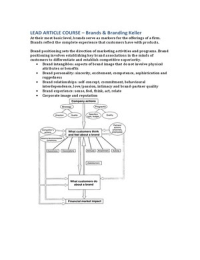
At their most basic level, brands serve as markers for the offerings of a firm.
Brands reflect the complete experience that customers have with products.
Brand positioning sets the direction of marketing activities and programs. Brand
positioning involves establishing key brand associations in the minds of
customers to differentiate and establish competitive superiority.
Brand intangibles: aspects of brand image that do not involve physical
attributes or benefits
Brand personality: sincerity, excitement, competence, sophistication and
ruggedness
Brand relationships: self-concept, commitment, behavioural
interdependence, love/passion, intimacy and brand-partner quality
Brand experience: sense, feel, think, act, relate
Corporate image and reputation
,Lecture 1
The impact of product name on dieters’ and nondieters’ food evaluations
and consumption
This research studies altering a name of a food item on dieters’ and nondieters’
evaluations of its healthfulness and taste. In four studies we show that when a
food item is assigned a relatively healthy name (e.g., salad), dieting tendency
does not affect health or taste perceptions; when the identical item (e.g., an item
with the same ingredients, appearance, portion size) is assigned a relatively un-
healthy name (e.g., pasta), however, dieters perceive the item to be less healthful
and less tasty than do nondieters. These evaluations, in turn, affect consumption.
The results of four studies show that when foods are assigned unhealthy names,
dieters rate these items as lower in perceived healthfulness than do nondieters.
Identical items that are assigned healthier product names are perceived as
equally healthful by dieters and nondieters. These differences in food
evaluations between dieters and nondieters are attributed to dieters’ reliance on
food-related cues and learned associations, particularly those related to foods’
unhealthfulness, as well as nondieters’ apparent immunity to health-related
signals conveyed by the name of the food item. This results in an increased
tendency to engage in heuristic processing when evaluating foods for dieters,
compared to nondieters.
Further, we found in our studies that dieters pay more attention to cues related
to foods’ unhealthfulness, rather than healthfulness: when a food item was
given a relatively unhealthy product name (i.e., pasta, candy chews) there was
a significant decrease in the perceived healthfulness of the food item as dieting
tendency increased; however, when the food item was given a relatively
healthy product name (i.e., salad, fruit chews), dieting tendency did not have a
significant effect on perceived healthfulness of the food item.
, An anchoring and adjustment model of purchase quantity decisions
If the price justifies stockpiling, a consumer will make an upward adjustment
from the small anchor; this adjustment, however, will not eliminate the impact
of the starting anchor value. Because of this, retailers might be able to increase
sales by using anchor-based promotions to present consumers with a larger
than normal purchase quantity. In effect, these large anchors supplant the
smaller ones. When considering how many units to buy, a consumer will make
an insufficient downward adjustment from this large anchor. This leads to
larger purchase quantities.
POP = point of purchase
Default anchors ("How many units do you usually buy?") and expansion anchors
C'Think of al! the different ways you could consume this product over the next two
weeks")—influence purchase intentions and effectively nullify any impact of
contemporaneously presented external POP anchors.
At their most basic level, brands serve as markers for the offerings of a firm.
Brands reflect the complete experience that customers have with products.
Brand positioning sets the direction of marketing activities and programs. Brand
positioning involves establishing key brand associations in the minds of
customers to differentiate and establish competitive superiority.
Brand intangibles: aspects of brand image that do not involve physical
attributes or benefits
Brand personality: sincerity, excitement, competence, sophistication and
ruggedness
Brand relationships: self-concept, commitment, behavioural
interdependence, love/passion, intimacy and brand-partner quality
Brand experience: sense, feel, think, act, relate
Corporate image and reputation
,Lecture 1
The impact of product name on dieters’ and nondieters’ food evaluations
and consumption
This research studies altering a name of a food item on dieters’ and nondieters’
evaluations of its healthfulness and taste. In four studies we show that when a
food item is assigned a relatively healthy name (e.g., salad), dieting tendency
does not affect health or taste perceptions; when the identical item (e.g., an item
with the same ingredients, appearance, portion size) is assigned a relatively un-
healthy name (e.g., pasta), however, dieters perceive the item to be less healthful
and less tasty than do nondieters. These evaluations, in turn, affect consumption.
The results of four studies show that when foods are assigned unhealthy names,
dieters rate these items as lower in perceived healthfulness than do nondieters.
Identical items that are assigned healthier product names are perceived as
equally healthful by dieters and nondieters. These differences in food
evaluations between dieters and nondieters are attributed to dieters’ reliance on
food-related cues and learned associations, particularly those related to foods’
unhealthfulness, as well as nondieters’ apparent immunity to health-related
signals conveyed by the name of the food item. This results in an increased
tendency to engage in heuristic processing when evaluating foods for dieters,
compared to nondieters.
Further, we found in our studies that dieters pay more attention to cues related
to foods’ unhealthfulness, rather than healthfulness: when a food item was
given a relatively unhealthy product name (i.e., pasta, candy chews) there was
a significant decrease in the perceived healthfulness of the food item as dieting
tendency increased; however, when the food item was given a relatively
healthy product name (i.e., salad, fruit chews), dieting tendency did not have a
significant effect on perceived healthfulness of the food item.
, An anchoring and adjustment model of purchase quantity decisions
If the price justifies stockpiling, a consumer will make an upward adjustment
from the small anchor; this adjustment, however, will not eliminate the impact
of the starting anchor value. Because of this, retailers might be able to increase
sales by using anchor-based promotions to present consumers with a larger
than normal purchase quantity. In effect, these large anchors supplant the
smaller ones. When considering how many units to buy, a consumer will make
an insufficient downward adjustment from this large anchor. This leads to
larger purchase quantities.
POP = point of purchase
Default anchors ("How many units do you usually buy?") and expansion anchors
C'Think of al! the different ways you could consume this product over the next two
weeks")—influence purchase intentions and effectively nullify any impact of
contemporaneously presented external POP anchors.


