2026-2027 NEW VERSION!! UTA NURS 5315 Advanced
Pathophysiology EXAM_1_STUDY_GUIDE 2 University of Texas,
Arlington
STUDY GUIDE
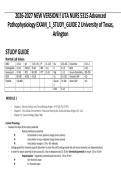
Normal Lab Values
WBC 4.5-11 pH 7.35-7.45 PT 11-12.5 Na 135-145 Creatinine 0.5-1.3
Hemoglobin 13-16 PaCO2 35-45 INR <1.6 K 3.5-5 BUN 8-22
Hematocrit 37-49 PO2 80-100 PTT 23-33 Mg 1.2-2 Serum Osmolality 285-295
MCV 80-100 HCO3 22-28 Ca 8.5-10.5 Osmolar GAP <10
Platelet 130-400 Glucos 70-100 Anion GAP <10
e
PO4 3-4.5
MODULE 1
▪ Chapter 2: Altered Cellular and Tissue Biology (Pages: 47-57,68-70, 87-97)
▪ Chapter 3: The Cellular Environment: Fluids and Electrolytes, Acids and Bases (Pages:115-121)
▪ Chapter 12: Cancer Biology (Page: 368)
Cellular Physiology
- Analyze the steps of the action potential.
▪ Resting membrane potential
❖ Extracellular is more positive charge (more cations)
❖ Intracellular is more negative charge (more anions)
❖ Intracellular charge is -70 to -85 millivolts
▪ Voltage gated Na+ channels open & allow Na+ to enter the cell voltage inside the cell moves towards zero (depolarization)
▪ In order for action potential to be successful, it has to depolarize by 15-20 mV (threshold potential) to reach -55 to -65 mV
▪ Repolarization – negatively restored back into cell to -70 to -85 mV
❖ Na+ channels close
❖ K+ channels open
,▪ Refractory period – time which cell membrane resists depolarization (occurs during most of the action potential)
▪ Absolute refractory period – membrane will not respond to any stimulus
▪ Relative refractory period – occurs when membrane is repolarizing, will only respond to a very strong stimulus
▪ Hyperpolarized – when resting membrane potential is > -85 mV. Less excitable d/t greater distance btwn resting membrane
potential & threshold potential
▪ Hypopolarized – resting membrane potential is closer to 0, e.g. -65 mV. More excitable b/c resting membrane potential is
closer to threshold potential
, - Hypokalemia (serum outside cell is low)
▪ Intracellular K leaves cell easily
▪ Cell becomes more negative -100mV hyperpolarized
▪ Decrease in neuromuscular excitability
▪ Weakness in smooth muscle, atony, paresthesias, cardiac dysrhythmias
- Hyperkalemia
▪ More ECF K causes cell to become more positively -60 mV, hypopolarized
▪ More excitable, peaked T waves, if ECF continues to rise getting closer to threshold potential, QRS will widen
▪ When resting membrane potential equals = threshold, no action potential will be generated and cardiac standstill will occur,
paralysis and paresthesia may also occur
- Hypocalcemia
▪ Low serum Ca increases cell permeability to Na causing progressive depolarization
▪ Causes resting membrane closer to threshold potential, hypopolarized
▪ More easily excitable, tetany hyperreflexia, circumoral paresthesia, seizures, & dysrhythmias
- Hypercalcemia
▪ Decreases cell permeability to Na
▪ Distance btwn resting and threshold increases, hyperpolarized
▪ Cells are less excitable, weakness, hyporeflexia, fatigue, lethargy, confusion, encephalopathy, shortened QT segment,
depressed widened T waves on EKG
Cellular Adaptation Patterns
Disease Etiology Pathophysiology Example
Atrophy Physiologic/pathologic Physio – thymus gland atrophy during Aging brain cells.
Malnutrition childhood Endocrine-dependent (gonads
Pathologic – workload, use, pressure, blood shrink as hormonal stimulation
supply, nutrition, hormonal, nervous decreases
stimulation
Disuse – decrease workload use
Hypertrophy Physiologic – increased Patho cardiac – mechanical signals, trophic Physio - (atrial natriuretic peptide),
demand, stimulation signals (growth factors & vasoactive agents) growth factors, skeletal muscle use,
hormones pregnancy
Pathologic – chronic Patho – hypertension/heart valve
hemodynamic overload dysfunction
Hyperplasia Physiologic Compensatory – Duplication Compensatory – callus formation;
(compensatory & Hormonal – estrogen dependent (uterus, liver regeneration after removal.
hormonal) breast. Hormonal – after ovulation,
Pathophysiology EXAM_1_STUDY_GUIDE 2 University of Texas,
Arlington
STUDY GUIDE
Normal Lab Values
WBC 4.5-11 pH 7.35-7.45 PT 11-12.5 Na 135-145 Creatinine 0.5-1.3
Hemoglobin 13-16 PaCO2 35-45 INR <1.6 K 3.5-5 BUN 8-22
Hematocrit 37-49 PO2 80-100 PTT 23-33 Mg 1.2-2 Serum Osmolality 285-295
MCV 80-100 HCO3 22-28 Ca 8.5-10.5 Osmolar GAP <10
Platelet 130-400 Glucos 70-100 Anion GAP <10
e
PO4 3-4.5
MODULE 1
▪ Chapter 2: Altered Cellular and Tissue Biology (Pages: 47-57,68-70, 87-97)
▪ Chapter 3: The Cellular Environment: Fluids and Electrolytes, Acids and Bases (Pages:115-121)
▪ Chapter 12: Cancer Biology (Page: 368)
Cellular Physiology
- Analyze the steps of the action potential.
▪ Resting membrane potential
❖ Extracellular is more positive charge (more cations)
❖ Intracellular is more negative charge (more anions)
❖ Intracellular charge is -70 to -85 millivolts
▪ Voltage gated Na+ channels open & allow Na+ to enter the cell voltage inside the cell moves towards zero (depolarization)
▪ In order for action potential to be successful, it has to depolarize by 15-20 mV (threshold potential) to reach -55 to -65 mV
▪ Repolarization – negatively restored back into cell to -70 to -85 mV
❖ Na+ channels close
❖ K+ channels open
,▪ Refractory period – time which cell membrane resists depolarization (occurs during most of the action potential)
▪ Absolute refractory period – membrane will not respond to any stimulus
▪ Relative refractory period – occurs when membrane is repolarizing, will only respond to a very strong stimulus
▪ Hyperpolarized – when resting membrane potential is > -85 mV. Less excitable d/t greater distance btwn resting membrane
potential & threshold potential
▪ Hypopolarized – resting membrane potential is closer to 0, e.g. -65 mV. More excitable b/c resting membrane potential is
closer to threshold potential
, - Hypokalemia (serum outside cell is low)
▪ Intracellular K leaves cell easily
▪ Cell becomes more negative -100mV hyperpolarized
▪ Decrease in neuromuscular excitability
▪ Weakness in smooth muscle, atony, paresthesias, cardiac dysrhythmias
- Hyperkalemia
▪ More ECF K causes cell to become more positively -60 mV, hypopolarized
▪ More excitable, peaked T waves, if ECF continues to rise getting closer to threshold potential, QRS will widen
▪ When resting membrane potential equals = threshold, no action potential will be generated and cardiac standstill will occur,
paralysis and paresthesia may also occur
- Hypocalcemia
▪ Low serum Ca increases cell permeability to Na causing progressive depolarization
▪ Causes resting membrane closer to threshold potential, hypopolarized
▪ More easily excitable, tetany hyperreflexia, circumoral paresthesia, seizures, & dysrhythmias
- Hypercalcemia
▪ Decreases cell permeability to Na
▪ Distance btwn resting and threshold increases, hyperpolarized
▪ Cells are less excitable, weakness, hyporeflexia, fatigue, lethargy, confusion, encephalopathy, shortened QT segment,
depressed widened T waves on EKG
Cellular Adaptation Patterns
Disease Etiology Pathophysiology Example
Atrophy Physiologic/pathologic Physio – thymus gland atrophy during Aging brain cells.
Malnutrition childhood Endocrine-dependent (gonads
Pathologic – workload, use, pressure, blood shrink as hormonal stimulation
supply, nutrition, hormonal, nervous decreases
stimulation
Disuse – decrease workload use
Hypertrophy Physiologic – increased Patho cardiac – mechanical signals, trophic Physio - (atrial natriuretic peptide),
demand, stimulation signals (growth factors & vasoactive agents) growth factors, skeletal muscle use,
hormones pregnancy
Pathologic – chronic Patho – hypertension/heart valve
hemodynamic overload dysfunction
Hyperplasia Physiologic Compensatory – Duplication Compensatory – callus formation;
(compensatory & Hormonal – estrogen dependent (uterus, liver regeneration after removal.
hormonal) breast. Hormonal – after ovulation,