
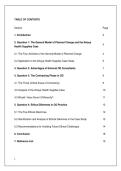
TABLE OF CONTENTS
Section Page
1. Introduction 2
2. Question 1: The General Model of Planned Change and the Ikhaya
4
Health Supplies Case
2.1 The Four Activities of the General Model of Planned Change 4
2.2 Application to the Ikhaya Health Supplies Case Study 5
3. Question 2: Advantages of External OD Consultants 7
4. Question 3: The Contracting Phase in OD 9
4.1 The Three Critical Areas of Contracting 9
4.2 Analysis of the Ikhaya Health Supplies Case 10
4.3 Would I Have Done It Differently? 11
5. Question 4: Ethical Dilemmas in OD Practice 12
5.1 The Five Ethical Dilemmas 12
5.2 Identification and Analysis of Ethical Dilemmas in the Case Study 13
5.3 Recommendations for Avoiding Future Ethical Challenges 14
6. Conclusion 18
7. Reference List 19
1
,IOP3705 ASSIGNMENT 2 2026
DUE SEPTEMBER 2026
1. Introduction
Organisational Development (OD) is a planned process that helps an organisation work
better and improves the well-being of its employees by using knowledge and practices
from behavioural science (Cummings, Worley & Donovan, 2020, p. 2).
My assignment looks at the case of Ikhaya Health Supplies, a medium-sized medical
distribution company that is facing problems with its operations and human resources.
The case will be analysed using OD theories. It will focus on the general model of
planned change, the role of external consultants, the importance of the contracting
stage, and ethical problems that may happen during OD work. These ideas will be
applied to the events in the case study.
2
, 2. Question 1: The General Model of Planned Change and the Ikhaya Health
Supplies Case
The General Model of Planned Change provides a foundational framework for
understanding how OD efforts typically unfold. According to Cummings et al. (2020, pp.
29-31), the model describes four basic, interconnected activities that practitioners and
organisation members jointly carry out to implement effective change.
2.1 The Four Activities of the General Model of Planned Change
1. Entering and Contracting
This is the initial phase where an organisation and an OD practitioner first engage. It
involves clarifying the organisational issue or "presenting problem," determining the
relevant client system, and selecting an appropriate practitioner. The key output is a
formal or informal contract that outlines the objectives, resources, roles, responsibilities,
and ground rules for the change process. This step is crucial for setting clear
expectations and establishing a collaborative relationship (Cummings et al., 2020, p.
29).
2. Diagnosing
This phase involves a systematic study of the client system to understand its current
functioning. Diagnosis can be problem-focused, aiming to uncover the root causes of
organisational issues, or it can be strengths-based, focusing on what the organisation
does well. The process includes selecting appropriate diagnostic models, gathering data
(e.g., through interviews, questionnaires, observations), analyzing the information, and
3


