
JD-Next Exam Legal Terms Latest Versions Top
Rated A+
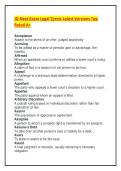
Acceptance
Assent to the terms of an offer, judged objectively.
Accruing
To be added as a matter of periodic gain or advantage, like
interest.
Affirmed
When an appellate court confirms or ratifies a lower court's ruling.
Allegation
A claim of fact in a lawsuit not yet proven to be true.
Appeal
A challenge to a previous legal determination directed to a higher
power.
Appellant
The party who appeals a lower court's decision to a higher court.
Appellee
The party against whom an appeal is filed.
Arbitrary Discretion
A judicial ruling based on individual discretion rather than fair
application of law.
Assent
The expression of approval or agreement.
Assignee
A person to whom a property right is transferred by an assignor.
Assume a Debt
To take over another person's duty or liability for a debt.
Avers
To state or assert to be the case.
Award
A final judgment or decision, usually declaring a monetary
obligation.
, Bear interest
When an account or investment pays a particular amount for
holding money.
Black letter law
Basic standard rules that are generally known and free from
doubt.
Breach
Violation of a law or contractual duty.
Breach of contract
The violation of a contractual obligation by non-performance or
interference.
Brief
Written arguments submitted to the court.
Business efficacy
The power of a business transaction to produce intended results.
Capricious
Given to sudden and unaccountable changes of mood or
behavior.
Case Brief
A written summary dissecting the basic components of a judicial
opinion.
Case law
Law based on judicial decisions rather than constitutions,
statutes, or regulations.
Cause of action
A set of predefined factual elements allowing for a legal remedy.
Chattels
A category of personal property associated with tangible, movable
goods.
Circuit Court
One of the twelve federal regional courts of appeals.
Claim
A set of operative facts creating a right enforceable in court.
Cold calling
Rated A+
Acceptance
Assent to the terms of an offer, judged objectively.
Accruing
To be added as a matter of periodic gain or advantage, like
interest.
Affirmed
When an appellate court confirms or ratifies a lower court's ruling.
Allegation
A claim of fact in a lawsuit not yet proven to be true.
Appeal
A challenge to a previous legal determination directed to a higher
power.
Appellant
The party who appeals a lower court's decision to a higher court.
Appellee
The party against whom an appeal is filed.
Arbitrary Discretion
A judicial ruling based on individual discretion rather than fair
application of law.
Assent
The expression of approval or agreement.
Assignee
A person to whom a property right is transferred by an assignor.
Assume a Debt
To take over another person's duty or liability for a debt.
Avers
To state or assert to be the case.
Award
A final judgment or decision, usually declaring a monetary
obligation.
, Bear interest
When an account or investment pays a particular amount for
holding money.
Black letter law
Basic standard rules that are generally known and free from
doubt.
Breach
Violation of a law or contractual duty.
Breach of contract
The violation of a contractual obligation by non-performance or
interference.
Brief
Written arguments submitted to the court.
Business efficacy
The power of a business transaction to produce intended results.
Capricious
Given to sudden and unaccountable changes of mood or
behavior.
Case Brief
A written summary dissecting the basic components of a judicial
opinion.
Case law
Law based on judicial decisions rather than constitutions,
statutes, or regulations.
Cause of action
A set of predefined factual elements allowing for a legal remedy.
Chattels
A category of personal property associated with tangible, movable
goods.
Circuit Court
One of the twelve federal regional courts of appeals.
Claim
A set of operative facts creating a right enforceable in court.
Cold calling


