

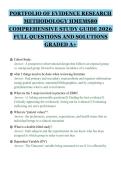
PORTFOLIO OF EVIDENCE RESEARCH
METHODOLOGY HMEMS80
COMPREHENSIVE STUDY GUIDE 2026
FULL QUESTIONS AND SOLUTIONS
GRADED A+
◍ Cohort Study.
Answer: A prospective observational design that follows an exposed group
vs. unexposed group forward to measure incidence of a condition.
◍ what 3 things need to be done when reviewing literature.
Answer: find primary and secondary sourcesobtain and organize information
(using guided questions, annotated bibliographies, and by completing a
grid)determine what is and is not known
◍ What are the 5 steps involved in practice of EBM?.
Answer: 1) Asking answerable questions2) Finding the best evidence3)
Critically appraising the evidence4) Acting ont he evidence5) Evaluating
(reflecting on) one's performance
◍ What are "patient values"?.
Answer: the preferences, concerns, expectations, and health status that an
individual brings to a clinical encounter
◍ What is a double-blind study?.
Answer: both subjects and the experimenter do not know who has been
assigned to which group in order to prevent bias
◍ Dependent Variable (DV).
Answer: The 'Outcome' variable being measured to see if it is affected by
, the IV.
◍ Nominal Scale.
Answer: The lowest measurement level; uses categories with no order or
quantitative value (e.g., gender, eye color).
◍ What type of study an N of 1 ?.
Answer: is experimental NOT descriptive b/c pts are their own control group
◍ Nuremberg Code (1947).
Answer: The first international document to emphasize voluntary consent,
established following WWII medical atrocities.
◍ what does a exploratory study do?.
Answer: finds relationships
◍ how is the research process cyclical.
Answer: communicating findings → suggestions for further study →
develop new research question
◍ What is an evidence-based physician assistant?.
Answer: any PA, regardless of specialty, should be able to find, critically
evaluate, and apply research findings to the clinical setting. This individual
has a fundamental understanding of clinical research and can apply this
research on an individual patient-by-patient basis.*NOT a person who
publishes- someone who can read literature and extract information to apply
◍ Havasupai Tribe Case.
Answer: An ethical violation where blood samples for diabetes research
were used for studies on schizophrenia and inbreeding without tribal
consent.
◍ what are the 2 categories of health science research that are "the lifeblood"
of all medical professions and disciplines.
Answer: basic science researchclinical research
◍ What 2 study designs follow RCTs on the hierarchy of evidence?.
Answer: 4) Cohort studies 5) Case- control designs* these are exploratory in
METHODOLOGY HMEMS80
COMPREHENSIVE STUDY GUIDE 2026
FULL QUESTIONS AND SOLUTIONS
GRADED A+
◍ Cohort Study.
Answer: A prospective observational design that follows an exposed group
vs. unexposed group forward to measure incidence of a condition.
◍ what 3 things need to be done when reviewing literature.
Answer: find primary and secondary sourcesobtain and organize information
(using guided questions, annotated bibliographies, and by completing a
grid)determine what is and is not known
◍ What are the 5 steps involved in practice of EBM?.
Answer: 1) Asking answerable questions2) Finding the best evidence3)
Critically appraising the evidence4) Acting ont he evidence5) Evaluating
(reflecting on) one's performance
◍ What are "patient values"?.
Answer: the preferences, concerns, expectations, and health status that an
individual brings to a clinical encounter
◍ What is a double-blind study?.
Answer: both subjects and the experimenter do not know who has been
assigned to which group in order to prevent bias
◍ Dependent Variable (DV).
Answer: The 'Outcome' variable being measured to see if it is affected by
, the IV.
◍ Nominal Scale.
Answer: The lowest measurement level; uses categories with no order or
quantitative value (e.g., gender, eye color).
◍ What type of study an N of 1 ?.
Answer: is experimental NOT descriptive b/c pts are their own control group
◍ Nuremberg Code (1947).
Answer: The first international document to emphasize voluntary consent,
established following WWII medical atrocities.
◍ what does a exploratory study do?.
Answer: finds relationships
◍ how is the research process cyclical.
Answer: communicating findings → suggestions for further study →
develop new research question
◍ What is an evidence-based physician assistant?.
Answer: any PA, regardless of specialty, should be able to find, critically
evaluate, and apply research findings to the clinical setting. This individual
has a fundamental understanding of clinical research and can apply this
research on an individual patient-by-patient basis.*NOT a person who
publishes- someone who can read literature and extract information to apply
◍ Havasupai Tribe Case.
Answer: An ethical violation where blood samples for diabetes research
were used for studies on schizophrenia and inbreeding without tribal
consent.
◍ what are the 2 categories of health science research that are "the lifeblood"
of all medical professions and disciplines.
Answer: basic science researchclinical research
◍ What 2 study designs follow RCTs on the hierarchy of evidence?.
Answer: 4) Cohort studies 5) Case- control designs* these are exploratory in


