
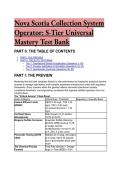
Nova Scotia Collection System
Operator: S-Tier Universal
Mastery Test Bank
PART 0: THE TABLE OF CONTENTS
1. PART I: THE PREVIEW
2. PART II: THE ELITE TEST BANK
○ Tier 1: Foundational Syntax & Application (Questions 1–18)
○ Tier 2: Complex Application & Simulation (Questions 19–37)
○ Tier 3: Grandmaster Synthesis (Questions 38–55)
PART I: THE PREVIEW
Mastering this test bank translates directly to elite performance by forging the analytical stamina
required to manage high-stakes, multi-variable wastewater infrastructure under strict regulatory
frameworks. Every scenario within this gauntlet reflects real-world operational hazards,
compliance thresholds, and engineering constraints that separate certified operators from true
industry titans.
The "Critical Axioms" Cheat Sheet:
Axiom Category Critical Rule / Threshold Regulatory / Scientific Basis
Federal Effluent Limits CBOD ≤ 25 mg/L; TSS ≤ 25
(WSER) mg/L; TRC ≤ 0.02 mg/L;
Un-ionized Ammonia < 1.25
mg/L
Confined Space Safe Oxygen (O_2) window:
Atmospheres 19.5% to 22.5%
Biogenic Sulfide Corrosion Anaerobic Sulfate-Reducing
Bacteria (SRB) produce H_2S
in sludge; Aerobic
Acidithiobacillus convert H_2S
to H_2SO_4 at the crown
Pneumatic Testing (ASTM Stabilize at 4.0 psig, test begins
C828) at 3.5 psig. Add 0.43 psig per
foot of groundwater above pipe
invert
The Chemical Pounds Feed Rate (lbs/day) = Dosage
Formula (mg/L) × Flow (MGD) × 8.34
,PART II: THE ELITE TEST BANK
Tier 1: Foundational Syntax & Application
Q1: A continuous-discharge wastewater system collects an average daily volume of 120 m^3 of
influent. Based on the principles of the Canadian Wastewater Systems Effluent Regulations
(WSER), which effluent concentration limit is MANDATORY? A) Carbonaceous Biochemical
Oxygen Demand (CBOD) must not exceed 25 mg/L. B) Total Residual Chlorine (TRC) must not
exceed 2.0 mg/L. C) Total Suspended Solids (TSS) must not exceed 50 mg/L. D) Un-ionized
ammonia must exceed 1.25 mg/L.
Answer: A (Carbonaceous Biochemical Oxygen Demand (CBOD) must not exceed 25 mg/L)
Distractor Analysis:
● A is incorrect: [Distractor analysis inherently skips the correct answer in the breakdown,
moving to incorrect options].
● B is incorrect: TRC limits are extraordinarily strict, capping at 0.02 mg/L, not 2.0 mg/L, to
prevent acute lethality to aquatic life.
● C is incorrect: The federal standard for TSS is an average of 25 mg/L, not 50 mg/L.
● D is incorrect: Un-ionized ammonia must be strictly less than 1.25 mg/L.
The Mentor's Analysis: Federal WSER limits represent the absolute hard deck of environmental
protection in Canada for systems over 100 m^3/day. When facing effluent monitoring, the
immediate priority is adhering to the 25/25 rule for CBOD and TSS. By utilizing strict biological
controls, you bypass the common trap of federal non-compliance. Professional Intuition: CBOD
and TSS share a mirrored absolute ceiling of 25 mg/L.
Q2: An Operator-in-Training (OIT) has successfully passed the provincial exam and is assigned
to a Class II facility. Based on the principles of the Nova Scotia Water and Wastewater Facilities
Regulations, which action is STRICTLY PROHIBITED for this individual? A) Performing routine
maintenance on lift station check valves. B) Acting in overall direct responsible charge (DRC) of
the facility. C) Conducting confined space atmospheric testing under supervision. D) Operating
bypass pumps during an active sanitary sewer overflow.
Answer: B (Acting in overall direct responsible charge (DRC) of the facility) Distractor Analysis:
● A is incorrect: OITs are deemed certified to perform standard operational duties and
maintenance.
● C is incorrect: Atmospheric testing is a standard operational duty permitted for an OIT.
● D is incorrect: Emergency operations are permitted; OITs are licensed operators, just not
supervisors.
The Mentor's Analysis: The OIT designation bridges the gap between theoretical knowledge and
practical experience. When facing facility staffing, the immediate priority is ensuring legal
compliance for system oversight. By utilizing fully certified operators for DRC, you bypass the
common trap of delegating ultimate accountability to an uncredentialed trainee. Professional
Intuition: An OIT may operate the tools, but they cannot legally hold the reins.
Q3: A maintenance crew is preparing to enter a 4-meter-deep lift station wet well. Based on the
principles of Nova Scotia Occupational Health and Safety, which atmospheric oxygen
concentration is the ACCEPTABLE WINDOW for entry without positive pressure respirators? A)
18.5% to 23.5% B) 19.0% to 21.0% C) 19.5% to 22.5% D) 20.5% to 24.5%
Answer: C (19.5% to 22.5%) Distractor Analysis:
● A is incorrect: 18.5% is severely oxygen-deficient and legally hazardous.
● B is incorrect: This is a narrower, non-regulatory window that ignores the legal upper and
, lower bounds.
● D is incorrect: 24.5% is a dangerously oxygen-enriched environment posing severe
explosion risks.
The Mentor's Analysis: Confined space atmospheres are unforgiving. When facing wet well
entry, the immediate priority is verifying the exact physiological survival window. By utilizing the
19.5% to 22.5% regulatory threshold, you bypass the common trap of relying on olfactory
senses or assumptions to dictate life-safety. Professional Intuition: Below 19.5% you
suffocate; above 22.5% you combust.
Q4: A gravity collection main experiences severe solids deposition. Based on the principles of
biological corrosion, which organism is PRIMARILY RESPONSIBLE for generating the
precursor gas in this submerged anaerobic sludge? A) Acidithiobacillus B) Sulfate-reducing
bacteria (SRB) C) Aerobic nitrifying bacteria D) Coliform bacteria
Answer: B (Sulfate-reducing bacteria (SRB)) Distractor Analysis:
● A is incorrect: Acidithiobacillus is aerobic and lives on the crown, converting the gas into
acid; it does not produce the gas .
● C is incorrect: Nitrifiers require dissolved oxygen and do not generate hydrogen sulfide .
● D is incorrect: Coliforms are indicator organisms, not the primary drivers of anaerobic
sulfate reduction .
The Mentor's Analysis: Corrosion is a two-step biological warfare campaign. When facing flat
gravity mains, the immediate priority is managing anaerobic retention times. By utilizing flow
velocity to disrupt SRB habitat in the sludge, you bypass the common trap of treating only the
airspace. Professional Intuition: SRBs in the sludge load the gun; aerobic bacteria on the
crown pull the trigger.
Q5: An inspection of a concrete force main discharge reveals severe spalling and material loss
at the pipe crown. Based on the principles of biogenic sulfide corrosion, which compound is the
DIRECT AGENT dissolving the concrete? A) Hydrogen sulfide gas (H_2S) B) Carbonic acid
(H_2CO_3) C) Sulfuric acid (H_2SO_4) D) Calcium hydroxide (Ca(OH)_2)
Answer: C (Sulfuric acid (H_2SO_4)) Distractor Analysis:
● A is incorrect: H_2S is the toxic precursor gas; it does not directly corrode concrete until
oxidized by bacteria .
● B is incorrect: Carbonic acid is weak and associated with natural weathering, not rapid
biogenic sewer corrosion .
● D is incorrect: Calcium hydroxide is the component of the concrete being attacked, not the
attacker .
The Mentor's Analysis: Understanding the mechanism of crown failure dictates the remediation
strategy. When facing structural degradation, the immediate priority is neutralizing surface
acidity. By utilizing pH stabilization or antimicrobial liners, you bypass the common trap of simply
patching the concrete without stopping the biological acid factory. Professional Intuition:
Hydrogen sulfide is the transport mechanism; sulfuric acid is the weapon.
Q6: A pump seal failure results in a domestic heating oil spill near a lift station. Based on the
principles of the Nova Scotia Environment Act, what is the MINIMUM VOLUME of spilled oil that
mandates immediate reporting to the regulatory authority? A) 10 Liters B) 50 Liters C) 100 Liters
D) 250 Liters
Answer: C (100 Liters) Distractor Analysis:
● A is incorrect: 10 liters of standard domestic oil is below the statutory reporting threshold,
though still an environmental concern.
● B is incorrect: 50 liters represents a legacy misconception of volumetric thresholds.
● D is incorrect: Waiting for a spill to reach 250 liters violates the legal threshold and risks
Operator: S-Tier Universal
Mastery Test Bank
PART 0: THE TABLE OF CONTENTS
1. PART I: THE PREVIEW
2. PART II: THE ELITE TEST BANK
○ Tier 1: Foundational Syntax & Application (Questions 1–18)
○ Tier 2: Complex Application & Simulation (Questions 19–37)
○ Tier 3: Grandmaster Synthesis (Questions 38–55)
PART I: THE PREVIEW
Mastering this test bank translates directly to elite performance by forging the analytical stamina
required to manage high-stakes, multi-variable wastewater infrastructure under strict regulatory
frameworks. Every scenario within this gauntlet reflects real-world operational hazards,
compliance thresholds, and engineering constraints that separate certified operators from true
industry titans.
The "Critical Axioms" Cheat Sheet:
Axiom Category Critical Rule / Threshold Regulatory / Scientific Basis
Federal Effluent Limits CBOD ≤ 25 mg/L; TSS ≤ 25
(WSER) mg/L; TRC ≤ 0.02 mg/L;
Un-ionized Ammonia < 1.25
mg/L
Confined Space Safe Oxygen (O_2) window:
Atmospheres 19.5% to 22.5%
Biogenic Sulfide Corrosion Anaerobic Sulfate-Reducing
Bacteria (SRB) produce H_2S
in sludge; Aerobic
Acidithiobacillus convert H_2S
to H_2SO_4 at the crown
Pneumatic Testing (ASTM Stabilize at 4.0 psig, test begins
C828) at 3.5 psig. Add 0.43 psig per
foot of groundwater above pipe
invert
The Chemical Pounds Feed Rate (lbs/day) = Dosage
Formula (mg/L) × Flow (MGD) × 8.34
,PART II: THE ELITE TEST BANK
Tier 1: Foundational Syntax & Application
Q1: A continuous-discharge wastewater system collects an average daily volume of 120 m^3 of
influent. Based on the principles of the Canadian Wastewater Systems Effluent Regulations
(WSER), which effluent concentration limit is MANDATORY? A) Carbonaceous Biochemical
Oxygen Demand (CBOD) must not exceed 25 mg/L. B) Total Residual Chlorine (TRC) must not
exceed 2.0 mg/L. C) Total Suspended Solids (TSS) must not exceed 50 mg/L. D) Un-ionized
ammonia must exceed 1.25 mg/L.
Answer: A (Carbonaceous Biochemical Oxygen Demand (CBOD) must not exceed 25 mg/L)
Distractor Analysis:
● A is incorrect: [Distractor analysis inherently skips the correct answer in the breakdown,
moving to incorrect options].
● B is incorrect: TRC limits are extraordinarily strict, capping at 0.02 mg/L, not 2.0 mg/L, to
prevent acute lethality to aquatic life.
● C is incorrect: The federal standard for TSS is an average of 25 mg/L, not 50 mg/L.
● D is incorrect: Un-ionized ammonia must be strictly less than 1.25 mg/L.
The Mentor's Analysis: Federal WSER limits represent the absolute hard deck of environmental
protection in Canada for systems over 100 m^3/day. When facing effluent monitoring, the
immediate priority is adhering to the 25/25 rule for CBOD and TSS. By utilizing strict biological
controls, you bypass the common trap of federal non-compliance. Professional Intuition: CBOD
and TSS share a mirrored absolute ceiling of 25 mg/L.
Q2: An Operator-in-Training (OIT) has successfully passed the provincial exam and is assigned
to a Class II facility. Based on the principles of the Nova Scotia Water and Wastewater Facilities
Regulations, which action is STRICTLY PROHIBITED for this individual? A) Performing routine
maintenance on lift station check valves. B) Acting in overall direct responsible charge (DRC) of
the facility. C) Conducting confined space atmospheric testing under supervision. D) Operating
bypass pumps during an active sanitary sewer overflow.
Answer: B (Acting in overall direct responsible charge (DRC) of the facility) Distractor Analysis:
● A is incorrect: OITs are deemed certified to perform standard operational duties and
maintenance.
● C is incorrect: Atmospheric testing is a standard operational duty permitted for an OIT.
● D is incorrect: Emergency operations are permitted; OITs are licensed operators, just not
supervisors.
The Mentor's Analysis: The OIT designation bridges the gap between theoretical knowledge and
practical experience. When facing facility staffing, the immediate priority is ensuring legal
compliance for system oversight. By utilizing fully certified operators for DRC, you bypass the
common trap of delegating ultimate accountability to an uncredentialed trainee. Professional
Intuition: An OIT may operate the tools, but they cannot legally hold the reins.
Q3: A maintenance crew is preparing to enter a 4-meter-deep lift station wet well. Based on the
principles of Nova Scotia Occupational Health and Safety, which atmospheric oxygen
concentration is the ACCEPTABLE WINDOW for entry without positive pressure respirators? A)
18.5% to 23.5% B) 19.0% to 21.0% C) 19.5% to 22.5% D) 20.5% to 24.5%
Answer: C (19.5% to 22.5%) Distractor Analysis:
● A is incorrect: 18.5% is severely oxygen-deficient and legally hazardous.
● B is incorrect: This is a narrower, non-regulatory window that ignores the legal upper and
, lower bounds.
● D is incorrect: 24.5% is a dangerously oxygen-enriched environment posing severe
explosion risks.
The Mentor's Analysis: Confined space atmospheres are unforgiving. When facing wet well
entry, the immediate priority is verifying the exact physiological survival window. By utilizing the
19.5% to 22.5% regulatory threshold, you bypass the common trap of relying on olfactory
senses or assumptions to dictate life-safety. Professional Intuition: Below 19.5% you
suffocate; above 22.5% you combust.
Q4: A gravity collection main experiences severe solids deposition. Based on the principles of
biological corrosion, which organism is PRIMARILY RESPONSIBLE for generating the
precursor gas in this submerged anaerobic sludge? A) Acidithiobacillus B) Sulfate-reducing
bacteria (SRB) C) Aerobic nitrifying bacteria D) Coliform bacteria
Answer: B (Sulfate-reducing bacteria (SRB)) Distractor Analysis:
● A is incorrect: Acidithiobacillus is aerobic and lives on the crown, converting the gas into
acid; it does not produce the gas .
● C is incorrect: Nitrifiers require dissolved oxygen and do not generate hydrogen sulfide .
● D is incorrect: Coliforms are indicator organisms, not the primary drivers of anaerobic
sulfate reduction .
The Mentor's Analysis: Corrosion is a two-step biological warfare campaign. When facing flat
gravity mains, the immediate priority is managing anaerobic retention times. By utilizing flow
velocity to disrupt SRB habitat in the sludge, you bypass the common trap of treating only the
airspace. Professional Intuition: SRBs in the sludge load the gun; aerobic bacteria on the
crown pull the trigger.
Q5: An inspection of a concrete force main discharge reveals severe spalling and material loss
at the pipe crown. Based on the principles of biogenic sulfide corrosion, which compound is the
DIRECT AGENT dissolving the concrete? A) Hydrogen sulfide gas (H_2S) B) Carbonic acid
(H_2CO_3) C) Sulfuric acid (H_2SO_4) D) Calcium hydroxide (Ca(OH)_2)
Answer: C (Sulfuric acid (H_2SO_4)) Distractor Analysis:
● A is incorrect: H_2S is the toxic precursor gas; it does not directly corrode concrete until
oxidized by bacteria .
● B is incorrect: Carbonic acid is weak and associated with natural weathering, not rapid
biogenic sewer corrosion .
● D is incorrect: Calcium hydroxide is the component of the concrete being attacked, not the
attacker .
The Mentor's Analysis: Understanding the mechanism of crown failure dictates the remediation
strategy. When facing structural degradation, the immediate priority is neutralizing surface
acidity. By utilizing pH stabilization or antimicrobial liners, you bypass the common trap of simply
patching the concrete without stopping the biological acid factory. Professional Intuition:
Hydrogen sulfide is the transport mechanism; sulfuric acid is the weapon.
Q6: A pump seal failure results in a domestic heating oil spill near a lift station. Based on the
principles of the Nova Scotia Environment Act, what is the MINIMUM VOLUME of spilled oil that
mandates immediate reporting to the regulatory authority? A) 10 Liters B) 50 Liters C) 100 Liters
D) 250 Liters
Answer: C (100 Liters) Distractor Analysis:
● A is incorrect: 10 liters of standard domestic oil is below the statutory reporting threshold,
though still an environmental concern.
● B is incorrect: 50 liters represents a legacy misconception of volumetric thresholds.
● D is incorrect: Waiting for a spill to reach 250 liters violates the legal threshold and risks


