

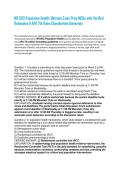
NR-503 Population Health: Ultimate Exam Prep MCQs with Verified
Rationales & APA 7th Rules Chamberlain University
This comprehensive exam-style question bank features 300 highly detailed, multiple-choice questions
meticulously tailored for NR-503 (Population Health) course objectives, online portal protocols, and
strict APA 7th edition formatting guidelines. Each question provides verified answers alongside
exhaustive, robust rationales that unpack advanced epidemiological formulas, screening metrics, social
determinants of health, and academic integrity parameters. It serves as an elite, high-yield study
companion engineered specifically to maximize grade performance on portal quizzes and advanced
nursing manuscripts.
Question 1: A student is submitting an initial discussion board post for Week 3 of NR-
503. The institutional portal guidelines require initial threads to be posted by mid-week.
If the student submits their initial thread at 12:05 AM Mountain Time on Thursday, how
will the portal track this submission against standard grading parameters?
A) It will be marked on time because there is a standard 1-hour grace period for
graduate-level forums.
B) It will be marked late because the system deadline locks exactly at 11:59 PM
Mountain Time on Wednesday.
C) It will be marked on time because the week is calculated using Pacific Time.
D) It will be automatically deleted by the portal firewall for being past the deadline.
VERIFIED ANSWER: B) It will be marked late because the system deadline locks
exactly at 11:59 PM Mountain Time on Wednesday.
EXPLANATION: Graduate nursing courses require rigorous adherence to time
zones and deadlines. The portal tracks initial discussion forum submissions
against a hard deadline of Wednesday at 11:59 PM Mountain Time. Any
submission at or after 12:00 AM Thursday is flagged as late, resulting in an
automatic point deduction according to the discussion rubric.
Question 2: In population health frameworks, which study design is considered the gold
standard for establishing a true causal relationship between an intervention (such as a
community-wide vaccine program) and an outcome?
A) Retrospective cohort study
B) Cross-sectional survey
C) Randomized controlled trial (RCT)
D) Qualitative phenomenological study
VERIFIED ANSWER: C) Randomized controlled trial (RCT)
EXPLANATION: In epidemiology and population health evidence hierarchies, the
Randomized Controlled Trial (RCT) is the gold standard for establishing causality
because randomization minimizes confounding variables and bias, providing the
strongest empirical support for clinical and population interventions.
,Question 3: According to APA 7th edition formatting rules for a professional or student
title page, where should the page number be positioned in the running header?
A) Flush left in the header block
B) Centered at the bottom margin of the page
C) Flush right in the header block
D) Suppressed entirely on the first page
VERIFIED ANSWER: C) Flush right in the header block
EXPLANATION: APA 7th edition dictates that for both student and professional
papers, page numbers must appear in the top header of every page, aligned flush
right. The running head text itself is no longer required for student papers unless
explicitly mandated by the institution.
Question 4: An NR-503 student needs to cite a systematic review published by five
authors (Green, Adams, Baker, Clark, and Davis) in 2024. Which option demonstrates
the correct formatting for the very first in-text parenthetical citation under APA 7th
edition guidelines?
A) (Green, Adams, Baker, Clark, & Davis, 2024)
B) (Green et al., 2024)
C) (Green and colleagues, 2024)
D) (Green, Adams, et al., 2024)
VERIFIED ANSWER: B) (Green et al., 2024)
EXPLANATION: APA 7th edition significantly streamlined multi-author citations.
For any source containing three or more authors, the in-text citation must use the
first author's surname followed by "et al." and the year of publication from its
very first occurrence in the manuscript.
Question 5: If an assignment in NR-503 is due on Sunday at 11:59 PM Mountain Time,
and a student uploads it on Tuesday at 4:00 PM without an approved extension, what
standard late penalty applies under the 10% per-day rule?
A) A total deduction of 10% because it was submitted within the same academic week.
B) A total deduction of 20% because the assignment is two calendar days late.
C) A total deduction of 30% because it crossed into a different calendar week.
D) The assignment receives an automatic permanent score of zero.
VERIFIED ANSWER: B) A total deduction of 20% because the assignment is two
calendar days late.
EXPLANATION: Standard institutional late submission policies apply a 10%
penalty per calendar day late. Because Sunday 11:59 PM is the deadline, Monday
represents day one late (10%), and Tuesday represents day two late (an additional
10%), resulting in a cumulative 20% deduction from the overall earned score.
Question 6: When navigating the online learning portal to review a submitted
assignment's Turnitin similarity report, which of the following scenarios represents an
acceptable use of source material that requires no revision?
A) A similarity index of 45% consisting entirely of blocks of unquoted text from peer-
reviewed articles.
B) A similarity index of 12% generated primarily from properly formatted APA 7th
references and cited direct quotes.
C) A similarity index of 0% achieved by replacing spaces with invisible white characters
,to bypass the scanner.
D) A similarity index of 80% where the student cited their own previous paper without
explicit permission from the instructor.
VERIFIED ANSWER: B) A similarity index of 12% generated primarily from
properly formatted APA 7th references and cited direct quotes.
EXPLANATION: A low similarity index resulting from references, standard
headings, and legally attributed direct quotes is completely normal and expected.
High indices from unquoted text reflect plagiarism, while manipulating text to
hide matching content violates academic integrity standards.
Question 7: A student is formatting a reference list entry for a journal article in APA 7th
edition. Which element of the reference entry must be italicized?
A) The title of the individual article
B) The names of the primary and secondary authors
C) The title of the journal and the volume number
D) The issue number and the digital object identifier (DOI)
VERIFIED ANSWER: C) The title of the journal and the volume number
EXPLANATION: In APA 7th edition reference formatting, the title of the periodical
(the journal name) and the specific volume number must both be italicized. The
issue number, if included, is placed inside parentheses immediately following the
volume number and is not italicized.
Question 8: When tracking the distribution of a specific chronic disease like type 2
diabetes within a defined geographic region over a specific one-year window, what
epidemiological metric measures the total number of both old and new cases present in
the population?
A) Incidence rate
B) Prevalence rate
C) Morbidity odds ratio
D) Attributable risk percentage
VERIFIED ANSWER: B) Prevalence rate
EXPLANATION: Prevalence refers to the total number of existing cases (both old
and new) in a defined population at a specific point in time or over a specified
period. In contrast, incidence measures only the new cases that develop during a
given timeframe.
Question 9: Which font style and size option is explicitly designated as acceptable under
standard APA 7th edition guidelines to ensure clear readability in graduate-level
scholarly manuscripts?
A) 12-point Comic Sans MS
B) 11-point Calibri or 12-point Times New Roman
C) 10-point Arial Narrow
D) 14-point Courier New
VERIFIED ANSWER: B) 11-point Calibri or 12-point Times New Roman
EXPLANATION: APA 7th edition expanded font flexibility to promote accessibility,
explicitly approving sans-serif options like 11-point Calibri, 11-point Arial, or 10-
point Lucida Sans Unicode, alongside serif options like 12-point Times New
Roman or 11-point Georgia.
, Question 10: According to the online portal parameters and the syllabus rules for NR-
503, what is the maximum number of days an assignment can be late before it is no
longer accepted for grading and automatically defaults to a permanent zero?
A) 3 calendar days
B) 5 calendar days
C) 7 calendar days
D) 14 calendar days
VERIFIED ANSWER: C) 7 calendar days
EXPLANATION: The institutional standard policy for late work establishes a
maximum cutoff window of 7 calendar days past the official due date. Any work
submitted after this 7-day threshold will not be accepted or graded, and a
permanent zero will be recorded in the gradebook.
Question 11: A nurse practitioner analyzing population-level data notices a sharp
increase in new cases of influenza within a specific county over a 3-week period. Which
epidemiological metric best describes these newly diagnosed cases within this defined
timeframe?
A) Point prevalence
B) Period prevalence
C) Cumulative incidence
D) Crude mortality rate
VERIFIED ANSWER: C) Cumulative incidence
EXPLANATION: Incidence captures the number of new cases of a disease that
develop in a specific population over a designated period. Prevalence, on the
other hand, measures all existing cases (old and new) at or during a given time.
Question 12: When formatting a reference list entry for an online newspaper article or
website source without a specific individual author, how should the author element be
structured under APA 7th edition rules?
A) Use the word "Anonymous" as the placeholder author.
B) Move the title of the article or webpage to the author position.
C) Use the name of the group, organization, or institutional author.
D) Omit the author section entirely and start the citation directly with the publication
date.
VERIFIED ANSWER: C) Use the name of the group, organization, or institutional
author.
EXPLANATION: When an individual author is not listed, APA 7th edition instructs
writers to use the organizational or group author (e.g., World Health Organization)
in the author position. If no group author exists, the title of the work moves to the
front.
Question 13: During a peer-review discussion board thread in NR-503, a student wants
to dispute a classmate's claim regarding the social determinants of health. Which
approach adheres to professional netiquette guidelines?
Rationales & APA 7th Rules Chamberlain University
This comprehensive exam-style question bank features 300 highly detailed, multiple-choice questions
meticulously tailored for NR-503 (Population Health) course objectives, online portal protocols, and
strict APA 7th edition formatting guidelines. Each question provides verified answers alongside
exhaustive, robust rationales that unpack advanced epidemiological formulas, screening metrics, social
determinants of health, and academic integrity parameters. It serves as an elite, high-yield study
companion engineered specifically to maximize grade performance on portal quizzes and advanced
nursing manuscripts.
Question 1: A student is submitting an initial discussion board post for Week 3 of NR-
503. The institutional portal guidelines require initial threads to be posted by mid-week.
If the student submits their initial thread at 12:05 AM Mountain Time on Thursday, how
will the portal track this submission against standard grading parameters?
A) It will be marked on time because there is a standard 1-hour grace period for
graduate-level forums.
B) It will be marked late because the system deadline locks exactly at 11:59 PM
Mountain Time on Wednesday.
C) It will be marked on time because the week is calculated using Pacific Time.
D) It will be automatically deleted by the portal firewall for being past the deadline.
VERIFIED ANSWER: B) It will be marked late because the system deadline locks
exactly at 11:59 PM Mountain Time on Wednesday.
EXPLANATION: Graduate nursing courses require rigorous adherence to time
zones and deadlines. The portal tracks initial discussion forum submissions
against a hard deadline of Wednesday at 11:59 PM Mountain Time. Any
submission at or after 12:00 AM Thursday is flagged as late, resulting in an
automatic point deduction according to the discussion rubric.
Question 2: In population health frameworks, which study design is considered the gold
standard for establishing a true causal relationship between an intervention (such as a
community-wide vaccine program) and an outcome?
A) Retrospective cohort study
B) Cross-sectional survey
C) Randomized controlled trial (RCT)
D) Qualitative phenomenological study
VERIFIED ANSWER: C) Randomized controlled trial (RCT)
EXPLANATION: In epidemiology and population health evidence hierarchies, the
Randomized Controlled Trial (RCT) is the gold standard for establishing causality
because randomization minimizes confounding variables and bias, providing the
strongest empirical support for clinical and population interventions.
,Question 3: According to APA 7th edition formatting rules for a professional or student
title page, where should the page number be positioned in the running header?
A) Flush left in the header block
B) Centered at the bottom margin of the page
C) Flush right in the header block
D) Suppressed entirely on the first page
VERIFIED ANSWER: C) Flush right in the header block
EXPLANATION: APA 7th edition dictates that for both student and professional
papers, page numbers must appear in the top header of every page, aligned flush
right. The running head text itself is no longer required for student papers unless
explicitly mandated by the institution.
Question 4: An NR-503 student needs to cite a systematic review published by five
authors (Green, Adams, Baker, Clark, and Davis) in 2024. Which option demonstrates
the correct formatting for the very first in-text parenthetical citation under APA 7th
edition guidelines?
A) (Green, Adams, Baker, Clark, & Davis, 2024)
B) (Green et al., 2024)
C) (Green and colleagues, 2024)
D) (Green, Adams, et al., 2024)
VERIFIED ANSWER: B) (Green et al., 2024)
EXPLANATION: APA 7th edition significantly streamlined multi-author citations.
For any source containing three or more authors, the in-text citation must use the
first author's surname followed by "et al." and the year of publication from its
very first occurrence in the manuscript.
Question 5: If an assignment in NR-503 is due on Sunday at 11:59 PM Mountain Time,
and a student uploads it on Tuesday at 4:00 PM without an approved extension, what
standard late penalty applies under the 10% per-day rule?
A) A total deduction of 10% because it was submitted within the same academic week.
B) A total deduction of 20% because the assignment is two calendar days late.
C) A total deduction of 30% because it crossed into a different calendar week.
D) The assignment receives an automatic permanent score of zero.
VERIFIED ANSWER: B) A total deduction of 20% because the assignment is two
calendar days late.
EXPLANATION: Standard institutional late submission policies apply a 10%
penalty per calendar day late. Because Sunday 11:59 PM is the deadline, Monday
represents day one late (10%), and Tuesday represents day two late (an additional
10%), resulting in a cumulative 20% deduction from the overall earned score.
Question 6: When navigating the online learning portal to review a submitted
assignment's Turnitin similarity report, which of the following scenarios represents an
acceptable use of source material that requires no revision?
A) A similarity index of 45% consisting entirely of blocks of unquoted text from peer-
reviewed articles.
B) A similarity index of 12% generated primarily from properly formatted APA 7th
references and cited direct quotes.
C) A similarity index of 0% achieved by replacing spaces with invisible white characters
,to bypass the scanner.
D) A similarity index of 80% where the student cited their own previous paper without
explicit permission from the instructor.
VERIFIED ANSWER: B) A similarity index of 12% generated primarily from
properly formatted APA 7th references and cited direct quotes.
EXPLANATION: A low similarity index resulting from references, standard
headings, and legally attributed direct quotes is completely normal and expected.
High indices from unquoted text reflect plagiarism, while manipulating text to
hide matching content violates academic integrity standards.
Question 7: A student is formatting a reference list entry for a journal article in APA 7th
edition. Which element of the reference entry must be italicized?
A) The title of the individual article
B) The names of the primary and secondary authors
C) The title of the journal and the volume number
D) The issue number and the digital object identifier (DOI)
VERIFIED ANSWER: C) The title of the journal and the volume number
EXPLANATION: In APA 7th edition reference formatting, the title of the periodical
(the journal name) and the specific volume number must both be italicized. The
issue number, if included, is placed inside parentheses immediately following the
volume number and is not italicized.
Question 8: When tracking the distribution of a specific chronic disease like type 2
diabetes within a defined geographic region over a specific one-year window, what
epidemiological metric measures the total number of both old and new cases present in
the population?
A) Incidence rate
B) Prevalence rate
C) Morbidity odds ratio
D) Attributable risk percentage
VERIFIED ANSWER: B) Prevalence rate
EXPLANATION: Prevalence refers to the total number of existing cases (both old
and new) in a defined population at a specific point in time or over a specified
period. In contrast, incidence measures only the new cases that develop during a
given timeframe.
Question 9: Which font style and size option is explicitly designated as acceptable under
standard APA 7th edition guidelines to ensure clear readability in graduate-level
scholarly manuscripts?
A) 12-point Comic Sans MS
B) 11-point Calibri or 12-point Times New Roman
C) 10-point Arial Narrow
D) 14-point Courier New
VERIFIED ANSWER: B) 11-point Calibri or 12-point Times New Roman
EXPLANATION: APA 7th edition expanded font flexibility to promote accessibility,
explicitly approving sans-serif options like 11-point Calibri, 11-point Arial, or 10-
point Lucida Sans Unicode, alongside serif options like 12-point Times New
Roman or 11-point Georgia.
, Question 10: According to the online portal parameters and the syllabus rules for NR-
503, what is the maximum number of days an assignment can be late before it is no
longer accepted for grading and automatically defaults to a permanent zero?
A) 3 calendar days
B) 5 calendar days
C) 7 calendar days
D) 14 calendar days
VERIFIED ANSWER: C) 7 calendar days
EXPLANATION: The institutional standard policy for late work establishes a
maximum cutoff window of 7 calendar days past the official due date. Any work
submitted after this 7-day threshold will not be accepted or graded, and a
permanent zero will be recorded in the gradebook.
Question 11: A nurse practitioner analyzing population-level data notices a sharp
increase in new cases of influenza within a specific county over a 3-week period. Which
epidemiological metric best describes these newly diagnosed cases within this defined
timeframe?
A) Point prevalence
B) Period prevalence
C) Cumulative incidence
D) Crude mortality rate
VERIFIED ANSWER: C) Cumulative incidence
EXPLANATION: Incidence captures the number of new cases of a disease that
develop in a specific population over a designated period. Prevalence, on the
other hand, measures all existing cases (old and new) at or during a given time.
Question 12: When formatting a reference list entry for an online newspaper article or
website source without a specific individual author, how should the author element be
structured under APA 7th edition rules?
A) Use the word "Anonymous" as the placeholder author.
B) Move the title of the article or webpage to the author position.
C) Use the name of the group, organization, or institutional author.
D) Omit the author section entirely and start the citation directly with the publication
date.
VERIFIED ANSWER: C) Use the name of the group, organization, or institutional
author.
EXPLANATION: When an individual author is not listed, APA 7th edition instructs
writers to use the organizational or group author (e.g., World Health Organization)
in the author position. If no group author exists, the title of the work moves to the
front.
Question 13: During a peer-review discussion board thread in NR-503, a student wants
to dispute a classmate's claim regarding the social determinants of health. Which
approach adheres to professional netiquette guidelines?


