
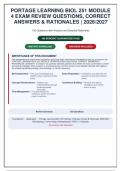
PORTAGE LEARNING BIOL 251 MODULE
4 EXAM REVIEW QUESTIONS, CORRECT
ANSWERS & RATIONALES | 2026/2027
130 Questions with Answers and Detailed Rationales
100 PERCENT GUARANTEED PASS
INSTANT DOWNLOAD ANSWERS INCLUDED
IMPORTANCE OF THIS DOCUMENT
This comprehensive examination preparation guide has been meticulously developed to help you succeed in the
PORTAGE LEARNING BIOL 251 MODULE 4 EXAM REVIEW QUESTIONS, CORRECT ANSWERS &
RATIONALES | 2026/2027. It contains 130 carefully selected questions that reflect the most current exam content
and testing strategies. Each question is accompanied by a correct answer and a detailed rationale that explains
the underlying pathophysiology, pharmacology, or clinical reasoning.
Self-Assessment – Test your knowledge and Exam Preparation – Familiarize yourself with the
identify areas requiring further question format and content
study areas
Concept Reinforcement – Deepen your Confidence Building – Develop test-taking
understanding through strategies and reduce
evidence-based exam anxiety
rationales
Time Management – Practice answering
questions under simulated
exam conditions
Review Summary 130 Questions
Foundations - Application - Portage Learning BIOL 251 Module 4 Review Correct & Rationales 2026/2027
Microbiology / Immunology Undergraduate YEAR 3 / Graduate
All answers with rationales
,Table of Contents
Content Area Questions Key Topics
Innate Immunity 1-22 Likely, Cells, Researcher, Bacterial, Response
Adaptive Immunity 23-44 Viral, Virus, Infection, Researcher, Studying
Antibody Structure AND 45-66 Cells, Bacterial, Likely, Complement, Deficiency
Function
Major Histocompatibility 67-88 Cells, Activation, Researcher, Viral, Critical
Complex MHC AND Antigen
Presentation
T Cell-mediated Immunity 89-110 Explains, Likely, Cells, Researcher, Pathogen
B Cell-mediated Immunity 111-130 Protein, Promoter, Researcher, Approach, Mechanism
AND Humoral Response
TOTAL 130 All questions include answers and detailed rationales
,Section A - Innate Immunity
Q1.
A researcher identifies a novel pattern recognition receptor (PRR) that recognizes
bacterial lipopeptides. In a knockout mouse model, macrophages fail to produce TNF- in
response to the ligand, but retain response to LPS. Which signaling adaptor is most likely
disrupted?
A. TRIF B. MyD88
C. IRF3 D. STING
Correct: B - MyD88
Rationale:Bacterial lipopeptides are recognized by TLR2/TLR1 or TLR2/TLR6 heterodimers,
which signal through MyD88. LPS signals via TLR4 using both MyD88 and TRIF; the
retention of LPS response indicates MyD88-independent TRIF pathway is intact, so MyD88 is
the disrupted adaptor.
Why the other answers are wrong:
A. TRIF is used by TLR3 and TLR4, not TLR2; LPS response would be impaired if TRIF were
disrupted.
C. IRF3 is a transcription factor downstream of TRIF, not an adaptor for TLR2.
D. STING is involved in cytosolic DNA sensing, not TLR2 signaling.
Reference: Abbas, Cellular and Molecular Immunology, 10th Ed., Ch. 4
Q2.
A patient with recurrent sinopulmonary infections has a normal complete blood count, but
flow cytometry reveals absence of CD19+ B cells, reduced serum IgG, and markedly
decreased peripheral T cell count. Which defect best explains this combined
immunodeficiency?
A. X-linked agammaglobulinemia (Bruton's B. Severe combined immunodeficiency due
tyrosine kinase mutation) to RAG1 mutation
C. Common variable immunodeficiency D. DiGeorge syndrome (22q11.2 deletion)
(CVID)
Correct: B - Severe combined immunodeficiency due to RAG1 mutation
Rationale:RAG1/RAG2 mutations cause SCID with absence of both B and T cells due to
defective V(D)J recombination. XLA affects only B cells, CVID typically has B cells present,
and DiGeorge has T cell deficiency but B cells are normal.
Why the other answers are wrong:
A. XLA leads to B cell deficiency but T cell numbers are normal.
Page 3
, Section A - Innate Immunity
C. CVID usually has B cells present, though differentiation is impaired.
D. DiGeorge syndrome causes T cell deficiency but B cells are normal.
Reference: Abbas, Cellular and Molecular Immunology, 10th Ed., Ch. 21
Q3.
A patient develops hemolytic anemia after taking penicillin. Laboratory findings show IgG
and complement on red blood cells. This reaction is best classified as which type of
hypersensitivity, and what is the primary mechanism?
A. Type II; antibody-dependent B. Type II; complement-mediated lysis
cell-mediated cytotoxicity
C. Type III; immune complex deposition D. Type IV; cytotoxic T cell response
Correct: B - Type II; complement-mediated lysis
Rationale:Penicillin acts as a hapten, binding to RBC membranes; anti-drug IgG then
activates complement, leading to intravascular hemolysis. This is a Type II hypersensitivity
reaction, specifically complement-mediated lysis.
Why the other answers are wrong:
A. ADCC is a Type II mechanism but complement activation is the primary cause here, not NK
cell killing.
C. Type III involves soluble immune complexes, not cell-bound antigens.
D. Type IV is T cell-mediated, not antibody-mediated.
Reference: Abbas, Cellular and Molecular Immunology, 10th Ed., Ch. 15
Q4.
A researcher is studying a cytokine that promotes differentiation of naive CD4 T cells into
Th17 cells. Which signaling pathway is most likely activated by this cytokine, and which
transcription factor is induced?
A. JAK-STAT3; RORt B. JAK-STAT1; T-bet
C. JAK-STAT4; GATA3 D. JAK-STAT6; FoxP3
Correct: A - JAK-STAT3; RORt
Rationale:TGF-² and IL-6 (or IL-21) induce Th17 differentiation via STAT3, which activates
the transcription factor RORt. T-bet is for Th1, GATA3 for Th2, and FoxP3 for Tregs.
Why the other answers are wrong:
B. STAT1 and T-bet are associated with Th1 differentiation, not Th17.
C. STAT4 and GATA3 are for Th1/Th2, not Th17.
D. STAT6 and FoxP3 are for Th2/Treg, not Th17.
Reference: Murphy, Janeway's Immunobiology, 9th Ed., Ch. 13
Page 4
4 EXAM REVIEW QUESTIONS, CORRECT
ANSWERS & RATIONALES | 2026/2027
130 Questions with Answers and Detailed Rationales
100 PERCENT GUARANTEED PASS
INSTANT DOWNLOAD ANSWERS INCLUDED
IMPORTANCE OF THIS DOCUMENT
This comprehensive examination preparation guide has been meticulously developed to help you succeed in the
PORTAGE LEARNING BIOL 251 MODULE 4 EXAM REVIEW QUESTIONS, CORRECT ANSWERS &
RATIONALES | 2026/2027. It contains 130 carefully selected questions that reflect the most current exam content
and testing strategies. Each question is accompanied by a correct answer and a detailed rationale that explains
the underlying pathophysiology, pharmacology, or clinical reasoning.
Self-Assessment – Test your knowledge and Exam Preparation – Familiarize yourself with the
identify areas requiring further question format and content
study areas
Concept Reinforcement – Deepen your Confidence Building – Develop test-taking
understanding through strategies and reduce
evidence-based exam anxiety
rationales
Time Management – Practice answering
questions under simulated
exam conditions
Review Summary 130 Questions
Foundations - Application - Portage Learning BIOL 251 Module 4 Review Correct & Rationales 2026/2027
Microbiology / Immunology Undergraduate YEAR 3 / Graduate
All answers with rationales
,Table of Contents
Content Area Questions Key Topics
Innate Immunity 1-22 Likely, Cells, Researcher, Bacterial, Response
Adaptive Immunity 23-44 Viral, Virus, Infection, Researcher, Studying
Antibody Structure AND 45-66 Cells, Bacterial, Likely, Complement, Deficiency
Function
Major Histocompatibility 67-88 Cells, Activation, Researcher, Viral, Critical
Complex MHC AND Antigen
Presentation
T Cell-mediated Immunity 89-110 Explains, Likely, Cells, Researcher, Pathogen
B Cell-mediated Immunity 111-130 Protein, Promoter, Researcher, Approach, Mechanism
AND Humoral Response
TOTAL 130 All questions include answers and detailed rationales
,Section A - Innate Immunity
Q1.
A researcher identifies a novel pattern recognition receptor (PRR) that recognizes
bacterial lipopeptides. In a knockout mouse model, macrophages fail to produce TNF- in
response to the ligand, but retain response to LPS. Which signaling adaptor is most likely
disrupted?
A. TRIF B. MyD88
C. IRF3 D. STING
Correct: B - MyD88
Rationale:Bacterial lipopeptides are recognized by TLR2/TLR1 or TLR2/TLR6 heterodimers,
which signal through MyD88. LPS signals via TLR4 using both MyD88 and TRIF; the
retention of LPS response indicates MyD88-independent TRIF pathway is intact, so MyD88 is
the disrupted adaptor.
Why the other answers are wrong:
A. TRIF is used by TLR3 and TLR4, not TLR2; LPS response would be impaired if TRIF were
disrupted.
C. IRF3 is a transcription factor downstream of TRIF, not an adaptor for TLR2.
D. STING is involved in cytosolic DNA sensing, not TLR2 signaling.
Reference: Abbas, Cellular and Molecular Immunology, 10th Ed., Ch. 4
Q2.
A patient with recurrent sinopulmonary infections has a normal complete blood count, but
flow cytometry reveals absence of CD19+ B cells, reduced serum IgG, and markedly
decreased peripheral T cell count. Which defect best explains this combined
immunodeficiency?
A. X-linked agammaglobulinemia (Bruton's B. Severe combined immunodeficiency due
tyrosine kinase mutation) to RAG1 mutation
C. Common variable immunodeficiency D. DiGeorge syndrome (22q11.2 deletion)
(CVID)
Correct: B - Severe combined immunodeficiency due to RAG1 mutation
Rationale:RAG1/RAG2 mutations cause SCID with absence of both B and T cells due to
defective V(D)J recombination. XLA affects only B cells, CVID typically has B cells present,
and DiGeorge has T cell deficiency but B cells are normal.
Why the other answers are wrong:
A. XLA leads to B cell deficiency but T cell numbers are normal.
Page 3
, Section A - Innate Immunity
C. CVID usually has B cells present, though differentiation is impaired.
D. DiGeorge syndrome causes T cell deficiency but B cells are normal.
Reference: Abbas, Cellular and Molecular Immunology, 10th Ed., Ch. 21
Q3.
A patient develops hemolytic anemia after taking penicillin. Laboratory findings show IgG
and complement on red blood cells. This reaction is best classified as which type of
hypersensitivity, and what is the primary mechanism?
A. Type II; antibody-dependent B. Type II; complement-mediated lysis
cell-mediated cytotoxicity
C. Type III; immune complex deposition D. Type IV; cytotoxic T cell response
Correct: B - Type II; complement-mediated lysis
Rationale:Penicillin acts as a hapten, binding to RBC membranes; anti-drug IgG then
activates complement, leading to intravascular hemolysis. This is a Type II hypersensitivity
reaction, specifically complement-mediated lysis.
Why the other answers are wrong:
A. ADCC is a Type II mechanism but complement activation is the primary cause here, not NK
cell killing.
C. Type III involves soluble immune complexes, not cell-bound antigens.
D. Type IV is T cell-mediated, not antibody-mediated.
Reference: Abbas, Cellular and Molecular Immunology, 10th Ed., Ch. 15
Q4.
A researcher is studying a cytokine that promotes differentiation of naive CD4 T cells into
Th17 cells. Which signaling pathway is most likely activated by this cytokine, and which
transcription factor is induced?
A. JAK-STAT3; RORt B. JAK-STAT1; T-bet
C. JAK-STAT4; GATA3 D. JAK-STAT6; FoxP3
Correct: A - JAK-STAT3; RORt
Rationale:TGF-² and IL-6 (or IL-21) induce Th17 differentiation via STAT3, which activates
the transcription factor RORt. T-bet is for Th1, GATA3 for Th2, and FoxP3 for Tregs.
Why the other answers are wrong:
B. STAT1 and T-bet are associated with Th1 differentiation, not Th17.
C. STAT4 and GATA3 are for Th1/Th2, not Th17.
D. STAT6 and FoxP3 are for Th2/Treg, not Th17.
Reference: Murphy, Janeway's Immunobiology, 9th Ed., Ch. 13
Page 4


