
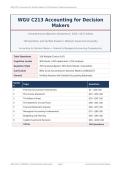
WGU C213 Accounting for Decision Makers | 100 Questions | Objective Assessment
WGU C213 Accounting for Decision
Makers
Comprehensive Objective Assessment | Edition
100 Questions and Verified Answers | Western Governors University
Accounting for Decision Makers • Financial & Managerial Accounting Competencies
Total Questions 100 Multiple Choice (A-D)
Cognitive Levels 30% Recall | 45% Application | 25% Analysis
Question Style 70% Scenario-Based | 30% Direct Recall / Calculation
Curriculum WGU C213 Accounting for Decision Makers (2026/2027)
Format Verified Answers with Detailed Accounting Rationales
Sectio
Topic Questions
n
1 Financial Accounting Fundamentals Q1 - Q20 (20)
2 The Income Statement Q21 - Q30 (10)
3 The Balance Sheet Q31 - Q45 (15)
4 The Statement of Cash Flows Q46 - Q55 (10)
5 Financial Statement Analysis Q56 - Q70 (15)
6 Managerial Accounting Fundamentals Q71 - Q80 (10)
7 Budgeting and Planning Q81 - Q90 (10)
8 Capital Investment Decisions Q91 - Q100 (10)
TOTAL 100 Questions
WGU C213 | 2026/2027 Comprehensive Examination Page 1 Accounting for Decision Makers
,WGU C213 Accounting for Decision Makers | 100 Questions | Objective Assessment
Section 1: Financial Accounting Fundamentals
Accounting Principles, Financial Statements, Accounting Equation, & Transaction Analysis
Q1: A sole proprietor opens a bakery by depositing $50,000 of personal funds
into a business bank account. Under the business entity concept, what is the
effect on the bakery's accounting records?
A. No entry is required because the owner and the business are the same legal entity
B. The business records an increase in Cash of $50,000 and an increase in Owner's
Equity (Capital) of $50,000 [CORRECT]
C. The business records an increase in Cash and a decrease in Owner's Equity
D. The business records an increase in Cash and an increase in Revenue
Correct Answer: B | The business records an increase in Cash of $50,000 and an
increase in Owner's Equity (Capital) of $50,000
Rationale:
Under the business entity concept, the business is accounted for separately from its owner.
The deposit of personal funds into the business is treated as a contribution of capital: Cash
(asset) increases by $50,000, and Owner's Equity increases by $50,000, keeping the
accounting equation (Assets = Liabilities + Equity) in balance. Option A violates the entity
concept. Option C reverses the equity effect. Option D confuses a capital contribution with
revenue, which would overstate income.
Q2: Which of the following best describes the going concern assumption?
A. The business will be liquidated within the next 12 months
B. The business will continue to operate in the foreseeable future, allowing assets
to be reported at historical cost rather than liquidation value [CORRECT]
C. The business must report assets at fair market value each reporting period
D. The business must report all liabilities at their current settlement value
Correct Answer: B | The business will continue to operate in the foreseeable
future, allowing assets to be reported at historical cost rather than liquidation
value
Rationale:
The going concern assumption holds that the business will continue operating for the
foreseeable future, which justifies reporting assets at historical cost (less depreciation) rather
than at liquidation value. Option A describes liquidation basis accounting. Option C describes
fair value accounting, which is required only for specific assets (e.g., certain investments).
Option D is unrelated to the going concern concept. WGU C213 stresses that without going
concern, the balance sheet classification of current vs. non-current would lose its meaning.
Q3: The matching principle requires that:
A. Revenues be recognized when cash is received
WGU C213 | 2026/2027 Comprehensive Examination Page 2 Accounting for Decision Makers
,WGU C213 Accounting for Decision Makers | 100 Questions | Objective Assessment
B. Expenses be recognized in the same period as the revenues they help generate
[CORRECT]
C. Assets be matched with liabilities on the balance sheet
D. Cash inflows be matched with cash outflows
Correct Answer: B | Expenses be recognized in the same period as the revenues
they help generate
Rationale:
The matching principle (a core accrual accounting concept) requires that expenses be
recognized in the same period as the revenues they help generate. This is the foundation of
accrual-basis net income. Option A describes cash-basis revenue recognition. Option C
confuses balance sheet matching with expense matching. Option D describes cash flow
matching, not accrual matching. WGU C213 tests the matching principle as the basis for
accrual expense recognition.
Q4: A company purchases a delivery truck for $40,000 cash. How does this
transaction affect the accounting equation?
A. Assets increase by $40,000; Equity increases by $40,000
B. Assets increase by $40,000; Liabilities increase by $40,000
C. Total assets are unchanged; one asset (Cash) decreases by $40,000 and
another asset (Truck) increases by $40,000 [CORRECT]
D. Assets decrease by $40,000; Equity decreases by $40,000
Correct Answer: C | Total assets are unchanged; one asset (Cash) decreases by
$40,000 and another asset (Truck) increases by $40,000
Rationale:
Purchasing a truck for cash is an asset exchange: Cash (asset) decreases by $40,000 and
Equipment (asset) increases by $40,000, so total assets are unchanged and the equation
remains in balance. Option A incorrectly treats a purchase as income. Option B describes a
purchase on credit. Option D describes a loss. WGU C213 tests transaction analysis as the
foundation of double-entry bookkeeping.
Q5: A company provides services to a customer on account for $5,000. What is
the journal entry?
A. Debit Cash $5,000; Credit Service Revenue $5,000
B. Debit Accounts Receivable $5,000; Credit Service Revenue $5,000 [CORRECT]
C. Debit Service Revenue $5,000; Credit Accounts Receivable $5,000
D. Debit Accounts Payable $5,000; Credit Cash $5,000
Correct Answer: B | Debit Accounts Receivable $5,000; Credit Service Revenue
$5,000
Rationale:
WGU C213 | 2026/2027 Comprehensive Examination Page 3 Accounting for Decision Makers
, WGU C213 Accounting for Decision Makers | 100 Questions | Objective Assessment
Providing services on account means the customer owes the company money, so Accounts
Receivable (asset) is debited for $5,000 and Service Revenue (revenue) is credited for $5,000
under accrual accounting. Option A describes a cash sale. Option C reverses the entry. Option
D describes paying a payable. WGU C213 tests the distinction between cash and accrual
revenue recognition.
Q6: Which of the following accounts normally has a debit balance?
A. Accounts Payable
B. Common Stock
C. Equipment [CORRECT]
D. Service Revenue
Correct Answer: C | Equipment
Rationale:
Equipment is an asset account, and asset accounts normally have debit balances. Accounts
Payable (liability) and Common Stock (equity) normally have credit balances. Service
Revenue (revenue) normally has a credit balance. WGU C213 tests the debit/credit rules:
assets and expenses increase with debits; liabilities, equity, and revenues increase with
credits.
Q7: A trial balance is prepared to:
A. Verify that total debits equal total credits in the ledger [CORRECT]
B. Verify that all journal entries were correctly analyzed
C. Confirm that net income was calculated correctly
D. Confirm that the balance sheet balances
Correct Answer: A | Verify that total debits equal total credits in the ledger
Rationale:
A trial balance lists all ledger accounts and their balances to verify that total debits equal total
credits, detecting certain posting errors. It does not guarantee that journal entries were
correctly analyzed (option B), that net income is correct (option C), or that the balance sheet
balances (option D, which is a separate calculation). WGU C213 stresses that a balanced trial
balance catches arithmetic errors but not errors of omission, wrong account, or reversed
entries.
Q8: Under accrual accounting, expenses are recognized when:
A. Cash is paid
B. They are incurred, regardless of when cash is paid [CORRECT]
C. The related revenue is collected in cash
D. The financial statements are prepared
Correct Answer: B | They are incurred, regardless of when cash is paid
WGU C213 | 2026/2027 Comprehensive Examination Page 4 Accounting for Decision Makers
WGU C213 Accounting for Decision
Makers
Comprehensive Objective Assessment | Edition
100 Questions and Verified Answers | Western Governors University
Accounting for Decision Makers • Financial & Managerial Accounting Competencies
Total Questions 100 Multiple Choice (A-D)
Cognitive Levels 30% Recall | 45% Application | 25% Analysis
Question Style 70% Scenario-Based | 30% Direct Recall / Calculation
Curriculum WGU C213 Accounting for Decision Makers (2026/2027)
Format Verified Answers with Detailed Accounting Rationales
Sectio
Topic Questions
n
1 Financial Accounting Fundamentals Q1 - Q20 (20)
2 The Income Statement Q21 - Q30 (10)
3 The Balance Sheet Q31 - Q45 (15)
4 The Statement of Cash Flows Q46 - Q55 (10)
5 Financial Statement Analysis Q56 - Q70 (15)
6 Managerial Accounting Fundamentals Q71 - Q80 (10)
7 Budgeting and Planning Q81 - Q90 (10)
8 Capital Investment Decisions Q91 - Q100 (10)
TOTAL 100 Questions
WGU C213 | 2026/2027 Comprehensive Examination Page 1 Accounting for Decision Makers
,WGU C213 Accounting for Decision Makers | 100 Questions | Objective Assessment
Section 1: Financial Accounting Fundamentals
Accounting Principles, Financial Statements, Accounting Equation, & Transaction Analysis
Q1: A sole proprietor opens a bakery by depositing $50,000 of personal funds
into a business bank account. Under the business entity concept, what is the
effect on the bakery's accounting records?
A. No entry is required because the owner and the business are the same legal entity
B. The business records an increase in Cash of $50,000 and an increase in Owner's
Equity (Capital) of $50,000 [CORRECT]
C. The business records an increase in Cash and a decrease in Owner's Equity
D. The business records an increase in Cash and an increase in Revenue
Correct Answer: B | The business records an increase in Cash of $50,000 and an
increase in Owner's Equity (Capital) of $50,000
Rationale:
Under the business entity concept, the business is accounted for separately from its owner.
The deposit of personal funds into the business is treated as a contribution of capital: Cash
(asset) increases by $50,000, and Owner's Equity increases by $50,000, keeping the
accounting equation (Assets = Liabilities + Equity) in balance. Option A violates the entity
concept. Option C reverses the equity effect. Option D confuses a capital contribution with
revenue, which would overstate income.
Q2: Which of the following best describes the going concern assumption?
A. The business will be liquidated within the next 12 months
B. The business will continue to operate in the foreseeable future, allowing assets
to be reported at historical cost rather than liquidation value [CORRECT]
C. The business must report assets at fair market value each reporting period
D. The business must report all liabilities at their current settlement value
Correct Answer: B | The business will continue to operate in the foreseeable
future, allowing assets to be reported at historical cost rather than liquidation
value
Rationale:
The going concern assumption holds that the business will continue operating for the
foreseeable future, which justifies reporting assets at historical cost (less depreciation) rather
than at liquidation value. Option A describes liquidation basis accounting. Option C describes
fair value accounting, which is required only for specific assets (e.g., certain investments).
Option D is unrelated to the going concern concept. WGU C213 stresses that without going
concern, the balance sheet classification of current vs. non-current would lose its meaning.
Q3: The matching principle requires that:
A. Revenues be recognized when cash is received
WGU C213 | 2026/2027 Comprehensive Examination Page 2 Accounting for Decision Makers
,WGU C213 Accounting for Decision Makers | 100 Questions | Objective Assessment
B. Expenses be recognized in the same period as the revenues they help generate
[CORRECT]
C. Assets be matched with liabilities on the balance sheet
D. Cash inflows be matched with cash outflows
Correct Answer: B | Expenses be recognized in the same period as the revenues
they help generate
Rationale:
The matching principle (a core accrual accounting concept) requires that expenses be
recognized in the same period as the revenues they help generate. This is the foundation of
accrual-basis net income. Option A describes cash-basis revenue recognition. Option C
confuses balance sheet matching with expense matching. Option D describes cash flow
matching, not accrual matching. WGU C213 tests the matching principle as the basis for
accrual expense recognition.
Q4: A company purchases a delivery truck for $40,000 cash. How does this
transaction affect the accounting equation?
A. Assets increase by $40,000; Equity increases by $40,000
B. Assets increase by $40,000; Liabilities increase by $40,000
C. Total assets are unchanged; one asset (Cash) decreases by $40,000 and
another asset (Truck) increases by $40,000 [CORRECT]
D. Assets decrease by $40,000; Equity decreases by $40,000
Correct Answer: C | Total assets are unchanged; one asset (Cash) decreases by
$40,000 and another asset (Truck) increases by $40,000
Rationale:
Purchasing a truck for cash is an asset exchange: Cash (asset) decreases by $40,000 and
Equipment (asset) increases by $40,000, so total assets are unchanged and the equation
remains in balance. Option A incorrectly treats a purchase as income. Option B describes a
purchase on credit. Option D describes a loss. WGU C213 tests transaction analysis as the
foundation of double-entry bookkeeping.
Q5: A company provides services to a customer on account for $5,000. What is
the journal entry?
A. Debit Cash $5,000; Credit Service Revenue $5,000
B. Debit Accounts Receivable $5,000; Credit Service Revenue $5,000 [CORRECT]
C. Debit Service Revenue $5,000; Credit Accounts Receivable $5,000
D. Debit Accounts Payable $5,000; Credit Cash $5,000
Correct Answer: B | Debit Accounts Receivable $5,000; Credit Service Revenue
$5,000
Rationale:
WGU C213 | 2026/2027 Comprehensive Examination Page 3 Accounting for Decision Makers
, WGU C213 Accounting for Decision Makers | 100 Questions | Objective Assessment
Providing services on account means the customer owes the company money, so Accounts
Receivable (asset) is debited for $5,000 and Service Revenue (revenue) is credited for $5,000
under accrual accounting. Option A describes a cash sale. Option C reverses the entry. Option
D describes paying a payable. WGU C213 tests the distinction between cash and accrual
revenue recognition.
Q6: Which of the following accounts normally has a debit balance?
A. Accounts Payable
B. Common Stock
C. Equipment [CORRECT]
D. Service Revenue
Correct Answer: C | Equipment
Rationale:
Equipment is an asset account, and asset accounts normally have debit balances. Accounts
Payable (liability) and Common Stock (equity) normally have credit balances. Service
Revenue (revenue) normally has a credit balance. WGU C213 tests the debit/credit rules:
assets and expenses increase with debits; liabilities, equity, and revenues increase with
credits.
Q7: A trial balance is prepared to:
A. Verify that total debits equal total credits in the ledger [CORRECT]
B. Verify that all journal entries were correctly analyzed
C. Confirm that net income was calculated correctly
D. Confirm that the balance sheet balances
Correct Answer: A | Verify that total debits equal total credits in the ledger
Rationale:
A trial balance lists all ledger accounts and their balances to verify that total debits equal total
credits, detecting certain posting errors. It does not guarantee that journal entries were
correctly analyzed (option B), that net income is correct (option C), or that the balance sheet
balances (option D, which is a separate calculation). WGU C213 stresses that a balanced trial
balance catches arithmetic errors but not errors of omission, wrong account, or reversed
entries.
Q8: Under accrual accounting, expenses are recognized when:
A. Cash is paid
B. They are incurred, regardless of when cash is paid [CORRECT]
C. The related revenue is collected in cash
D. The financial statements are prepared
Correct Answer: B | They are incurred, regardless of when cash is paid
WGU C213 | 2026/2027 Comprehensive Examination Page 4 Accounting for Decision Makers


