
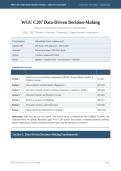
WGU C207 | Data-Driven Decision-Making — Objective Assessment Latest Edition | 100 Questions
WGU C207 Data-Driven Decision-Making
Objective Assessment Comprehensive Examination
Western Governors University | Comprehensive Examination
Total Questions 100 (Multiple Choice, 4 options each)
Cognitive Mix 30% Recall | 45% Application | 25% Analysis
Item Style 70% Scenario-based | 30% Direct Recall
Sections 7 sections, sequenced Q1-Q100
Format Question -> 4 options (A-D) -> Correct Answer -> Rationale
Examination Sections
Section Topic Items
Data-Driven Decision-Making Fundamentals (DMAIC, Decision-Making Models, &
Section 1 Q1-Q20
Problem Framing)
Section 2 Data Acquisition and Data Quality Management Q21-Q35
Section 3 Descriptive Analytics (Central Tendency, Dispersion, Visualization, & KPIs) Q36-Q50
Section 4 Inferential Statistics and Hypothesis Testing Q51-Q65
Section 5 Predictive Analytics and Modeling Q66-Q75
Section 6 Prescriptive Analytics and Optimization Q76-Q85
Section 7 Organizational and Implementation Challenges Q86-Q100
Instructions: Each item has one best answer. The correct answer is identified by the [CORRECT] marker and
confirmed below the options. Rationales apply WGU C207-specific data analytics reasoning (statistical methods,
business implications, and data interpretation) and explain why the distractors are incorrect.
Section 1: Data-Driven Decision-Making Fundamentals
WGU C207 Data-Driven Decision-Making Page 1
,WGU C207 | Data-Driven Decision-Making — Objective Assessment Latest Edition | 100 Questions
Q1: A manufacturing firm uses DMAIC to reduce defect rates in its packaging line. After defining the
problem and measuring baseline defect rates, the team identifies root causes through Pareto analysis and
implements a new sensor-based inspection process with control charts to monitor ongoing performance.
Which two phases remain incomplete if the team stops after installing the new process?
A. Define and Measure
B. Improve and Control [CORRECT]
C. Analyze and Improve
D. Measure and Analyze
Correct Answer: B
Rationale:
DMAIC stands for Define, Measure, Analyze, Improve, Control. Installing the new process corresponds to the
Improve phase, but without ongoing monitoring via control charts and standard work, the Control phase is
incomplete. Stopping after Improve means Control is missing. Define and Measure are already completed, and
Analyze was performed via Pareto analysis.
Q2: A hospital aims to reduce patient wait times. The team defines the problem as 'improve patient
experience,' collects baseline wait-time data, performs root-cause analysis showing staffing gaps during
peak hours, pilots a new scheduling system, and establishes monthly audits to sustain improvements.
This sequence best follows which methodology?
A. DMAIC (Define, Measure, Analyze, Improve, Control) [CORRECT]
B. Waterfall project management
C. Agile sprint cycle
D. PDCA only, without DMAIC framing
Correct Answer: A
Rationale:
The sequence maps directly to DMAIC: Define (problem statement), Measure (baseline data), Analyze
(root-cause analysis), Improve (pilot scheduling system), and Control (monthly audits). Waterfall and Agile are
project management frameworks, not process-improvement methodologies. PDCA (Plan-Do-Check-Act) is a
related but simpler continuous improvement cycle without the explicit five-phase structure of DMAIC.
WGU C207 Data-Driven Decision-Making Page 2
,WGU C207 | Data-Driven Decision-Making — Objective Assessment Latest Edition | 100 Questions
Q3: When framing a business problem for analytics, which of the following is the BEST first step?
A. Selecting the visualization tool to use
B. Clearly defining the business question and decision to be made, including stakeholders and success
criteria [CORRECT]
C. Collecting all available data regardless of relevance
D. Building a predictive model immediately
Correct Answer: B
Rationale:
Problem framing begins with clearly defining the business question, the decision to be made, relevant
stakeholders, and success criteria, which ensures subsequent data collection and analysis are purposeful. Selecting
tools, collecting all data, or jumping to modeling without clarity often wastes effort and produces irrelevant
insights. A well-framed problem drives focused measurement and analysis aligned with decision needs.
Q4: A manager asks analysts to 'predict churn for all customers using all available data.' This request is
too vague for effective analytics. Which refined problem statement best supports decision-making?
A. Identify customers likely to churn in the next 90 days so the retention team can target them with
personalized offers, with success measured by reduction in monthly churn rate from 5% to 3%
[CORRECT]
B. Predict churn for all customers
C. Build a churn model using logistic regression
D. Analyze churn data
Correct Answer: A
Rationale:
A well-framed problem specifies the prediction horizon (next 90 days), the intended decision/action (targeted
retention offers), and the success metric (reduce churn from 5% to 3%), enabling focused analysis. Options B, C,
and D lack horizon, action, and success criteria, making them too vague to guide effective analytics work. The
refined statement aligns with decision-making needs.
Q5: Which decision-making model relies primarily on intuition, experience, and judgment rather than
quantitative analysis?
A. Data-driven decision-making
B. Evidence-based decision-making
C. Intuitive decision-making [CORRECT]
D. Cost-benefit analysis
Correct Answer: C
Rationale:
Intuitive decision-making relies on intuition, experience, and judgment without systematic quantitative analysis.
Data-driven and evidence-based decision-making explicitly incorporate data and analytical evidence. Cost-benefit
analysis is a quantitative method, not intuition-based. Intuition can be valuable but is subject to biases that
data-driven approaches aim to mitigate.
WGU C207 Data-Driven Decision-Making Page 3
, WGU C207 | Data-Driven Decision-Making — Objective Assessment Latest Edition | 100 Questions
Q6: In the DIKW pyramid, 'wisdom' is best described as:
A. Raw facts and figures
B. Organized and structured data with context
C. Applied knowledge to make sound, ethical, and context-aware decisions [CORRECT]
D. Statistical analysis output
Correct Answer: C
Rationale:
In the DIKW hierarchy (Data, Information, Knowledge, Wisdom), wisdom is the application of knowledge to
make sound, ethical, and context-aware decisions. Raw facts are data, structured data with context is information,
and analytical outputs feed knowledge. Wisdom adds judgment and ethical context, distinguishing it from mere
knowledge.
Q7: A retail executive makes a pricing decision based on a competitor analysis memo from five years ago,
ignoring current market data. This is an example of:
A. Data-driven decision-making
B. Anchoring bias and outdated evidence use [CORRECT]
C. Evidence-based decision-making
D. Rigorous analytical reasoning
Correct Answer: B
Rationale:
Relying on outdated information while ignoring current data reflects anchoring bias and weak evidence-based
practice. Data-driven and evidence-based decision-making require current, relevant data. The executive is not
exercising analytical rigor; relying on stale evidence introduces significant risk of poor decisions.
Q8: Which of the following BEST describes 'analytical mindset' in data-driven cultures?
A. Trusting intuition over data when conflict arises
B. Asking data-supported questions, validating assumptions with evidence, and making decisions
transparent and reproducible [CORRECT]
C. Avoiding qualitative information entirely
D. Always choosing the most complex model available
Correct Answer: B
Rationale:
An analytical mindset involves asking data-supported questions, validating assumptions with evidence, and
making decisions transparent and reproducible. Trusting intuition over data, avoiding qualitative information
entirely, or always using complex models are distortions of analytical thinking. The mindset balances rigor,
evidence, and transparency.
WGU C207 Data-Driven Decision-Making Page 4
WGU C207 Data-Driven Decision-Making
Objective Assessment Comprehensive Examination
Western Governors University | Comprehensive Examination
Total Questions 100 (Multiple Choice, 4 options each)
Cognitive Mix 30% Recall | 45% Application | 25% Analysis
Item Style 70% Scenario-based | 30% Direct Recall
Sections 7 sections, sequenced Q1-Q100
Format Question -> 4 options (A-D) -> Correct Answer -> Rationale
Examination Sections
Section Topic Items
Data-Driven Decision-Making Fundamentals (DMAIC, Decision-Making Models, &
Section 1 Q1-Q20
Problem Framing)
Section 2 Data Acquisition and Data Quality Management Q21-Q35
Section 3 Descriptive Analytics (Central Tendency, Dispersion, Visualization, & KPIs) Q36-Q50
Section 4 Inferential Statistics and Hypothesis Testing Q51-Q65
Section 5 Predictive Analytics and Modeling Q66-Q75
Section 6 Prescriptive Analytics and Optimization Q76-Q85
Section 7 Organizational and Implementation Challenges Q86-Q100
Instructions: Each item has one best answer. The correct answer is identified by the [CORRECT] marker and
confirmed below the options. Rationales apply WGU C207-specific data analytics reasoning (statistical methods,
business implications, and data interpretation) and explain why the distractors are incorrect.
Section 1: Data-Driven Decision-Making Fundamentals
WGU C207 Data-Driven Decision-Making Page 1
,WGU C207 | Data-Driven Decision-Making — Objective Assessment Latest Edition | 100 Questions
Q1: A manufacturing firm uses DMAIC to reduce defect rates in its packaging line. After defining the
problem and measuring baseline defect rates, the team identifies root causes through Pareto analysis and
implements a new sensor-based inspection process with control charts to monitor ongoing performance.
Which two phases remain incomplete if the team stops after installing the new process?
A. Define and Measure
B. Improve and Control [CORRECT]
C. Analyze and Improve
D. Measure and Analyze
Correct Answer: B
Rationale:
DMAIC stands for Define, Measure, Analyze, Improve, Control. Installing the new process corresponds to the
Improve phase, but without ongoing monitoring via control charts and standard work, the Control phase is
incomplete. Stopping after Improve means Control is missing. Define and Measure are already completed, and
Analyze was performed via Pareto analysis.
Q2: A hospital aims to reduce patient wait times. The team defines the problem as 'improve patient
experience,' collects baseline wait-time data, performs root-cause analysis showing staffing gaps during
peak hours, pilots a new scheduling system, and establishes monthly audits to sustain improvements.
This sequence best follows which methodology?
A. DMAIC (Define, Measure, Analyze, Improve, Control) [CORRECT]
B. Waterfall project management
C. Agile sprint cycle
D. PDCA only, without DMAIC framing
Correct Answer: A
Rationale:
The sequence maps directly to DMAIC: Define (problem statement), Measure (baseline data), Analyze
(root-cause analysis), Improve (pilot scheduling system), and Control (monthly audits). Waterfall and Agile are
project management frameworks, not process-improvement methodologies. PDCA (Plan-Do-Check-Act) is a
related but simpler continuous improvement cycle without the explicit five-phase structure of DMAIC.
WGU C207 Data-Driven Decision-Making Page 2
,WGU C207 | Data-Driven Decision-Making — Objective Assessment Latest Edition | 100 Questions
Q3: When framing a business problem for analytics, which of the following is the BEST first step?
A. Selecting the visualization tool to use
B. Clearly defining the business question and decision to be made, including stakeholders and success
criteria [CORRECT]
C. Collecting all available data regardless of relevance
D. Building a predictive model immediately
Correct Answer: B
Rationale:
Problem framing begins with clearly defining the business question, the decision to be made, relevant
stakeholders, and success criteria, which ensures subsequent data collection and analysis are purposeful. Selecting
tools, collecting all data, or jumping to modeling without clarity often wastes effort and produces irrelevant
insights. A well-framed problem drives focused measurement and analysis aligned with decision needs.
Q4: A manager asks analysts to 'predict churn for all customers using all available data.' This request is
too vague for effective analytics. Which refined problem statement best supports decision-making?
A. Identify customers likely to churn in the next 90 days so the retention team can target them with
personalized offers, with success measured by reduction in monthly churn rate from 5% to 3%
[CORRECT]
B. Predict churn for all customers
C. Build a churn model using logistic regression
D. Analyze churn data
Correct Answer: A
Rationale:
A well-framed problem specifies the prediction horizon (next 90 days), the intended decision/action (targeted
retention offers), and the success metric (reduce churn from 5% to 3%), enabling focused analysis. Options B, C,
and D lack horizon, action, and success criteria, making them too vague to guide effective analytics work. The
refined statement aligns with decision-making needs.
Q5: Which decision-making model relies primarily on intuition, experience, and judgment rather than
quantitative analysis?
A. Data-driven decision-making
B. Evidence-based decision-making
C. Intuitive decision-making [CORRECT]
D. Cost-benefit analysis
Correct Answer: C
Rationale:
Intuitive decision-making relies on intuition, experience, and judgment without systematic quantitative analysis.
Data-driven and evidence-based decision-making explicitly incorporate data and analytical evidence. Cost-benefit
analysis is a quantitative method, not intuition-based. Intuition can be valuable but is subject to biases that
data-driven approaches aim to mitigate.
WGU C207 Data-Driven Decision-Making Page 3
, WGU C207 | Data-Driven Decision-Making — Objective Assessment Latest Edition | 100 Questions
Q6: In the DIKW pyramid, 'wisdom' is best described as:
A. Raw facts and figures
B. Organized and structured data with context
C. Applied knowledge to make sound, ethical, and context-aware decisions [CORRECT]
D. Statistical analysis output
Correct Answer: C
Rationale:
In the DIKW hierarchy (Data, Information, Knowledge, Wisdom), wisdom is the application of knowledge to
make sound, ethical, and context-aware decisions. Raw facts are data, structured data with context is information,
and analytical outputs feed knowledge. Wisdom adds judgment and ethical context, distinguishing it from mere
knowledge.
Q7: A retail executive makes a pricing decision based on a competitor analysis memo from five years ago,
ignoring current market data. This is an example of:
A. Data-driven decision-making
B. Anchoring bias and outdated evidence use [CORRECT]
C. Evidence-based decision-making
D. Rigorous analytical reasoning
Correct Answer: B
Rationale:
Relying on outdated information while ignoring current data reflects anchoring bias and weak evidence-based
practice. Data-driven and evidence-based decision-making require current, relevant data. The executive is not
exercising analytical rigor; relying on stale evidence introduces significant risk of poor decisions.
Q8: Which of the following BEST describes 'analytical mindset' in data-driven cultures?
A. Trusting intuition over data when conflict arises
B. Asking data-supported questions, validating assumptions with evidence, and making decisions
transparent and reproducible [CORRECT]
C. Avoiding qualitative information entirely
D. Always choosing the most complex model available
Correct Answer: B
Rationale:
An analytical mindset involves asking data-supported questions, validating assumptions with evidence, and
making decisions transparent and reproducible. Trusting intuition over data, avoiding qualitative information
entirely, or always using complex models are distortions of analytical thinking. The mindset balances rigor,
evidence, and transparency.
WGU C207 Data-Driven Decision-Making Page 4


