

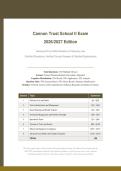
Cannon Trust School II Exam
2026/2027 Edition
Advanced Trust Administration & Fiduciary Law
Certified Questions, Verified Correct Answers & Detailed Explanations
Total Questions: 125 (Multiple Choice)
Format: Cannon Financial Institute Curriculum Alignment
Cognitive Distribution: 25% Recall | 50% Application | 25% Analysis
Question Style: 70% Scenario-Based | 30% Direct Recall / Statutory Identification
Includes: Verified Answers with Comprehensive Fiduciary Rationales & Statutory Citations
Section Topic Questions
1 Fiduciary Law and Duties Q1 - Q20
2 Trust Administration and Management Q21 - Q40
3 Estate Planning and Wealth Transfer Q41 - Q55
4 Investment Management and Portfolio Oversight Q56 - Q70
5 Specialized Trusts Q71 - Q85
6 Taxation of Trusts and Estates Q86 - Q100
7 Ethical and Regulatory Compliance Q101 - Q115
8 Advanced Case Studies and Complex Scenarios Q116 - Q125
TOTAL 125
This study guide aligns with the Cannon Financial Institute Cannon Trust School II curriculum and the
2026-2027 examination standards. Each question includes a verified correct answer and a detailed
rationale grounded in fiduciary principles, statutory authority, and professional standards.
,Cannon Trust School II Exam 2026/2027 | Advanced Trust Administration & Fiduciary Law Certified Questions & Verified Answers
Section 1: Fiduciary Law and Duties
Fiduciary Responsibilities, Prudent Investor Rule, Duty of Loyalty, Duty of Impartiality, Duty to Inform, and Standards of
Care under the Uniform Trust Code (UTC) and the Restatement of Trusts.
Q1: A trustee personally purchases trust property at a price below fair market value without
disclosure to or consent from the beneficiaries. Which fiduciary duty has the trustee primarily
violated?
A. Duty of loyalty (self-dealing prohibition) [CORRECT]
B. Duty of impartiality
C. Duty to diversify
D. Duty to enforce claims
Correct Answer: A
Rationale: Under UTC Section 802 and the Restatement (Third) of Trusts, a trustee owes a strict duty of loyalty that
prohibits self-dealing; a trustee may not purchase trust property for personal benefit without informed consent from
beneficiaries and full disclosure. The duty of impartiality (Option B) requires fair treatment among beneficiary
classes but is not at issue here. The duty to diversify (Option C) is a prudent investor obligation, and the duty to
enforce claims (Option D) addresses claims against third parties. Self-dealing is voidable regardless of fairness
because it undermines the fiduciary relationship itself.
Q2: Under the Restatement (Third) of Trusts and the Uniform Prudent Investor Act (UPIA), which
standard governs a trustee's investment decisions?
A. The prudent investor rule, evaluating investments in the context of the entire portfolio rather than
in isolation [CORRECT]
B. The prudent person rule, evaluating each investment individually for safety
C. The legal list approach, restricting investments to government securities
D. The capital preservation standard, prioritizing principal over growth
Correct Answer: A
Rationale: The UPIA (adopted in nearly all states and codified as UTC Section 902) applies the prudent investor
rule, which evaluates investment prudence based on the portfolio as a whole, not individual investments in isolation,
and considers risk-return objectives appropriate to the trust. The older 'prudent person' rule (Option B) judged each
investment individually, which the UPIA explicitly rejected. The legal list approach (Option C) is a pre-1990s
standard no longer in force. Capital preservation (Option D) is only appropriate where the trust's purposes
specifically require it. The modern standard is portfolio-based, total-return oriented, and requires consideration of
the trust's purposes, distribution requirements, and tax considerations.
Cannon Trust School II Exam Page 2
,Cannon Trust School II Exam 2026/2027 | Advanced Trust Administration & Fiduciary Law Certified Questions & Verified Answers
Q3: A trust has two classes of beneficiaries: an income beneficiary (the settlor's surviving spouse) and
remainder beneficiaries (the settlor's children from a prior marriage). The trustee invests exclusively
in high-yield bonds to maximize income, which significantly erodes the principal through inflation.
Which duty has been breached?
A. Duty of impartiality, by favoring the income beneficiary at the expense of the remainder
beneficiaries [CORRECT]
B. Duty of loyalty, because the trustee has a conflict of interest
C. Duty to inform, because beneficiaries were not notified
D. Duty of confidentiality
Correct Answer: A
Rationale: Under UTC Section 803 and the Restatement (Third) of Trusts Section 79, the duty of impartiality
requires the trustee to administer the trust with due regard for the differing interests of income and remainder
beneficiaries; investing solely for yield imperils the remaindermen's interest and constitutes impartiality breach. The
duty of loyalty (Option B) concerns self-dealing, not inter-beneficiary balance. The duty to inform (Option C) is a
separate disclosure obligation under UTC Section 813. Confidentiality (Option D) addresses non-disclosure to third
parties. Modern prudent investor analysis favors total-return investing to balance income and growth appropriately.
Q4: Under UTC Section 813, what is a trustee's general duty to inform beneficiaries?
A. Upon request, the trustee must provide a complete copy of the trust instrument and relevant
information about trust assets, and must annually report on trust property, liabilities, receipts, and
disbursements [CORRECT]
B. The trustee must disclose all trust information only upon court order
C. The trustee has discretion to withhold all information from beneficiaries until the trust terminates
D. The trustee need only notify beneficiaries of their right to receive distributions
Correct Answer: A
Rationale: UTC Section 813 requires a trustee to keep qualified beneficiaries reasonably informed about the
administration and material facts necessary to protect their interests, including providing a copy of the trust
instrument upon request and annual reports of trust property, liabilities, receipts, and disbursements. Option B is
incorrect because court orders are not required for routine disclosure. Option C is incorrect; mandatory disclosure
cannot be withheld indefinitely. Option D understates the duty significantly. The duty to inform ensures beneficiaries
can hold the trustee accountable and protect their interests.
Cannon Trust School II Exam Page 3
, Cannon Trust School II Exam 2026/2027 | Advanced Trust Administration & Fiduciary Law Certified Questions & Verified Answers
Q5: A trustee delegates investment management to a registered investment adviser. Under the UPIA,
when is such delegation permitted and what standard applies?
A. Permitted if the trustee exercises reasonable care, skill, and caution in selecting and monitoring
the agent, and the delegation is appropriate under the circumstances [CORRECT]
B. Permitted only with unanimous beneficiary consent
C. Permitted only if the trustee is a corporate fiduciary
D. Never permitted; delegation of investment authority violates the duty of personal performance
Correct Answer: A
Rationale: UPIA Section 9 (and UTC Section 807) permits a trustee to delegate investment and management
functions that a prudent trustee of comparable skills could not perform without assistance, provided the trustee
exercises reasonable care, skill, and caution in selecting, establishing the scope of, and periodically reviewing the
agent. Option B is incorrect; beneficiary consent is not required. Option C is incorrect; both individual and corporate
trustees may delegate. Option D reflects pre-UPIA law, which the UPIA explicitly overturned. The trustee remains
liable for breach in selecting or monitoring the agent but is not liable for the agent's conduct absent negligence in
oversight.
Q6: Which of the following best describes the duty of care owed by a trustee under UTC Section 804?
A. The trustee shall administer the trust as a prudent person would, considering the purposes, terms,
distributional requirements, and other circumstances of the trust, and shall exercise reasonable care,
skill, and caution [CORRECT]
B. The trustee must achieve a minimum annual investment return of 8%
C. The trustee must personally perform all administrative tasks without assistance
D. The trustee's duty of care is satisfied by retaining the assets as funded by the settlor
Correct Answer: A
Rationale: UTC Section 804 imposes a duty of competence requiring the trustee to administer the trust as a prudent
person would, considering the trust's purposes, terms, distributional requirements, and other circumstances,
exercising reasonable care, skill, and caution. Option B is incorrect; no specific return is guaranteed. Option C is
incorrect; delegation is permitted under UTC Section 807. Option D is incorrect; the duty to review and, if
necessary, reposition assets arises within one year under UPIA Section 4. The duty of care is measured by process,
not outcome; no liability arises for losses if the trustee acted prudently.
Cannon Trust School II Exam Page 4
2026/2027 Edition
Advanced Trust Administration & Fiduciary Law
Certified Questions, Verified Correct Answers & Detailed Explanations
Total Questions: 125 (Multiple Choice)
Format: Cannon Financial Institute Curriculum Alignment
Cognitive Distribution: 25% Recall | 50% Application | 25% Analysis
Question Style: 70% Scenario-Based | 30% Direct Recall / Statutory Identification
Includes: Verified Answers with Comprehensive Fiduciary Rationales & Statutory Citations
Section Topic Questions
1 Fiduciary Law and Duties Q1 - Q20
2 Trust Administration and Management Q21 - Q40
3 Estate Planning and Wealth Transfer Q41 - Q55
4 Investment Management and Portfolio Oversight Q56 - Q70
5 Specialized Trusts Q71 - Q85
6 Taxation of Trusts and Estates Q86 - Q100
7 Ethical and Regulatory Compliance Q101 - Q115
8 Advanced Case Studies and Complex Scenarios Q116 - Q125
TOTAL 125
This study guide aligns with the Cannon Financial Institute Cannon Trust School II curriculum and the
2026-2027 examination standards. Each question includes a verified correct answer and a detailed
rationale grounded in fiduciary principles, statutory authority, and professional standards.
,Cannon Trust School II Exam 2026/2027 | Advanced Trust Administration & Fiduciary Law Certified Questions & Verified Answers
Section 1: Fiduciary Law and Duties
Fiduciary Responsibilities, Prudent Investor Rule, Duty of Loyalty, Duty of Impartiality, Duty to Inform, and Standards of
Care under the Uniform Trust Code (UTC) and the Restatement of Trusts.
Q1: A trustee personally purchases trust property at a price below fair market value without
disclosure to or consent from the beneficiaries. Which fiduciary duty has the trustee primarily
violated?
A. Duty of loyalty (self-dealing prohibition) [CORRECT]
B. Duty of impartiality
C. Duty to diversify
D. Duty to enforce claims
Correct Answer: A
Rationale: Under UTC Section 802 and the Restatement (Third) of Trusts, a trustee owes a strict duty of loyalty that
prohibits self-dealing; a trustee may not purchase trust property for personal benefit without informed consent from
beneficiaries and full disclosure. The duty of impartiality (Option B) requires fair treatment among beneficiary
classes but is not at issue here. The duty to diversify (Option C) is a prudent investor obligation, and the duty to
enforce claims (Option D) addresses claims against third parties. Self-dealing is voidable regardless of fairness
because it undermines the fiduciary relationship itself.
Q2: Under the Restatement (Third) of Trusts and the Uniform Prudent Investor Act (UPIA), which
standard governs a trustee's investment decisions?
A. The prudent investor rule, evaluating investments in the context of the entire portfolio rather than
in isolation [CORRECT]
B. The prudent person rule, evaluating each investment individually for safety
C. The legal list approach, restricting investments to government securities
D. The capital preservation standard, prioritizing principal over growth
Correct Answer: A
Rationale: The UPIA (adopted in nearly all states and codified as UTC Section 902) applies the prudent investor
rule, which evaluates investment prudence based on the portfolio as a whole, not individual investments in isolation,
and considers risk-return objectives appropriate to the trust. The older 'prudent person' rule (Option B) judged each
investment individually, which the UPIA explicitly rejected. The legal list approach (Option C) is a pre-1990s
standard no longer in force. Capital preservation (Option D) is only appropriate where the trust's purposes
specifically require it. The modern standard is portfolio-based, total-return oriented, and requires consideration of
the trust's purposes, distribution requirements, and tax considerations.
Cannon Trust School II Exam Page 2
,Cannon Trust School II Exam 2026/2027 | Advanced Trust Administration & Fiduciary Law Certified Questions & Verified Answers
Q3: A trust has two classes of beneficiaries: an income beneficiary (the settlor's surviving spouse) and
remainder beneficiaries (the settlor's children from a prior marriage). The trustee invests exclusively
in high-yield bonds to maximize income, which significantly erodes the principal through inflation.
Which duty has been breached?
A. Duty of impartiality, by favoring the income beneficiary at the expense of the remainder
beneficiaries [CORRECT]
B. Duty of loyalty, because the trustee has a conflict of interest
C. Duty to inform, because beneficiaries were not notified
D. Duty of confidentiality
Correct Answer: A
Rationale: Under UTC Section 803 and the Restatement (Third) of Trusts Section 79, the duty of impartiality
requires the trustee to administer the trust with due regard for the differing interests of income and remainder
beneficiaries; investing solely for yield imperils the remaindermen's interest and constitutes impartiality breach. The
duty of loyalty (Option B) concerns self-dealing, not inter-beneficiary balance. The duty to inform (Option C) is a
separate disclosure obligation under UTC Section 813. Confidentiality (Option D) addresses non-disclosure to third
parties. Modern prudent investor analysis favors total-return investing to balance income and growth appropriately.
Q4: Under UTC Section 813, what is a trustee's general duty to inform beneficiaries?
A. Upon request, the trustee must provide a complete copy of the trust instrument and relevant
information about trust assets, and must annually report on trust property, liabilities, receipts, and
disbursements [CORRECT]
B. The trustee must disclose all trust information only upon court order
C. The trustee has discretion to withhold all information from beneficiaries until the trust terminates
D. The trustee need only notify beneficiaries of their right to receive distributions
Correct Answer: A
Rationale: UTC Section 813 requires a trustee to keep qualified beneficiaries reasonably informed about the
administration and material facts necessary to protect their interests, including providing a copy of the trust
instrument upon request and annual reports of trust property, liabilities, receipts, and disbursements. Option B is
incorrect because court orders are not required for routine disclosure. Option C is incorrect; mandatory disclosure
cannot be withheld indefinitely. Option D understates the duty significantly. The duty to inform ensures beneficiaries
can hold the trustee accountable and protect their interests.
Cannon Trust School II Exam Page 3
, Cannon Trust School II Exam 2026/2027 | Advanced Trust Administration & Fiduciary Law Certified Questions & Verified Answers
Q5: A trustee delegates investment management to a registered investment adviser. Under the UPIA,
when is such delegation permitted and what standard applies?
A. Permitted if the trustee exercises reasonable care, skill, and caution in selecting and monitoring
the agent, and the delegation is appropriate under the circumstances [CORRECT]
B. Permitted only with unanimous beneficiary consent
C. Permitted only if the trustee is a corporate fiduciary
D. Never permitted; delegation of investment authority violates the duty of personal performance
Correct Answer: A
Rationale: UPIA Section 9 (and UTC Section 807) permits a trustee to delegate investment and management
functions that a prudent trustee of comparable skills could not perform without assistance, provided the trustee
exercises reasonable care, skill, and caution in selecting, establishing the scope of, and periodically reviewing the
agent. Option B is incorrect; beneficiary consent is not required. Option C is incorrect; both individual and corporate
trustees may delegate. Option D reflects pre-UPIA law, which the UPIA explicitly overturned. The trustee remains
liable for breach in selecting or monitoring the agent but is not liable for the agent's conduct absent negligence in
oversight.
Q6: Which of the following best describes the duty of care owed by a trustee under UTC Section 804?
A. The trustee shall administer the trust as a prudent person would, considering the purposes, terms,
distributional requirements, and other circumstances of the trust, and shall exercise reasonable care,
skill, and caution [CORRECT]
B. The trustee must achieve a minimum annual investment return of 8%
C. The trustee must personally perform all administrative tasks without assistance
D. The trustee's duty of care is satisfied by retaining the assets as funded by the settlor
Correct Answer: A
Rationale: UTC Section 804 imposes a duty of competence requiring the trustee to administer the trust as a prudent
person would, considering the trust's purposes, terms, distributional requirements, and other circumstances,
exercising reasonable care, skill, and caution. Option B is incorrect; no specific return is guaranteed. Option C is
incorrect; delegation is permitted under UTC Section 807. Option D is incorrect; the duty to review and, if
necessary, reposition assets arises within one year under UPIA Section 4. The duty of care is measured by process,
not outcome; no liability arises for losses if the trustee acted prudently.
Cannon Trust School II Exam Page 4


