

Written by students who passed Immediately available after payment Read online or as PDF Wrong document? Swap it for free 4.6 TrustPilot
logo-home
Document preview thumbnail
Preview 2 out of 6 pages
Exam (elaborations)

PMHNP Certification Prep Exam Questions Verified & Provided with A+ Graded Answers Latest Updated 2026/2027 – Psychotherapy, Substance Use, Suicide Assessment, Neurocognitive Disorders, Crisis Intervention | Instant Download

Document preview thumbnail
Preview 2 out of 6 pages

# PMHNP Certification Prep Exam Questions – Latest Updated 2026/2027 Prepare for your **PMHNP certification exam** with this comprehensive collection of **exam questions, verified answers, and high-yield psychiatric mental health nursing concepts** designed for efficient review and exam preparation. This resource covers major topics relevant to **Psychiatric-Mental Health Nurse Practitioner (PMHNP)** certification preparation, including psychotherapy theories, neurocognitive assessment, substance-related disorders, suicide and violence assessment, crisis intervention, family therapy, eating disorders, psychiatric assessment, prevention, genetics, and psychopharmacology-related clinical concepts. The material is organized around concise, high-yield concepts that can help you rapidly review important terminology, assessment tools, diagnostic concepts, therapeutic approaches, and clinical decision-making principles. ## HIGH-YIELD PMHNP CERTIFICATION CONTENT ### Neurocognitive Assessment & Screening Review commonly tested cognitive assessment tools and interpretation concepts, including: * SLUMS examination * MMSE * Cognitive impairment screening * Mild neurocognitive disorder * Dementia screening * Cognitive assessment concepts * Psychiatric mental status evaluation * Hamilton Anxiety Rating Scale * Vanderbilt Assessment Scale * Abnormal Involuntary Movement Scale (AIMS) * PET scan and psychiatric/neurobiological assessment ### Suicide & Safety Assessment Includes important psychiatric safety concepts involving: * SLAP suicide assessment * Social support * Lethality * Access to means * Suicide plan * Previous suicide attempts * Hopelessness as a suicide risk factor * Suicide risk assessment * Violence risk assessment * History of violence as a predictor * Aggression and serotonin * Domestic violence * Child abuse indicators * Elder abuse considerations * Youth violence and homicide ### Genetics & Psychiatric Assessment Review fundamental genetic concepts such as: * Autosomal dominant inheritance * Autosomal recessive inheritance * Huntington disease * Cystic fibrosis * Genetic transmission patterns * Family history considerations * Psychiatric genetic risk concepts ### Prevention & Primary Care Concepts Covers: * Primary prevention * Secondary prevention * Tertiary prevention * Health promotion * Screening and early detection * Rehabilitation * Cancer screening concepts * Medicare screening concepts * Major causes of mortality * Lung cancer * Hepatitis A vaccination * Preventive health concepts ### Endocrine & Medical Conditions in Psychiatric Practice Review medical conditions that may mimic or contribute to psychiatric symptoms: * Low T4 * Thyroid disease * Hyperthyroidism * Hypothyroidism * Low TSH * Elevated TSH * Mania-like symptoms * Depression-like symptoms * HPA axis * Hypothalamus * Pituitary gland * Adrenal cortex * Laboratory assessment ### Psychotherapy Theories & Therapeutic Modalities Extensive psychotherapy coverage includes: * Psychoanalytic psychotherapy * Structure of the mind * Id, ego, and superego * Defense and relief behaviors * Ego strength * Goals of psychoanalytic therapy * Interpersonal Therapy * Harry Stack Sullivan * Good Me, Bad Me, Not Me * Transactional Analysis * Eric Berne * Parent, Adult, and Child ego states * Gestalt Therapy * Frederick Perls * Person-Centered Therapy * Carl Rogers * Empathy * Warmth * Unconditional positive regard * Motivational Interviewing * Stages of Change * Precontemplation * Contemplation * Preparation * Action * Maintenance * Relapse ### Behavioral & Cognitive Therapies Review high-yield concepts involving: * Behavioral Therapy * Pavlov * Skinner * Bandura * Wolpe * Rational Emotive Therapy * Albert Ellis * Cognitive Behavioral Therapy * Aaron Beck * Cognitive restructuring * Irrational beliefs * Socratic dialogue * Cognitive therapy * Cognitive distortions * Psychologically minded patients * Self-examination * Introspection * Personal insight * Supportive psychotherapy ### Therapeutic Relationship & Psychiatric Nursing Covers the therapeutic relationship and psychiatric nursing process, including: * Orientation phase * Working phase * Termination phase * Establishing trust * Therapeutic boundaries * Confidentiality * Contracting * Problem solving * Resistance * Adaptive coping * Self-esteem * Therapeutic goals * Termination planning * Therapeutic communication ### Therapeutic Milieu & Group Therapy Review important concepts related to psychiatric treatment environments: * Therapeutic milieu * Multidisciplinary team * Structure * Involvement * Containment * Support * Validation * NP role in the milieu * Reality orientation * Medication management * Setting limits * Patient education * Group size * Open-ended groups * Closed-ended groups * Group leadership * Autocratic leadership * Democratic leadership * Laissez-faire leadership * Yalom's therapeutic factors * Universality * Instillation of hope * Group education * Social skills * Role modeling * Insight * Emotional expression * Existential factors ### Family Therapy Includes major family systems concepts and theorists: * Family Systems Theory * Murray Bowen * Triangles * Genograms * Family relationships * Strategic Family Therapy * Jay Haley * Milton Erickson * Problem-solving strategies * Structural Family Therapy * Salvador Minuchin * Family structure * Subsystems * Boundaries * Diffuse boundaries * Rigid boundaries ### Impulse-Control & Related Disorders Review concepts involving: * Kleptomania * Pyromania * Trichotillomania * Impulse-control disorders * Compulsive behaviors * Tension and affective arousal * Hair-pulling disorder * Behavioral interventions * Pharmacologic treatment concepts ### Feeding & Eating Disorders Includes high-yield eating disorder concepts such as: * Feeding and eating disorders * Anorexia nervosa * Bulimia nervosa * Binge Eating Disorder * Epidemiology * Male-to-female prevalence * Binge eating treatment * Lisdexamfetamine (Vyvanse) * Eating disorder assessment * Clinical manifestations ### Substance-Related & Addictive Disorders Review important substance-use concepts, including: * Substance-related disorders * Behavioral manifestations of substance use * Impaired control * Social impairment * Risky substance use * Pharmacological criteria * Quantity and duration of use * Unsuccessful attempts to reduce use * Time spent obtaining or using substances * Substance-related suicide risk * Methadone withdrawal * Heroin withdrawal * Alcohol withdrawal * Withdrawal assessment ### Alcohol Withdrawal & CIWA-Ar Covers: * Clinical Institute Withdrawal Assessment for Alcohol (CIWA-Ar) * Alcohol withdrawal monitoring * Withdrawal scoring * Benzodiazepine treatment * Long-acting benzodiazepines * Symptom-triggered regimens * Fixed-dose regimens * Wernicke encephalopathy * Thiamine-related neurologic complications * Withdrawal severity assessment ### Heroin & Opioid Withdrawal Review: * Heroin withdrawal onset * Withdrawal peak * Duration of opioid withdrawal * Methadone withdrawal * Opioid withdrawal assessment * Monitoring patients during withdrawal * Clinical withdrawal symptoms ### Psychiatric & Medical Laboratory Concepts Includes review of: * AST * ALT * Liver function * Alcohol-related laboratory assessment * Medication-related laboratory changes * Thyroid function testing * T4 * TSH * Psychiatric differential diagnosis * Medical causes of psychiatric symptoms ### Culture, Violence & Social Determinants Important concepts include: * Acculturation * Assimilation * Culture-bound syndromes * Homelessness and mental health * Violence risk * Domestic violence * Child abuse * Elder abuse * Aggression * Learned violence * Cultural considerations in psychiatric care ### Crisis Intervention Review major crisis concepts: * Crisis definition * Crisis intervention * Hazardous events * Precipitating events * Disorganization * Problem-solving failure * Return to previous level of functioning * Situational crisis * Adventitious crisis * Natural disasters * Crime and violence * Financial and occupational stress * Loss * Physical illness ### Cognitive Theory & Depression Includes: * Beck's Cognitive Triad * Negative view of self * Negative interpretation of experiences * Negative view of the future * Hopelessness * Cognitive patterns associated with depression ### Psychiatric Neuroscience Review foundational neurobiological concepts including: * Limbic system * Hippocampus * Amygdala * Hypothalamus * Emotions and drives * HPA axis * Stress response * Psychiatric neurobiology ## IDEAL FOR PMHNP EXAM PREPARATION This resource can be useful for: * PMHNP certification preparation * ANCC PMHNP exam review * Psychiatric Mental Health Nurse Practitioner students * PMHNP certification candidates * Psychiatric nursing students * Graduate nursing students * Comprehensive psychiatric assessment review * Psychotherapy theory review * Neurocognitive assessment review * Substance-use disorder review * Crisis intervention review * Suicide and violence assessment * Last-minute exam preparation * High-yield PMHNP review Use the material to reinforce key concepts, identify areas requiring additional study, and build familiarity with terminology frequently encountered in psychiatric mental health nursing and certification preparation. **Instant Download:** Get immediate access to the study material and begin reviewing high-yield PMHNP concepts whenever convenient.

Content preview

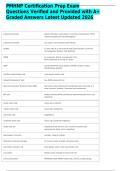
PMHNP Certification Prep Exam
Questions Verified and Provided with A+
Graded Answers Latest Updated 2026


autosomal dominant genetic inheritance. will present in more than one generation. 50/50
chance of passing on trait (Huningtons)


autosomal recessive two copies must be present (cystic fibrosis


SLUMS 11 items. Max 30, 27-30 normal for high school education, 21-60 mild
neurocognitive disorder, 0-20 dementia


MMSE 11 components. Max 30, no impairment 24-30
Delirium/dementia 18-23 mild, 0-7 severe


SLAP suicide assessment. Social support, Lethality, Access to means,
Plan/Previous attempt


Hamilton Anxiety Rating scale most popular anxiety scale


Vanderbilt Assessment Scale free ADHD assessment tool


Abnormal Involuntary Movement Scale (AIMS) total score is less important than monitoring areas of the body. 2 or
more is positive. Question 7 examines trunk movements


PET scan localizes mental activities, primarily as experimental basis and is very
expensive


tender lymph node classic sign of infection


rubbery lymph node classic sign of lymphoma


soft lymph node insignificant


nontender lymph node classic sign of potential malignancy


lymph node size insignificant if less than 2cm, 3cm in axilla and inguinal. but if
supraclavicular fossa, >1cm is significant


lasts longest in the urine cannabis. 3 days to 4 weeks


Medicare B screening coverage for cervical, breast, prostate, colorectal cancer


top 4 killers of adults in US heart disease, cancer, lower resp disease, CVA


lung cancer highest cancer mortality in women and men,


primary prevention PROMOTES health PRIOR. healthy diet, exercise, avoiding things

, secondary prevention focuses on early identification and treatment of existing problems.
includes REGULAR exams and screening like pap


tertiary prevention rehab and restoration of health


hepatitis A vaccine for military, travelers to endemic areas, men who have sex with men


low T4 indicates disease state is due to thyroid gland


hyperthyroid low TSH, high or normal T4
mimics mania


hypothyroid high TSH, low T4
mimics depression


Chlamydia treatment zithromax OR doxy. report to health department


Gonorrhea rocephin 250mg IM one dose + ziethromax 1gm one dose


Syphilis benzathine penicillin G 2.4 million units IM. how often depends on the
stage. doxy if allergic


Structure of the mind Id: unconscious instinctual drives, pleasure principle
Ego: rational, maintains harmony between id and
superego Superego: perfection principles, forms the
conscious

relief behaviors actions, healthy and not healthy, to reduce stress


Goals of therapy make the unconscious conscious and strengthen the ego so that
behavior is based more on reality and less on instinctual drives


Interpersonal Therapy Harry Stack Sullivan
good me, bad me, not me


Transactional Analysis Eric Berne
Ego states include the Parent (shoulds), the Adult (gather information)
and the Child (feelings, impulses
Goal is to assist client to make new decisions about present behavior
and life


Gestalt Therapy Frederick Perls
Focuses on the now


psychoanalytic psychotherapy is best matched with the client with MATURE defenses, some object
constancy


Person centered therapy Carl Rogers
qualities of therapist are accurate empathy, warmth, unconditional
positive regard. Does NOT include history taking


Document information

Uploaded on
September 4, 2026
Number of pages
6
Written in
2026/2027
Type
Exam (elaborations)
Contains
Questions & answers
$16.79

Wrong document? Swap it for free Within 14 days of purchase and before downloading, you can choose a different document. You can simply spend the amount again.
Written by students who passed
Immediately available after payment
Read online or as PDF

Seller avatar
Reputation scores are based on the amount of documents a seller has sold for a fee and the reviews they have received for those documents. There are three levels: Bronze, Silver and Gold. The better the reputation, the more your can rely on the quality of the sellers work.
LectDeniz
5.0
(1)
Sold
21
Followers
16
Items
5281
Last sold
10 months ago


Why students choose Stuvia

Created by fellow students, verified by reviews

Quality you can trust: written by students who passed their tests and reviewed by others who've used these notes.

Didn't get what you expected? Choose another document

No worries! You can instantly pick a different document that better fits what you're looking for.

Pay as you like, start learning right away

No subscription, no commitments. Pay the way you're used to via credit card and download your PDF document instantly.

Student with book image

“Bought, downloaded, and aced it. It really can be that simple.”

Alisha Student

Working on your references?

Create accurate citations in APA, MLA and Harvard with our free citation generator.

Working on your references?

Frequently asked questions
