

ANCC PMHNP Prep Exam Questions
Verified and Provided with A+ Graded
Answers Latest Updated 2026
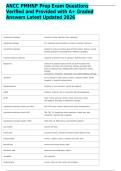
mesocortical pathway executive function: attention, focus, depression
nigrostriatal pathway from substantia nigra (brainstem) to striatum (muscles): Parkinson's
mesolimbic pathway projects to nucleus accumbens (part of limbic system). Pleasure, reward,
positive symptoms of schizophrenia: Addiction, gambling
Tuberoinfundibular pathway regulation of prolactin (acts on pituitary). Hypersexuality in mania
Dopamine produced in substania nigra and VTA. D2 & D4 receptors most
important. Elevated in the mesolimbic pathway associated with
pleasure and psychosis. Antispychotics block dopamine. travels
through
mesocoritcal, mesolimbic, nigrostriatal, and tuberinfundibular pathways
Serotonin 5-HT. produced in raphe nucleus. emotion, impulses, dreams. 5HT2A
receptors = atypical antipsychotics.
Norepinephrine produced in locus coeruleus. arousal and vigilance
GABA inhibitory. produces calm in conjunction with benzodiazepines.
ACTH motor control, learning, memory, sleep, and dreams. Helps
with balance. Decrease in Alzheimer's disease
hypothalamus-pituitary-adrenal axis (HPA) CRH, ACTH, then cortisol. Worsens with stress and depression
hypothalamus-pituitary-thyroid (HPT) TRH, TSH, T4. Hypothyroid causes depression, weight gain, slow
metabolism. Hyperthyroid is opposite.
hypothalamus-pituitary-gonadal (HPG) GnRH, FSH, LH. Malfunctions cause infertility problems.
gray matter neurons are found
frontal lobe executive function, voluntary movement, speech (Broca's area)
Temporal lobe memory, cognition, speech, emotions (aka limbic area)
parietal lobe receive and process sensory input
Wernicke's area temporal and parietal lobes; speech
amygdala fear response.
hippocampus memory. Make up limbic system with amydgala
Verified and Provided with A+ Graded
Answers Latest Updated 2026
mesocortical pathway executive function: attention, focus, depression
nigrostriatal pathway from substantia nigra (brainstem) to striatum (muscles): Parkinson's
mesolimbic pathway projects to nucleus accumbens (part of limbic system). Pleasure, reward,
positive symptoms of schizophrenia: Addiction, gambling
Tuberoinfundibular pathway regulation of prolactin (acts on pituitary). Hypersexuality in mania
Dopamine produced in substania nigra and VTA. D2 & D4 receptors most
important. Elevated in the mesolimbic pathway associated with
pleasure and psychosis. Antispychotics block dopamine. travels
through
mesocoritcal, mesolimbic, nigrostriatal, and tuberinfundibular pathways
Serotonin 5-HT. produced in raphe nucleus. emotion, impulses, dreams. 5HT2A
receptors = atypical antipsychotics.
Norepinephrine produced in locus coeruleus. arousal and vigilance
GABA inhibitory. produces calm in conjunction with benzodiazepines.
ACTH motor control, learning, memory, sleep, and dreams. Helps
with balance. Decrease in Alzheimer's disease
hypothalamus-pituitary-adrenal axis (HPA) CRH, ACTH, then cortisol. Worsens with stress and depression
hypothalamus-pituitary-thyroid (HPT) TRH, TSH, T4. Hypothyroid causes depression, weight gain, slow
metabolism. Hyperthyroid is opposite.
hypothalamus-pituitary-gonadal (HPG) GnRH, FSH, LH. Malfunctions cause infertility problems.
gray matter neurons are found
frontal lobe executive function, voluntary movement, speech (Broca's area)
Temporal lobe memory, cognition, speech, emotions (aka limbic area)
parietal lobe receive and process sensory input
Wernicke's area temporal and parietal lobes; speech
amygdala fear response.
hippocampus memory. Make up limbic system with amydgala


