

Written by students who passed Immediately available after payment Read online or as PDF Wrong document? Swap it for free 4.6 TrustPilot
logo-home
Document preview thumbnail
Preview 1 out of 3 pages
Exam (elaborations)

**TITLE** Exam 1 Wilson/Giddens Health Assessment Questions Verified and Provided with A+ Graded Answers Latest Updated 2026/2027 – Health History, Physical Examination, Documentation, Health Assessment, Therapeutic Communication, Health History Compon

Document preview thumbnail
Preview 1 out of 3 pages

**DESCRIPTION** Get the **Exam 1 Wilson/Giddens Health Assessment Exam Questions Verified and Provided with A+ Graded Answers Latest Updated 2026/2027** — a comprehensive study resource covering major concepts from **Wilson/Giddens Chapters 1, 2, 3, 4 and 6**. This resource is designed for nursing students preparing for **Health Assessment Exam 1**, nursing school assessments, quizzes, module exams, and comprehensive health assessment coursework. This study resource brings together essential concepts involving **health history, physical examination, documentation, subjective and objective data, primary/secondary/tertiary prevention, therapeutic communication, interviewing techniques, health history components, infection prevention, physical assessment techniques, temperature, pulse, respirations, blood pressure, oxygen saturation and vision assessment**. ### HEALTH ASSESSMENT FUNDAMENTALS Review the essential **components of health assessment**, including: * Health history * Physical examination * Documentation of data * Subjective data * Objective data * Signs and symptoms * Primary source data * Secondary source data * Complete and accurate documentation * Collection and analysis of patient information ### HEALTH HISTORY Master the major components of a nursing **health history**, including: * Biographic data * Reason for seeking care * History of present illness * Present health status * Past health history * Family history * Personal history * Psychosocial history * Review of systems * Medications * Allergies * Chronic health conditions * Activities of daily living * Family and genetic patterns ### PRIMARY, SECONDARY & TERTIARY PREVENTION Understand the three levels of disease prevention: **Primary Prevention** — preventing disease before it develops through healthy lifestyles and health promotion. **Secondary Prevention** — early identification of disease and intervention before progression or significant symptoms. **Tertiary Prevention** — minimizing disease severity, complications and disability through appropriate treatment and management of chronic conditions. ### HEALTH INTERVIEW & COMMUNICATION Prepare for questions involving the phases of the patient interview: * Introduction phase * Discussion phase * Summary phase * Patient-centered communication * Open-ended questions * Closed-ended questions * Therapeutic communication * Data collection techniques * Patient clarification * Validation and summarization The resource also covers communication behaviors that can interfere with accurate data collection, including: * Medical terminology and jargon * Expressing judgment * Interrupting patients * Paternalistic communication * Why questions * Ineffective interviewing techniques ### THERAPEUTIC COMMUNICATION Review the **SOLER** approach to therapeutic communication: * **S — Sit facing the patient** * **O — Open stance** * **L — Lean toward the patient** * **E — Eye contact** * **R — Relax** These concepts are important for establishing rapport, encouraging communication and creating an effective patient interview environment. ### PHYSICAL SETTING FOR THE INTERVIEW Study the characteristics of an appropriate health interview environment: * Private * Quiet * Comfortable * Free from distractions * Face-to-face positioning * Patient-centered environment * Professional communication environment ### TYPES OF HEALTH ASSESSMENTS This resource reviews different approaches to health assessment, including: * Comprehensive health history * Comprehensive assessment * Problem-based health assessment * Focused assessment * Episodic assessment * Follow-up assessment * Assessment based on the patient's current problem ### BIOGRAPHIC DATA Know the information collected as part of biographic data: * Name * Gender * Address * Birth date * Birthplace * Religion * Race/ethnicity * Marital status * Occupation * Contact person ### PRESENT HEALTH STATUS Review assessment of the patient's current health status, including: * Chronic health conditions * Effect of illness on activities of daily living * Medications * Medication route * Medication purpose * Food allergies * Environmental allergies * Medication allergies ### PAST HEALTH HISTORY Study important elements of past health history: * Childhood diseases * Immunizations * Major illnesses * Surgeries * Injuries * Childbirth history * Hospitalizations * Previous health conditions ### FAMILY & PSYCHOSOCIAL HISTORY Prepare for questions involving: * Familial disease patterns * Genetic patterns * Personal status * Education * Finances * Mental health * Functional ability * Diet and nutrition * Access to health care * Psychosocial factors ### INFECTION CONTROL Review essential infection-control concepts, especially **hand hygiene**, identified as the single most important action for reducing transmission of infection. Also review **Personal Protective Equipment (PPE)**, including: * Gloves * Masks * Eye protection * Face shields * Gowns ### PHYSICAL ASSESSMENT TECHNIQUES Master the four classic physical examination techniques: **Inspection** — visual examination of the patient, including overall appearance and skin, lips and nail color. **Palpation** — assessment through touch to evaluate structures, tenderness, texture and other physical findings. **Percussion** — assessment used to evaluate size, borders and consistency of internal organs and detect tenderness. **Auscultation** — listening to body sounds with a stethoscope, including heart, lung and gastrointestinal sounds. ### VITAL SIGNS Review key normal adult vital-sign concepts: * Normal heart rate: **60–100 beats/min** * Normal respiratory rate: **12–20 breaths/min** * Normal blood pressure: **approximately 120/80 mmHg** * Normal body temperature concepts * Oxygen saturation assessment * Pulse assessment * Respiratory assessment ### TEMPERATURE ASSESSMENT Study different temperature measurement methods: * Oral temperature * Temporal artery temperature * Tympanic temperature * Axillary temperature * Rectal temperature * Hypothalamic temperature regulation * Relative accuracy of temperature routes * Pediatric temperature assessment ### PULSE OXIMETRY Review the **pulse oximeter**, including its purpose in measuring oxygen saturation in arterial blood and the basic principle of light-based measurement. ### VISION ASSESSMENT Master the use of the **Snellen chart** for visual acuity testing, including proper positioning and distance from the patient. ### EXAM-FOCUSED STUDY RESOURCE This resource is useful for students studying: * Nursing Health Assessment * Health Assessment Exam 1 * Wilson/Giddens Health Assessment * Nursing physical examination * Patient interviewing * Health history * Therapeutic communication * Nursing assessment * Infection control * Vital signs * Physical assessment techniques * Temperature assessment * Pulse assessment * Respiratory assessment * Blood pressure assessment * Pulse oximetry * Vision assessment * Disease prevention * Patient-centered nursing care **Latest Updated 2026/2027 | Instant Download | Exam 1 Health Assessment Study Resource | Wilson/Giddens Chapters 1, 2, 3, 4 & 6**

Content preview

Science Medicine Nursing


Exam 1 (Wilson/Giddens 1, 2, 3, 4, 6) Exam
Questions Verified and Provided with A+
Graded Answers Latest Updated 2026


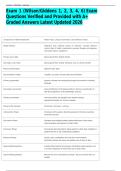
Components of Health Assessment Health history, physical examination, documentation of data


Health History Subjective data collected during an interview. Includes patient's
current state of health, medications, previous illnesses and surgeries
and family history. Symptoms


Primary source data Data acquired from patient directly


Secondary source data Data acquired from another individual, such as a family member


Physical examination Objective data; Signs


Documentation of Data complete, accurate, and descriptive documentation


Primary prevention prevent a disease from developing through the promotion of healthy
lifestyles


Secondary prevention early identification of the disease before it becomes symptomatic to
halt the progression of the pathologic process


Tertiary prevention minimize severity and disability from disease through
appropriate therapy for chronic disease


Phases of the interview Introduction, Discussion, summary


Introduction Phase Introduces self to patient, describes purpose of interview, describes
interview process


Discussion Phase Facilitates and maintains patient-centered discussion. Uses various
communication techniques to collect data


Summary Phase Summarizes data with patient. Allows patient to clarify data. Validates to
patient that he or she understands problems


Physical setting private, quiet, comfortable room free from environmental
distractions where the nurse and patient can sit face to face


Open-ended questions broadly stated question encourage a free-flowing, open response; aim
is to elicit responses of more than one or two words


Close-ended questions Require only one or two words to answer; "Do you have feel short of
breath"


Document information

Uploaded on
September 4, 2026
Number of pages
3
Written in
2026/2027
Type
Exam (elaborations)
Contains
Questions & answers
$15.99

Wrong document? Swap it for free Within 14 days of purchase and before downloading, you can choose a different document. You can simply spend the amount again.
Written by students who passed
Immediately available after payment
Read online or as PDF

Seller avatar
Reputation scores are based on the amount of documents a seller has sold for a fee and the reviews they have received for those documents. There are three levels: Bronze, Silver and Gold. The better the reputation, the more your can rely on the quality of the sellers work.
LectDeniz
5.0
(1)
Sold
21
Followers
16
Items
5281
Last sold
10 months ago


Why students choose Stuvia

Created by fellow students, verified by reviews

Quality you can trust: written by students who passed their tests and reviewed by others who've used these notes.

Didn't get what you expected? Choose another document

No worries! You can instantly pick a different document that better fits what you're looking for.

Pay as you like, start learning right away

No subscription, no commitments. Pay the way you're used to via credit card and download your PDF document instantly.

Student with book image

“Bought, downloaded, and aced it. It really can be that simple.”

Alisha Student

Working on your references?

Create accurate citations in APA, MLA and Harvard with our free citation generator.

Working on your references?

Frequently asked questions
