

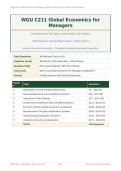
WGU C211 Global Economics for Managers | 300 Questions | 100% Correct Verified Answers
WGU C211 Global Economics for
Managers
Comprehensive Test Bank | Latest Edition
300 Questions and Verified Answers | 100% Correct
Western Governors University • Competency-Based Assessment Preparation
Total Questions 300 Multiple Choice (A-D)
Cognitive Levels 30% Recall | 50% Application | 20% Analysis
Question Style 65% Scenario-Based | 35% Direct Recall
Curriculum WGU C211 Global Economics for Managers (2026/2027)
Format Verified Answers with Detailed Rationales
Sectio
Topic Questions
n
1 Globalization and the Institution-Based View Q1 - Q40 (40)
2 Resource-Based View and Competitive Dynamics Q41 - Q70 (30)
3 International Trade Theories Q71 - Q110 (40)
4 Foreign Direct Investment (FDI) and Political Systems Q111 - Q145 (35)
5 Economic Systems and Microeconomic Foundations Q146 - Q190 (45)
6 Macroeconomic Principles and Monetary Systems Q191 - Q240 (50)
7 Global Strategy, Integration, and Ethics Q241 - Q270 (30)
8 Integrative Scenarios and Application Q271 - Q300 (30)
TOTAL 300 Questions
WGU C211 | Latest Curriculum Page 1 Global Economics for Managers
,WGU C211 Global Economics for Managers | 300 Questions | 100% Correct Verified Answers
Section 1: Globalization and the Institution-Based View
Globalization Definitions, Institutional Pillars, & Emerging Markets
Q1: Which of the following best defines globalization as taught in WGU C211?
A. The political unification of all nations under a single world government
B. The close integration of countries and peoples of the world through trade,
investment, and technology transfer [CORRECT]
C. The elimination of all trade barriers between developed nations only
D. The process by which multinational corporations replace national governments
Correct Answer: B | The close integration of countries and peoples of the world
through trade, investment, and technology transfer
Rationale:
WGU C211 defines globalization as the close integration of countries and peoples of the world
through trade, investment, and technology transfer. This definition highlights the three primary
mechanisms — trade, investment, and technology transfer — that bind national economies together.
Political unification is incorrect because globalization operates through economic and technological
channels, not political merger. Limiting globalization to developed nations is incorrect because it
encompasses both developed and emerging economies. MNE replacement of governments is
incorrect because globalization coexists with national sovereignty.
Q2: A professor states: 'Globalization is a recent phenomenon driven primarily by
the rise of multinational enterprises and digital technology.' Which view of
globalization is being expressed?
A. Evolutionary view
B. Pendulum view
C. New view [CORRECT]
D. Radical view
Correct Answer: C | New view
Rationale:
The 'new' view of globalization holds that it is a recent phenomenon driven by the rise of MNEs and
advances in information/transportation technology. This contrasts with the evolutionary view, which
treats globalization as a long-run historical process extending back centuries. The pendulum view
characterizes globalization as swinging between integration and protectionism over time, not as a
recent break. The radical view is a Marxist critique of FDI, not a perspective on the timing of
globalization. WGU C211 tests students' ability to distinguish these three scholarly views.
Q3: An economist argues that globalization is not a one-way process but instead
swings like a pendulum between periods of integration and periods of
protectionism. Which view does this represent?
A. New view
B. Evolutionary view
C. Pendulum view [CORRECT]
D. Free market view
Correct Answer: C | Pendulum view
Rationale:
WGU C211 | Latest Curriculum Page 2 Global Economics for Managers
,WGU C211 Global Economics for Managers | 300 Questions | 100% Correct Verified Answers
The pendulum view portrays globalization as swinging back and forth between integration and
protectionism, reflecting political and economic cycles rather than a steady march forward. The new
view treats globalization as a recent break driven by technology, while the evolutionary view sees it
as a centuries-long continuous process. The free market view concerns FDI policy, not the historical
pattern of globalization. The pendulum view explains why globalization can reverse (as in interwar
protectionism) and reaccelerate (as after 1990).
Q4: A scholar claims globalization has been unfolding for hundreds of years,
accelerating and decelerating but never fundamentally new. Which view is being
expressed?
A. New view
B. Evolutionary view [CORRECT]
C. Pendulum view
D. Pragmatic nationalist view
Correct Answer: B | Evolutionary view
Rationale:
The evolutionary view treats globalization as a long-run historical process that has unfolded over
centuries, with phases of acceleration and slowdown rather than a sudden recent emergence. The
new view holds that globalization is fundamentally a recent phenomenon driven by technology and
MNEs. The pendulum view focuses on the cyclical swing between integration and protectionism. The
pragmatic nationalist view concerns FDI policy, not the historical interpretation of globalization. WGU
C211 emphasizes distinguishing these three scholarly lenses.
Q5: According to the institution-based view, what determines the success or
failure of a firm's international strategy?
A. Only the firm's internal resources and capabilities
B. Only the formal laws and regulations of host countries
C. The formal (regulatory) and informal (normative/cognitive) institutional
environments in which the firm operates [CORRECT]
D. The firm's choice between cost leadership and differentiation
Correct Answer: C | The formal (regulatory) and informal (normative/cognitive)
institutional environments in which the firm operates
Rationale:
The institution-based view holds that firm success or failure is shaped by both formal (regulatory)
and informal (normative/cognitive) institutional environments. Firms that ignore informal norms risk
failure even when legally compliant. Option A reflects the resource-based view, not the
institution-based view. Option B is incomplete because it omits informal institutions. Option D is
Porter's competitive strategy framework, unrelated to institutional theory. The institution-based view
is one of the two foundational lenses (with RBV) of WGU C211.
Q6: A country's written contract law, environmental regulations, and trade tariffs
are examples of which institutional pillar?
A. Normative pillar
B. Cognitive pillar
C. Regulatory pillar [CORRECT]
WGU C211 | Latest Curriculum Page 3 Global Economics for Managers
, WGU C211 Global Economics for Managers | 300 Questions | 100% Correct Verified Answers
D. Cultural pillar
Correct Answer: C | Regulatory pillar
Rationale:
The regulatory pillar consists of formal institutions — laws, regulations, rules, and government
policies — that are enforced through coercive power. Contract law, environmental regulations, and
tariffs all fit this definition. The normative pillar covers informal values, norms, and expectations
about appropriate conduct (not written laws). The cognitive pillar covers shared beliefs and cognitive
frameworks. 'Cultural pillar' is not a separate pillar in institutional theory. The three pillars
(regulatory, normative, cognitive) together form the institutional environment.
Q7: In a society where bribery is formally illegal yet widely practiced and socially
tolerated, the practice of bribery falls under which institutional concept?
A. Regulatory pillar only
B. Normative pillar [CORRECT]
C. Cognitive pillar only
D. Formal institution only
Correct Answer: B | Normative pillar
Rationale:
Even though bribery statutes belong to the regulatory pillar, the social tolerance of bribery reflects
the normative pillar — informal norms and values about acceptable conduct. When normative and
regulatory pillars conflict, firms face an ethical and operational dilemma that WGU C211 calls
'institutional duality.' Option A is wrong because it ignores the informal normative dimension. Option
C omits the regulatory dimension. Option D ignores the informal pillar entirely. Managers must
navigate both formal rules and informal norms when operating across borders.
Q8: When managers in a foreign country share a deep, unquestioned assumption
that business should be conducted only through personal relationships, this
shared belief exemplifies which pillar?
A. Regulatory pillar
B. Normative pillar
C. Cognitive pillar [CORRECT]
D. Legal pillar
Correct Answer: C | Cognitive pillar
Rationale:
The cognitive pillar consists of shared beliefs, assumptions, and taken-for-granted ways of thinking
within a society. The unquestioned assumption that business requires personal relationships is a
cognitive schema, not a formal rule or even an explicit norm. The regulatory pillar is formal law. The
normative pillar involves explicit values about right conduct. The cognitive pillar is the deepest, most
internalized layer of institutions and is the hardest for outsiders to perceive and imitate.
Q9: Which of the following best describes the concept of 'semiglobalization'?
A. Total isolation of national economies from one another
B. Complete integration of all national markets into a single global market
C. A state between total isolation and total integration where barriers exist but are
surmountable [CORRECT]
WGU C211 | Latest Curriculum Page 4 Global Economics for Managers
WGU C211 Global Economics for
Managers
Comprehensive Test Bank | Latest Edition
300 Questions and Verified Answers | 100% Correct
Western Governors University • Competency-Based Assessment Preparation
Total Questions 300 Multiple Choice (A-D)
Cognitive Levels 30% Recall | 50% Application | 20% Analysis
Question Style 65% Scenario-Based | 35% Direct Recall
Curriculum WGU C211 Global Economics for Managers (2026/2027)
Format Verified Answers with Detailed Rationales
Sectio
Topic Questions
n
1 Globalization and the Institution-Based View Q1 - Q40 (40)
2 Resource-Based View and Competitive Dynamics Q41 - Q70 (30)
3 International Trade Theories Q71 - Q110 (40)
4 Foreign Direct Investment (FDI) and Political Systems Q111 - Q145 (35)
5 Economic Systems and Microeconomic Foundations Q146 - Q190 (45)
6 Macroeconomic Principles and Monetary Systems Q191 - Q240 (50)
7 Global Strategy, Integration, and Ethics Q241 - Q270 (30)
8 Integrative Scenarios and Application Q271 - Q300 (30)
TOTAL 300 Questions
WGU C211 | Latest Curriculum Page 1 Global Economics for Managers
,WGU C211 Global Economics for Managers | 300 Questions | 100% Correct Verified Answers
Section 1: Globalization and the Institution-Based View
Globalization Definitions, Institutional Pillars, & Emerging Markets
Q1: Which of the following best defines globalization as taught in WGU C211?
A. The political unification of all nations under a single world government
B. The close integration of countries and peoples of the world through trade,
investment, and technology transfer [CORRECT]
C. The elimination of all trade barriers between developed nations only
D. The process by which multinational corporations replace national governments
Correct Answer: B | The close integration of countries and peoples of the world
through trade, investment, and technology transfer
Rationale:
WGU C211 defines globalization as the close integration of countries and peoples of the world
through trade, investment, and technology transfer. This definition highlights the three primary
mechanisms — trade, investment, and technology transfer — that bind national economies together.
Political unification is incorrect because globalization operates through economic and technological
channels, not political merger. Limiting globalization to developed nations is incorrect because it
encompasses both developed and emerging economies. MNE replacement of governments is
incorrect because globalization coexists with national sovereignty.
Q2: A professor states: 'Globalization is a recent phenomenon driven primarily by
the rise of multinational enterprises and digital technology.' Which view of
globalization is being expressed?
A. Evolutionary view
B. Pendulum view
C. New view [CORRECT]
D. Radical view
Correct Answer: C | New view
Rationale:
The 'new' view of globalization holds that it is a recent phenomenon driven by the rise of MNEs and
advances in information/transportation technology. This contrasts with the evolutionary view, which
treats globalization as a long-run historical process extending back centuries. The pendulum view
characterizes globalization as swinging between integration and protectionism over time, not as a
recent break. The radical view is a Marxist critique of FDI, not a perspective on the timing of
globalization. WGU C211 tests students' ability to distinguish these three scholarly views.
Q3: An economist argues that globalization is not a one-way process but instead
swings like a pendulum between periods of integration and periods of
protectionism. Which view does this represent?
A. New view
B. Evolutionary view
C. Pendulum view [CORRECT]
D. Free market view
Correct Answer: C | Pendulum view
Rationale:
WGU C211 | Latest Curriculum Page 2 Global Economics for Managers
,WGU C211 Global Economics for Managers | 300 Questions | 100% Correct Verified Answers
The pendulum view portrays globalization as swinging back and forth between integration and
protectionism, reflecting political and economic cycles rather than a steady march forward. The new
view treats globalization as a recent break driven by technology, while the evolutionary view sees it
as a centuries-long continuous process. The free market view concerns FDI policy, not the historical
pattern of globalization. The pendulum view explains why globalization can reverse (as in interwar
protectionism) and reaccelerate (as after 1990).
Q4: A scholar claims globalization has been unfolding for hundreds of years,
accelerating and decelerating but never fundamentally new. Which view is being
expressed?
A. New view
B. Evolutionary view [CORRECT]
C. Pendulum view
D. Pragmatic nationalist view
Correct Answer: B | Evolutionary view
Rationale:
The evolutionary view treats globalization as a long-run historical process that has unfolded over
centuries, with phases of acceleration and slowdown rather than a sudden recent emergence. The
new view holds that globalization is fundamentally a recent phenomenon driven by technology and
MNEs. The pendulum view focuses on the cyclical swing between integration and protectionism. The
pragmatic nationalist view concerns FDI policy, not the historical interpretation of globalization. WGU
C211 emphasizes distinguishing these three scholarly lenses.
Q5: According to the institution-based view, what determines the success or
failure of a firm's international strategy?
A. Only the firm's internal resources and capabilities
B. Only the formal laws and regulations of host countries
C. The formal (regulatory) and informal (normative/cognitive) institutional
environments in which the firm operates [CORRECT]
D. The firm's choice between cost leadership and differentiation
Correct Answer: C | The formal (regulatory) and informal (normative/cognitive)
institutional environments in which the firm operates
Rationale:
The institution-based view holds that firm success or failure is shaped by both formal (regulatory)
and informal (normative/cognitive) institutional environments. Firms that ignore informal norms risk
failure even when legally compliant. Option A reflects the resource-based view, not the
institution-based view. Option B is incomplete because it omits informal institutions. Option D is
Porter's competitive strategy framework, unrelated to institutional theory. The institution-based view
is one of the two foundational lenses (with RBV) of WGU C211.
Q6: A country's written contract law, environmental regulations, and trade tariffs
are examples of which institutional pillar?
A. Normative pillar
B. Cognitive pillar
C. Regulatory pillar [CORRECT]
WGU C211 | Latest Curriculum Page 3 Global Economics for Managers
, WGU C211 Global Economics for Managers | 300 Questions | 100% Correct Verified Answers
D. Cultural pillar
Correct Answer: C | Regulatory pillar
Rationale:
The regulatory pillar consists of formal institutions — laws, regulations, rules, and government
policies — that are enforced through coercive power. Contract law, environmental regulations, and
tariffs all fit this definition. The normative pillar covers informal values, norms, and expectations
about appropriate conduct (not written laws). The cognitive pillar covers shared beliefs and cognitive
frameworks. 'Cultural pillar' is not a separate pillar in institutional theory. The three pillars
(regulatory, normative, cognitive) together form the institutional environment.
Q7: In a society where bribery is formally illegal yet widely practiced and socially
tolerated, the practice of bribery falls under which institutional concept?
A. Regulatory pillar only
B. Normative pillar [CORRECT]
C. Cognitive pillar only
D. Formal institution only
Correct Answer: B | Normative pillar
Rationale:
Even though bribery statutes belong to the regulatory pillar, the social tolerance of bribery reflects
the normative pillar — informal norms and values about acceptable conduct. When normative and
regulatory pillars conflict, firms face an ethical and operational dilemma that WGU C211 calls
'institutional duality.' Option A is wrong because it ignores the informal normative dimension. Option
C omits the regulatory dimension. Option D ignores the informal pillar entirely. Managers must
navigate both formal rules and informal norms when operating across borders.
Q8: When managers in a foreign country share a deep, unquestioned assumption
that business should be conducted only through personal relationships, this
shared belief exemplifies which pillar?
A. Regulatory pillar
B. Normative pillar
C. Cognitive pillar [CORRECT]
D. Legal pillar
Correct Answer: C | Cognitive pillar
Rationale:
The cognitive pillar consists of shared beliefs, assumptions, and taken-for-granted ways of thinking
within a society. The unquestioned assumption that business requires personal relationships is a
cognitive schema, not a formal rule or even an explicit norm. The regulatory pillar is formal law. The
normative pillar involves explicit values about right conduct. The cognitive pillar is the deepest, most
internalized layer of institutions and is the hardest for outsiders to perceive and imitate.
Q9: Which of the following best describes the concept of 'semiglobalization'?
A. Total isolation of national economies from one another
B. Complete integration of all national markets into a single global market
C. A state between total isolation and total integration where barriers exist but are
surmountable [CORRECT]
WGU C211 | Latest Curriculum Page 4 Global Economics for Managers


