

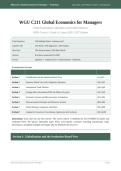
WGU C211 | Global Economics for Managers — Final Exam Latest Edition | Grade A | 100 Questions
WGU C211 Global Economics for Managers
Final Examination | Questions and Verified Answers
100% Correct | Grade A | Latest Edition
Total Questions 100 (Multiple Choice, 4 options each)
Cognitive Mix 25% Recall | 55% Application | 20% Analysis
Item Style 70% Scenario-based | 30% Direct Recall
Sections 8 sections, sequenced Q1–Q100
Format Question → 4 options (A–D) → Correct Answer → Rationale
Examination Sections
Section Topic Items
Section 1 Globalization and the Institution-Based View Q1–Q15
Section 2 Resource-Based View and Competitive Dynamics Q16–Q25
Section 3 International Trade Theories Q26–Q40
Section 4 Foreign Direct Investment (FDI) and Political Systems Q41–Q50
Section 5 Economic Systems and Microeconomic Foundations Q51–Q65
Section 6 Macroeconomic Principles and Monetary Systems Q66–Q80
Section 7 Global Strategy, Integration, and Ethics Q81–Q90
Section 8 Integrative Scenarios (Cross-Domain Application and Analysis) Q91–Q100
Instructions: Each item has one best answer. The correct answer is identified by the [CORRECT] marker and
confirmed below the options. Rationales apply WGU C211-specific economic reasoning (institutional, trade,
micro/macro, and global strategy) and explain why the distractors are incorrect.
Section 1: Globalization and the Institution-Based View
WGU C211 Global Economics for Managers Page 1
,WGU C211 | Global Economics for Managers — Final Exam Latest Edition | Grade A | 100 Questions
Q1: A multinational technology firm expands into Vietnam, citing lower labor costs and improved
telecommunications infrastructure as primary drivers. Which view of globalization best describes this
recent expansion pattern driven by technology and MNE activity?
A. Evolutionary view, because it traces back to historical trade routes
B. New view, because it is a recent phenomenon driven by technology and MNEs [CORRECT]
C. Pendulum view, because globalization swings between integration and isolation
D. Radical view, because it exploits developing nations
Correct Answer: B
Rationale:
The new view of globalization characterizes the recent, accelerated integration of countries driven by
technological advances and the activities of multinational enterprises (MNEs). The evolutionary view interprets
globalization as a long-run historical process, while the pendulum view emphasizes cyclical swings between
integration and protectionism. The radical view is a critical perspective that frames FDI as imperialist
exploitation, which is not a description of the expansion drivers cited.
Q2: A researcher argues that globalization is not a one-way street toward full integration; rather, history
shows recurring cycles of openness followed by protectionism (e.g., the 1930s collapse in trade, post-1980s
liberalization, and recent tariff escalations). Which view does the researcher adopt?
A. Pendulum view of globalization [CORRECT]
B. New view of globalization
C. Evolutionary view of globalization
D. Free market view of globalization
Correct Answer: A
Rationale:
The pendulum view conceptualizes globalization as swinging between periods of greater integration and periods
of protectionism or retrenchment, depending on political and economic conditions. The new view focuses on
recent technology-driven integration, while the evolutionary view treats globalization as a long historical
progression. The free market view is an FDI ideology, not a perspective on the trajectory of globalization.
WGU C211 Global Economics for Managers Page 2
,WGU C211 | Global Economics for Managers — Final Exam Latest Edition | Grade A | 100 Questions
Q3: When a U.S. beverage company enters India, it must comply with the Foreign Exchange
Management Act, food safety standards, and labeling requirements. These formal constraints reflect
which institutional pillar?
A. Normative pillar
B. Cognitive pillar
C. Regulatory pillar [CORRECT]
D. Cultural pillar
Correct Answer: C
Rationale:
The regulatory pillar comprises formal institutions such as laws, regulations, rules, and government policies that
are enforced through coercive power. The normative pillar refers to informal institutions reflecting societal values
and norms about appropriate conduct, while the cognitive pillar reflects shared beliefs and assumptions. Cultural
pillar is not one of the three institutional pillars in the institution-based view.
Q4: In Japan, lifetime employment expectations and consensus-based decision-making influence how
foreign firms operate there. These unwritten expectations reflect which institutional pillar?
A. Regulatory pillar
B. Normative pillar [CORRECT]
C. Cognitive pillar
D. Formal pillar
Correct Answer: B
Rationale:
The normative pillar captures informal institutions that embody societal values, norms, and expectations about
appropriate conduct, such as lifetime employment norms in Japan. The regulatory pillar addresses formal laws and
rules, while the cognitive pillar refers to shared beliefs and internalized ways of thinking. The formal pillar is not a
recognized institutional pillar in the institution-based view.
Q5: When Western managers assume that contracts will be enforced by courts in any country because
that is how business 'naturally' works, they are exhibiting cognition shaped by which institutional pillar?
A. Regulatory pillar
B. Normative pillar
C. Cognitive pillar [CORRECT]
D. Coercive pillar
Correct Answer: C
Rationale:
The cognitive pillar consists of informal institutions reflecting shared beliefs, assumptions, and internalized ways
of thinking within a society. Managers' taken-for-granted assumptions about how business works are cognitive
artifacts. The regulatory pillar concerns formal rules, and the normative pillar concerns values and norms about
appropriateness. Coercive pillar is not a recognized category; coercion is the enforcement mechanism of the
regulatory pillar.
WGU C211 Global Economics for Managers Page 3
, WGU C211 | Global Economics for Managers — Final Exam Latest Edition | Grade A | 100 Questions
Q6: Brazil, Russia, India, and China are collectively known in international business literature as:
A. BRIC, representing four major emerging economies [CORRECT]
B. MINT, representing Mexico, Indonesia, Nigeria, and Turkey
C. MERCOSUR, representing a South American trade bloc
D. ASEAN, representing Southeast Asian nations
Correct Answer: A
Rationale:
BRIC is the acronym coined by Jim O'Neill of Goldman Sachs to refer to Brazil, Russia, India, and China, four
large emerging economies expected to drive global growth. MINT refers to a different set of emerging markets,
MERCOSUR is a South American customs union, and ASEAN is the Association of Southeast Asian Nations.
None of these other groupings represent the four countries specified.
Q7: Despite decades of trade liberalization, firms still face tariffs, cultural barriers, and divergent
regulations when crossing borders. This state—neither full isolation nor complete integration—is best
described as:
A. Total globalization
B. Semiglobalization [CORRECT]
C. Deglobalization
D. Hyperglobalization
Correct Answer: B
Rationale:
Semiglobalization describes the intermediate state between total isolation and total integration where barriers exist
but are surmountable. Total globalization and hyperglobalization imply full integration, which does not match
observed border frictions. Deglobalization refers to a retreat from integration, not the persistence of partial
barriers. Semiglobalization best captures the contemporary reality where firms can operate internationally but
must navigate meaningful obstacles.
WGU C211 Global Economics for Managers Page 4
WGU C211 Global Economics for Managers
Final Examination | Questions and Verified Answers
100% Correct | Grade A | Latest Edition
Total Questions 100 (Multiple Choice, 4 options each)
Cognitive Mix 25% Recall | 55% Application | 20% Analysis
Item Style 70% Scenario-based | 30% Direct Recall
Sections 8 sections, sequenced Q1–Q100
Format Question → 4 options (A–D) → Correct Answer → Rationale
Examination Sections
Section Topic Items
Section 1 Globalization and the Institution-Based View Q1–Q15
Section 2 Resource-Based View and Competitive Dynamics Q16–Q25
Section 3 International Trade Theories Q26–Q40
Section 4 Foreign Direct Investment (FDI) and Political Systems Q41–Q50
Section 5 Economic Systems and Microeconomic Foundations Q51–Q65
Section 6 Macroeconomic Principles and Monetary Systems Q66–Q80
Section 7 Global Strategy, Integration, and Ethics Q81–Q90
Section 8 Integrative Scenarios (Cross-Domain Application and Analysis) Q91–Q100
Instructions: Each item has one best answer. The correct answer is identified by the [CORRECT] marker and
confirmed below the options. Rationales apply WGU C211-specific economic reasoning (institutional, trade,
micro/macro, and global strategy) and explain why the distractors are incorrect.
Section 1: Globalization and the Institution-Based View
WGU C211 Global Economics for Managers Page 1
,WGU C211 | Global Economics for Managers — Final Exam Latest Edition | Grade A | 100 Questions
Q1: A multinational technology firm expands into Vietnam, citing lower labor costs and improved
telecommunications infrastructure as primary drivers. Which view of globalization best describes this
recent expansion pattern driven by technology and MNE activity?
A. Evolutionary view, because it traces back to historical trade routes
B. New view, because it is a recent phenomenon driven by technology and MNEs [CORRECT]
C. Pendulum view, because globalization swings between integration and isolation
D. Radical view, because it exploits developing nations
Correct Answer: B
Rationale:
The new view of globalization characterizes the recent, accelerated integration of countries driven by
technological advances and the activities of multinational enterprises (MNEs). The evolutionary view interprets
globalization as a long-run historical process, while the pendulum view emphasizes cyclical swings between
integration and protectionism. The radical view is a critical perspective that frames FDI as imperialist
exploitation, which is not a description of the expansion drivers cited.
Q2: A researcher argues that globalization is not a one-way street toward full integration; rather, history
shows recurring cycles of openness followed by protectionism (e.g., the 1930s collapse in trade, post-1980s
liberalization, and recent tariff escalations). Which view does the researcher adopt?
A. Pendulum view of globalization [CORRECT]
B. New view of globalization
C. Evolutionary view of globalization
D. Free market view of globalization
Correct Answer: A
Rationale:
The pendulum view conceptualizes globalization as swinging between periods of greater integration and periods
of protectionism or retrenchment, depending on political and economic conditions. The new view focuses on
recent technology-driven integration, while the evolutionary view treats globalization as a long historical
progression. The free market view is an FDI ideology, not a perspective on the trajectory of globalization.
WGU C211 Global Economics for Managers Page 2
,WGU C211 | Global Economics for Managers — Final Exam Latest Edition | Grade A | 100 Questions
Q3: When a U.S. beverage company enters India, it must comply with the Foreign Exchange
Management Act, food safety standards, and labeling requirements. These formal constraints reflect
which institutional pillar?
A. Normative pillar
B. Cognitive pillar
C. Regulatory pillar [CORRECT]
D. Cultural pillar
Correct Answer: C
Rationale:
The regulatory pillar comprises formal institutions such as laws, regulations, rules, and government policies that
are enforced through coercive power. The normative pillar refers to informal institutions reflecting societal values
and norms about appropriate conduct, while the cognitive pillar reflects shared beliefs and assumptions. Cultural
pillar is not one of the three institutional pillars in the institution-based view.
Q4: In Japan, lifetime employment expectations and consensus-based decision-making influence how
foreign firms operate there. These unwritten expectations reflect which institutional pillar?
A. Regulatory pillar
B. Normative pillar [CORRECT]
C. Cognitive pillar
D. Formal pillar
Correct Answer: B
Rationale:
The normative pillar captures informal institutions that embody societal values, norms, and expectations about
appropriate conduct, such as lifetime employment norms in Japan. The regulatory pillar addresses formal laws and
rules, while the cognitive pillar refers to shared beliefs and internalized ways of thinking. The formal pillar is not a
recognized institutional pillar in the institution-based view.
Q5: When Western managers assume that contracts will be enforced by courts in any country because
that is how business 'naturally' works, they are exhibiting cognition shaped by which institutional pillar?
A. Regulatory pillar
B. Normative pillar
C. Cognitive pillar [CORRECT]
D. Coercive pillar
Correct Answer: C
Rationale:
The cognitive pillar consists of informal institutions reflecting shared beliefs, assumptions, and internalized ways
of thinking within a society. Managers' taken-for-granted assumptions about how business works are cognitive
artifacts. The regulatory pillar concerns formal rules, and the normative pillar concerns values and norms about
appropriateness. Coercive pillar is not a recognized category; coercion is the enforcement mechanism of the
regulatory pillar.
WGU C211 Global Economics for Managers Page 3
, WGU C211 | Global Economics for Managers — Final Exam Latest Edition | Grade A | 100 Questions
Q6: Brazil, Russia, India, and China are collectively known in international business literature as:
A. BRIC, representing four major emerging economies [CORRECT]
B. MINT, representing Mexico, Indonesia, Nigeria, and Turkey
C. MERCOSUR, representing a South American trade bloc
D. ASEAN, representing Southeast Asian nations
Correct Answer: A
Rationale:
BRIC is the acronym coined by Jim O'Neill of Goldman Sachs to refer to Brazil, Russia, India, and China, four
large emerging economies expected to drive global growth. MINT refers to a different set of emerging markets,
MERCOSUR is a South American customs union, and ASEAN is the Association of Southeast Asian Nations.
None of these other groupings represent the four countries specified.
Q7: Despite decades of trade liberalization, firms still face tariffs, cultural barriers, and divergent
regulations when crossing borders. This state—neither full isolation nor complete integration—is best
described as:
A. Total globalization
B. Semiglobalization [CORRECT]
C. Deglobalization
D. Hyperglobalization
Correct Answer: B
Rationale:
Semiglobalization describes the intermediate state between total isolation and total integration where barriers exist
but are surmountable. Total globalization and hyperglobalization imply full integration, which does not match
observed border frictions. Deglobalization refers to a retreat from integration, not the persistence of partial
barriers. Semiglobalization best captures the contemporary reality where firms can operate internationally but
must navigate meaningful obstacles.
WGU C211 Global Economics for Managers Page 4


