

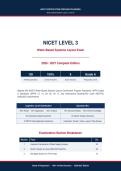
NICET CERTIFICATION PREPARATION SERIES
Water-Based Systems Layout | Level III
NICET LEVEL 3
Water-Based Systems Layout Exam
Complete Edition
120 100% 8 Grade A
Verified Questions Correct Answers Exam Sections Preparation Level
Aligned with NICET Water-Based Systems Layout Certification Program Standards, NFPA Codes
& Standards (NFPA 13, 14, 20, 22, 24, 1), and International Building/Fire Code (IBC/IFC)
2026/2027 requirements.
Cognitive Level Distribution Question Mix
25% Recall - 50% Application - 25% Analysis 75% Scenario-Based - 25% Direct Knowledge
20 Calculation-Based Questions 15 System Design Scenarios
10 NFPA Code Application Questions Hydraulics, Pumps, Tanks, Layout, Plan Review
Examination Section Breakdown
Section Topic Q's
1 Hydraulic Calculations & Water Supply Analysis 20
2 System Design & Layout (Sprinkler Systems) 20
3 Standpipe Systems & Fire Pumps 15
Grade A Preparation - 100% Verified Answers - 2026/2027 Edition
,NICET LEVEL 3 - WATER-BASED SYSTEMS LAYOUT EXAM 2026/2027 120 Verified Questions | Grade A
4 Water Storage Tanks & Water Supplies 10
5 NFPA 13 - Installation Standards 20
6 NFPA 14, 20, 22, 24 - Supporting Standards 15
7 Plan Review & Submittal Procedures 10
8 Project Management, Codes, & Regulations 10
TOTAL 120
NICET Certification Preparation | Aligned with NFPA 13, 14, 20, 22, 24 & IBC/IFC Page 2
,NICET LEVEL 3 - WATER-BASED SYSTEMS LAYOUT EXAM 2026/2027 120 Verified Questions | Grade A
NICET LEVEL 3 - WATER-BASED SYSTEMS LAYOUT
EXAM 2026/2027
Complete Exam with 120 Verified Questions and 100% Correct Answers (Grade A)
Instructions: This examination consists of 120 multiple-choice questions across eight sections. Each question
has one best answer. Rationales reference the applicable NFPA code section and NICET Water-Based Systems
Layout methodology. Cognitive distribution: 25% recall, 50% application, 25% analysis. Scenario-based questions
reflect real-world design projects, field installation scenarios, and code compliance reviews aligned with NICET
Level III certification standards.
Section 1: Hydraulic Calculations & Water Supply Analysis
This section covers hydraulic calculation methodology, water supply analysis, Hazen-Williams friction loss equations,
hydrant flow testing, residual pressure evaluation, and fire flow determination per NFPA 13, NFPA 291, and IFC/ISO
methodology. Includes 10 calculation-based questions.
Q1: A 4-inch Schedule 40 steel pipe (internal diameter 4.026 in.) conveys 450 gpm through a
250-ft run. Using the Hazen-Williams formula with C = 120, what is the approximate friction loss
in psi?
A. 12.4 psi
B. 18.7 psi *[CORRECT]*
C. 24.6 psi
D. 31.2 psi
Correct Answer: B
Rationale: Using Hazen-Williams p = 4.52 x Q^1.85 / (C^1.85 x d^4.87), with Q = 450 gpm, C = 120, and d =
4.026 in., the unit loss is about 0.075 psi/ft. Over 250 ft, p_total = 0.075 x 250 = 18.7 psi. Option A misapplies
the C exponent; Option C uses d = 4.5 in.; Option D uses C = 100 (old pipe). NFPA 13 Chapter 27 and the
NFPA 13 Handbook document the Hazen-Williams method for sprinkler hydraulic calculations.
Q2: A standard 1/2-inch orifice sprinkler with K = 5.6 operates at 18 psi. What is the discharge
flow in gpm?
A. 18.9 gpm
B. 23.7 gpm *[CORRECT]*
C. 28.4 gpm
D. 33.6 gpm
Correct Answer: B
Rationale: Using Q = K x sqrt(P) = 5.6 x sqrt(18) = 5.6 x 4.243 = 23.76 gpm. Option A confuses K = 4.2
(old-style); Option C uses P^1.5 in error; Option D adds a safety factor not permitted by NFPA 13. NFPA 13
Section 27.2.2 defines the standard discharge formula Q = K x sqrt(P) for sprinkler discharge calculations.
NICET Certification Preparation | Aligned with NFPA 13, 14, 20, 22, 24 & IBC/IFC Page 3
, NICET LEVEL 3 - WATER-BASED SYSTEMS LAYOUT EXAM 2026/2027 120 Verified Questions | Grade A
Q3: An Ordinary Hazard Group 2 (OH2) sprinkler system is being designed using the
density/area method. The most remote area is 1,500 sq ft. Using the NFPA 13 density/area curve
for OH2, what is the minimum design density?
A. 0.10 gpm/sq ft over 1,500 sq ft
B. 0.15 gpm/sq ft over 1,500 sq ft
C. 0.20 gpm/sq ft over 1,500 sq ft *[CORRECT]*
D. 0.30 gpm/sq ft over 1,500 sq ft
Correct Answer: C
Rationale: Per NFPA 13 Figure 19.3.3.1.1 (Density/Area Curves), Ordinary Hazard Group 2 requires a
minimum density of 0.20 gpm/sq ft over the most remote 1,500 sq ft for a hydraulically designed system. The
0.10 value is Light Hazard, 0.15 is OH1, and 0.30 is Extra Hazard Group 1. NICET Level III hydraulics
methodology requires correct hazard classification before density selection.
Q4: A design area of 2,500 sq ft requires a density of 0.30 gpm/sq ft (Extra Hazard Group 1).
Inside hose allowance is 100 gpm and outside hose allowance is 500 gpm. What is the total
system water demand at the base of the riser?
A. 750 gpm
B. 1,250 gpm
C. 1,350 gpm *[CORRECT]*
D. 1,500 gpm
Correct Answer: C
Rationale: Sprinkler demand = 0.30 x 2,500 = 750 gpm. Add inside hose (100 gpm) at the riser base = 850
gpm. Outside hose (500 gpm) is added for total water supply demand = 1,350 gpm. Option A omits hose;
Option B omits inside hose; Option D double-counts outside hose. NFPA 13 Section 19.2.5 governs hose
stream allowance in hydraulic calculations.
Q5: During a hydrant flow test, a 2.5-inch outlet with a discharge coefficient of 0.90 yields a pitot
tube reading of 20 psi. Using the NFPA 291 formula Q = 29.84 x C_d x d^2 x sqrt(P), what is the
discharge in gpm?
A. 610 gpm
B. 751 gpm *[CORRECT]*
C. 925 gpm
D. 1,180 gpm
Correct Answer: B
Rationale: Q = 29.84 x 0.90 x (2.5)^2 x sqrt(20) = 29.84 x 0.90 x 6.25 x 4.472 = 751 gpm. Option A uses C_d =
0.70; Option C uses C_d = 1.0 (smooth-bore rounded outlet); Option D uses d = 3.0 in. in error. NFPA 291
Section 4.5 and Table 4.5.3 document hydrant discharge coefficients and the standard pitot-tube flow formula.
NICET Certification Preparation | Aligned with NFPA 13, 14, 20, 22, 24 & IBC/IFC Page 4
Water-Based Systems Layout | Level III
NICET LEVEL 3
Water-Based Systems Layout Exam
Complete Edition
120 100% 8 Grade A
Verified Questions Correct Answers Exam Sections Preparation Level
Aligned with NICET Water-Based Systems Layout Certification Program Standards, NFPA Codes
& Standards (NFPA 13, 14, 20, 22, 24, 1), and International Building/Fire Code (IBC/IFC)
2026/2027 requirements.
Cognitive Level Distribution Question Mix
25% Recall - 50% Application - 25% Analysis 75% Scenario-Based - 25% Direct Knowledge
20 Calculation-Based Questions 15 System Design Scenarios
10 NFPA Code Application Questions Hydraulics, Pumps, Tanks, Layout, Plan Review
Examination Section Breakdown
Section Topic Q's
1 Hydraulic Calculations & Water Supply Analysis 20
2 System Design & Layout (Sprinkler Systems) 20
3 Standpipe Systems & Fire Pumps 15
Grade A Preparation - 100% Verified Answers - 2026/2027 Edition
,NICET LEVEL 3 - WATER-BASED SYSTEMS LAYOUT EXAM 2026/2027 120 Verified Questions | Grade A
4 Water Storage Tanks & Water Supplies 10
5 NFPA 13 - Installation Standards 20
6 NFPA 14, 20, 22, 24 - Supporting Standards 15
7 Plan Review & Submittal Procedures 10
8 Project Management, Codes, & Regulations 10
TOTAL 120
NICET Certification Preparation | Aligned with NFPA 13, 14, 20, 22, 24 & IBC/IFC Page 2
,NICET LEVEL 3 - WATER-BASED SYSTEMS LAYOUT EXAM 2026/2027 120 Verified Questions | Grade A
NICET LEVEL 3 - WATER-BASED SYSTEMS LAYOUT
EXAM 2026/2027
Complete Exam with 120 Verified Questions and 100% Correct Answers (Grade A)
Instructions: This examination consists of 120 multiple-choice questions across eight sections. Each question
has one best answer. Rationales reference the applicable NFPA code section and NICET Water-Based Systems
Layout methodology. Cognitive distribution: 25% recall, 50% application, 25% analysis. Scenario-based questions
reflect real-world design projects, field installation scenarios, and code compliance reviews aligned with NICET
Level III certification standards.
Section 1: Hydraulic Calculations & Water Supply Analysis
This section covers hydraulic calculation methodology, water supply analysis, Hazen-Williams friction loss equations,
hydrant flow testing, residual pressure evaluation, and fire flow determination per NFPA 13, NFPA 291, and IFC/ISO
methodology. Includes 10 calculation-based questions.
Q1: A 4-inch Schedule 40 steel pipe (internal diameter 4.026 in.) conveys 450 gpm through a
250-ft run. Using the Hazen-Williams formula with C = 120, what is the approximate friction loss
in psi?
A. 12.4 psi
B. 18.7 psi *[CORRECT]*
C. 24.6 psi
D. 31.2 psi
Correct Answer: B
Rationale: Using Hazen-Williams p = 4.52 x Q^1.85 / (C^1.85 x d^4.87), with Q = 450 gpm, C = 120, and d =
4.026 in., the unit loss is about 0.075 psi/ft. Over 250 ft, p_total = 0.075 x 250 = 18.7 psi. Option A misapplies
the C exponent; Option C uses d = 4.5 in.; Option D uses C = 100 (old pipe). NFPA 13 Chapter 27 and the
NFPA 13 Handbook document the Hazen-Williams method for sprinkler hydraulic calculations.
Q2: A standard 1/2-inch orifice sprinkler with K = 5.6 operates at 18 psi. What is the discharge
flow in gpm?
A. 18.9 gpm
B. 23.7 gpm *[CORRECT]*
C. 28.4 gpm
D. 33.6 gpm
Correct Answer: B
Rationale: Using Q = K x sqrt(P) = 5.6 x sqrt(18) = 5.6 x 4.243 = 23.76 gpm. Option A confuses K = 4.2
(old-style); Option C uses P^1.5 in error; Option D adds a safety factor not permitted by NFPA 13. NFPA 13
Section 27.2.2 defines the standard discharge formula Q = K x sqrt(P) for sprinkler discharge calculations.
NICET Certification Preparation | Aligned with NFPA 13, 14, 20, 22, 24 & IBC/IFC Page 3
, NICET LEVEL 3 - WATER-BASED SYSTEMS LAYOUT EXAM 2026/2027 120 Verified Questions | Grade A
Q3: An Ordinary Hazard Group 2 (OH2) sprinkler system is being designed using the
density/area method. The most remote area is 1,500 sq ft. Using the NFPA 13 density/area curve
for OH2, what is the minimum design density?
A. 0.10 gpm/sq ft over 1,500 sq ft
B. 0.15 gpm/sq ft over 1,500 sq ft
C. 0.20 gpm/sq ft over 1,500 sq ft *[CORRECT]*
D. 0.30 gpm/sq ft over 1,500 sq ft
Correct Answer: C
Rationale: Per NFPA 13 Figure 19.3.3.1.1 (Density/Area Curves), Ordinary Hazard Group 2 requires a
minimum density of 0.20 gpm/sq ft over the most remote 1,500 sq ft for a hydraulically designed system. The
0.10 value is Light Hazard, 0.15 is OH1, and 0.30 is Extra Hazard Group 1. NICET Level III hydraulics
methodology requires correct hazard classification before density selection.
Q4: A design area of 2,500 sq ft requires a density of 0.30 gpm/sq ft (Extra Hazard Group 1).
Inside hose allowance is 100 gpm and outside hose allowance is 500 gpm. What is the total
system water demand at the base of the riser?
A. 750 gpm
B. 1,250 gpm
C. 1,350 gpm *[CORRECT]*
D. 1,500 gpm
Correct Answer: C
Rationale: Sprinkler demand = 0.30 x 2,500 = 750 gpm. Add inside hose (100 gpm) at the riser base = 850
gpm. Outside hose (500 gpm) is added for total water supply demand = 1,350 gpm. Option A omits hose;
Option B omits inside hose; Option D double-counts outside hose. NFPA 13 Section 19.2.5 governs hose
stream allowance in hydraulic calculations.
Q5: During a hydrant flow test, a 2.5-inch outlet with a discharge coefficient of 0.90 yields a pitot
tube reading of 20 psi. Using the NFPA 291 formula Q = 29.84 x C_d x d^2 x sqrt(P), what is the
discharge in gpm?
A. 610 gpm
B. 751 gpm *[CORRECT]*
C. 925 gpm
D. 1,180 gpm
Correct Answer: B
Rationale: Q = 29.84 x 0.90 x (2.5)^2 x sqrt(20) = 29.84 x 0.90 x 6.25 x 4.472 = 751 gpm. Option A uses C_d =
0.70; Option C uses C_d = 1.0 (smooth-bore rounded outlet); Option D uses d = 3.0 in. in error. NFPA 291
Section 4.5 and Table 4.5.3 document hydrant discharge coefficients and the standard pitot-tube flow formula.
NICET Certification Preparation | Aligned with NFPA 13, 14, 20, 22, 24 & IBC/IFC Page 4


