
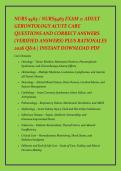
NURS 5463 / NURS5463 EXAM 2: ADULT
GERONTOLOGY ACUTE CARE
QUESTIONS AND CORRECT ANSWERS
(VERIFIED ANSWERS) PLUS RATIONALES
2026 Q&A | INSTANT DOWNLOAD PDF
Core Domains
• Oncology – Tumor Markers, Metastasis Patterns, Paraneoplastic
Syndromes, and Chemotherapy Adverse Effects
• Hematology – Multiple Myeloma, Leukemias, Lymphomas, and Anemia
of Chronic Disease
• Neurology – Altered Mental Status, Brain Tumors, Cerebral Edema, and
Seizure Management
• Cardiology – Acute Coronary Syndromes, Heart Failure, and
Arrhythmias
• Pulmonology – Respiratory Failure, Mechanical Ventilation, and ARDS
• Nephrology – Acute Kidney Injury, Fluid and Electrolyte Imbalances
• Infectious Disease – Sepsis, Antibiotic Stewardship, and
Immunocompromised Hosts
• Endocrine – Diabetic Ketoacidosis, Thyroid Storm, and Adrenal
Insufficiency
• Critical Care – Hemodynamic Monitoring, Shock States, and
Sedation/Analgesia
• Palliative and End-of-Life Care – Goals of Care, Futility, and Ethical
Decision-Making
,Introduction
This comprehensive practice examination is designed to assess advanced
practice nursing students' knowledge of adult-gerontology acute care
principles as tested in NURS 5463 Exam 2 at the University of Texas at
Arlington. The exam covers oncology, hematology, neurology, cardiology,
pulmonology, nephrology, infectious disease, endocrinology, critical care
monitoring, and palliative care. Candidates will demonstrate their
understanding of pathophysiology, clinical presentation, diagnostic evaluation,
and evidence-based management of acutely ill adult and geriatric patients. The
multiple-choice format includes foundational knowledge questions, applied
clinical scenarios, and critical thinking items that emphasize real-world
decision-making in acute care settings. Each question is followed by a detailed
rationale to reinforce understanding of the underlying concepts and promote
exam success.
SECTION ONE: QUESTIONS 1–100
Question 1
A 45-year-old female with a brain tumor is admitted with altered mental
status. The spouse reports increasing restlessness and confusion over the past
3 days. An MRI from 1 month ago showed cerebral edema. What is the priority
intervention?
A. Administer dexamethasone
B. Start broad-spectrum antibiotics
C. Obtain a stat CT head without contrast
D. Initiate seizure prophylaxis with levetiracetam
C
RATIONALE: In a patient with a known brain tumor and acute decline in
mental status, the priority is to rule out acute intracranial pathology such as
,hemorrhage, hydrocephalus, or new mass effect. A stat CT head without
contrast is the most appropriate first step. While dexamethasone for cerebral
edema and seizure prophylaxis may be indicated, these should follow after
imaging confirms the cause of deterioration.
Question 2
A patient with small cell lung cancer develops syndrome of inappropriate
antidiuretic hormone (SIADH). Which laboratory finding is most consistent
with this diagnosis?
A. Serum sodium 128 mEq/L, serum osmolality 260 mOsm/kg
B. Serum sodium 155 mEq/L, serum osmolality 310 mOsm/kg
C. Serum sodium 140 mEq/L, serum osmolality 285 mOsm/kg
D. Serum sodium 135 mEq/L, serum osmolality 295 mOsm/kg
A
RATIONALE: SIADH is characterized by hyponatremia (serum sodium
<135 mEq/L) with low serum osmolality (<275 mOsm/kg) due to
inappropriate ADH secretion. Small cell lung cancer is a common cause of
paraneoplastic SIADH. The low sodium and low osmolality in option A are
classic findings.
Question 3
A patient with metastatic breast cancer has a serum calcium of 12.5 mg/dL.
Which finding is most concerning for hypercalcemia?
A. Constipation
B. Polyuria
C. Lethargy and confusion
D. Bone pain
C
, RATIONALE: Hypercalcemia of malignancy can cause neurologic
symptoms including lethargy, confusion, and coma. While constipation,
polyuria, and bone pain are also associated with hypercalcemia, neurologic
changes indicate more severe hypercalcemia requiring urgent intervention.
Question 4
A patient with acute leukemia develops fever and neutropenia. What is the
most appropriate initial management?
A. Obtain blood cultures and start broad-spectrum antibiotics
B. Administer granulocyte colony-stimulating factor (G-CSF)
C. Obtain a chest X-ray and wait for results
D. Start antiviral therapy
A
RATIONALE: Febrile neutropenia in a patient with acute leukemia is a
medical emergency. The standard of care is to obtain blood cultures and
immediately start empiric broad-spectrum antibiotics covering both gram-
positive and gram-negative organisms. Delays in antibiotic administration are
associated with increased mortality.
Question 5
A patient with lung cancer develops new-onset confusion, headache, and
focal neurologic deficits. Which diagnostic test is most appropriate?
A. Lumbar puncture
B. CT head with contrast
C. MRI brain with and without contrast
D. Electroencephalogram (EEG)
C
GERONTOLOGY ACUTE CARE
QUESTIONS AND CORRECT ANSWERS
(VERIFIED ANSWERS) PLUS RATIONALES
2026 Q&A | INSTANT DOWNLOAD PDF
Core Domains
• Oncology – Tumor Markers, Metastasis Patterns, Paraneoplastic
Syndromes, and Chemotherapy Adverse Effects
• Hematology – Multiple Myeloma, Leukemias, Lymphomas, and Anemia
of Chronic Disease
• Neurology – Altered Mental Status, Brain Tumors, Cerebral Edema, and
Seizure Management
• Cardiology – Acute Coronary Syndromes, Heart Failure, and
Arrhythmias
• Pulmonology – Respiratory Failure, Mechanical Ventilation, and ARDS
• Nephrology – Acute Kidney Injury, Fluid and Electrolyte Imbalances
• Infectious Disease – Sepsis, Antibiotic Stewardship, and
Immunocompromised Hosts
• Endocrine – Diabetic Ketoacidosis, Thyroid Storm, and Adrenal
Insufficiency
• Critical Care – Hemodynamic Monitoring, Shock States, and
Sedation/Analgesia
• Palliative and End-of-Life Care – Goals of Care, Futility, and Ethical
Decision-Making
,Introduction
This comprehensive practice examination is designed to assess advanced
practice nursing students' knowledge of adult-gerontology acute care
principles as tested in NURS 5463 Exam 2 at the University of Texas at
Arlington. The exam covers oncology, hematology, neurology, cardiology,
pulmonology, nephrology, infectious disease, endocrinology, critical care
monitoring, and palliative care. Candidates will demonstrate their
understanding of pathophysiology, clinical presentation, diagnostic evaluation,
and evidence-based management of acutely ill adult and geriatric patients. The
multiple-choice format includes foundational knowledge questions, applied
clinical scenarios, and critical thinking items that emphasize real-world
decision-making in acute care settings. Each question is followed by a detailed
rationale to reinforce understanding of the underlying concepts and promote
exam success.
SECTION ONE: QUESTIONS 1–100
Question 1
A 45-year-old female with a brain tumor is admitted with altered mental
status. The spouse reports increasing restlessness and confusion over the past
3 days. An MRI from 1 month ago showed cerebral edema. What is the priority
intervention?
A. Administer dexamethasone
B. Start broad-spectrum antibiotics
C. Obtain a stat CT head without contrast
D. Initiate seizure prophylaxis with levetiracetam
C
RATIONALE: In a patient with a known brain tumor and acute decline in
mental status, the priority is to rule out acute intracranial pathology such as
,hemorrhage, hydrocephalus, or new mass effect. A stat CT head without
contrast is the most appropriate first step. While dexamethasone for cerebral
edema and seizure prophylaxis may be indicated, these should follow after
imaging confirms the cause of deterioration.
Question 2
A patient with small cell lung cancer develops syndrome of inappropriate
antidiuretic hormone (SIADH). Which laboratory finding is most consistent
with this diagnosis?
A. Serum sodium 128 mEq/L, serum osmolality 260 mOsm/kg
B. Serum sodium 155 mEq/L, serum osmolality 310 mOsm/kg
C. Serum sodium 140 mEq/L, serum osmolality 285 mOsm/kg
D. Serum sodium 135 mEq/L, serum osmolality 295 mOsm/kg
A
RATIONALE: SIADH is characterized by hyponatremia (serum sodium
<135 mEq/L) with low serum osmolality (<275 mOsm/kg) due to
inappropriate ADH secretion. Small cell lung cancer is a common cause of
paraneoplastic SIADH. The low sodium and low osmolality in option A are
classic findings.
Question 3
A patient with metastatic breast cancer has a serum calcium of 12.5 mg/dL.
Which finding is most concerning for hypercalcemia?
A. Constipation
B. Polyuria
C. Lethargy and confusion
D. Bone pain
C
, RATIONALE: Hypercalcemia of malignancy can cause neurologic
symptoms including lethargy, confusion, and coma. While constipation,
polyuria, and bone pain are also associated with hypercalcemia, neurologic
changes indicate more severe hypercalcemia requiring urgent intervention.
Question 4
A patient with acute leukemia develops fever and neutropenia. What is the
most appropriate initial management?
A. Obtain blood cultures and start broad-spectrum antibiotics
B. Administer granulocyte colony-stimulating factor (G-CSF)
C. Obtain a chest X-ray and wait for results
D. Start antiviral therapy
A
RATIONALE: Febrile neutropenia in a patient with acute leukemia is a
medical emergency. The standard of care is to obtain blood cultures and
immediately start empiric broad-spectrum antibiotics covering both gram-
positive and gram-negative organisms. Delays in antibiotic administration are
associated with increased mortality.
Question 5
A patient with lung cancer develops new-onset confusion, headache, and
focal neurologic deficits. Which diagnostic test is most appropriate?
A. Lumbar puncture
B. CT head with contrast
C. MRI brain with and without contrast
D. Electroencephalogram (EEG)
C


