

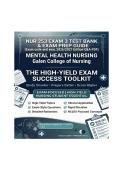
,INSTANT PDF DOWNLOAD — Verified NUR 253
Exam 3 Test Bank & Exam Prep Guide | Mental
Health Nursing | Galen College of Nursing | Q & A
| 2026/2027 Edition (PDF)
1. A client is found wandering confused in a park, unable to recall their identity or where they
live. The nurse should suspect which disorder?
A) Dissociative amnesia
B) Dissociative fugue
C) Dissociative identity disorder
D) Depersonalization disorder
Correct Answer: B) Dissociative fugue
Rationale: Dissociative fugue involves sudden, unexpected travel away from home with the
inability to recall one's identity or important autobiographical information. The client's
confusion, wandering, and amnesia regarding personal identity are consistent with this disorder.
Dissociative amnesia involves memory loss without travel; dissociative identity disorder involves
multiple personality states.
2. A client who survived a mass shooting reports recurrent nightmares, flashbacks,
hypervigilance, and avoidance of crowds. These symptoms have persisted for 4 months. Which
diagnosis is most likely?
,A) Acute stress disorder
B) Post-traumatic stress disorder (PTSD)
C) Generalized anxiety disorder
D) Adjustment disorder
Correct Answer: B) Post-traumatic stress disorder (PTSD)
Rationale: PTSD requires symptom duration greater than 1 month. Acute stress disorder is
diagnosed when symptoms last less than 1 month. Avoidance, re-experiencing
(flashbacks/nightmares), and hyperarousal (hypervigilance) are hallmark PTSD symptoms.
3. A client reports severe anxiety, insomnia, and difficulty concentrating that began 2 weeks
after losing their job. There is no history of trauma. What is the most likely diagnosis?
A) PTSD
B) Acute stress disorder
C) Adjustment disorder
D) Major depressive disorder
Correct Answer: C) Adjustment disorder
Rationale: Adjustment disorder occurs within 3 months of an identifiable stressor (job loss) and
causes emotional/behavioral symptoms. It lacks the trauma re-experiencing seen in PTSD and
does not involve exposure to a traumatic event.
, 4. A 20-year-old client with PTSD was sexually assaulted during a concert. Which of the
following is included in the diagnostic criteria for PTSD?
A) Recurring dreams of the incident
B) Excessive worry about future concerts
C) Avoidance of all social gatherings
D) Generalized anxiety unrelated to the trauma
Correct Answer: A) Recurring dreams of the incident
Rationale: Intrusion symptoms, such as recurring dreams or flashbacks of the traumatic event,
are a core diagnostic criterion for PTSD according to the DSM-5. Avoidance of all social
gatherings is too broad; PTSD avoidance is specific to trauma reminders.
5. A client was in a car accident 3 weeks ago. They report flashbacks, nightmares,
hypervigilance, and avoidance of driving. What is the most likely diagnosis?
A) PTSD
B) Acute stress disorder
C) Adjustment disorder
D) Panic disorder
Correct Answer: B) Acute stress disorder
Rationale: Acute stress disorder has the same symptoms as PTSD but duration is between 3 days
and 1 month. At 3 weeks, this meets criteria for acute stress disorder, not PTSD (which requires
greater than 1 month).
Exam 3 Test Bank & Exam Prep Guide | Mental
Health Nursing | Galen College of Nursing | Q & A
| 2026/2027 Edition (PDF)
1. A client is found wandering confused in a park, unable to recall their identity or where they
live. The nurse should suspect which disorder?
A) Dissociative amnesia
B) Dissociative fugue
C) Dissociative identity disorder
D) Depersonalization disorder
Correct Answer: B) Dissociative fugue
Rationale: Dissociative fugue involves sudden, unexpected travel away from home with the
inability to recall one's identity or important autobiographical information. The client's
confusion, wandering, and amnesia regarding personal identity are consistent with this disorder.
Dissociative amnesia involves memory loss without travel; dissociative identity disorder involves
multiple personality states.
2. A client who survived a mass shooting reports recurrent nightmares, flashbacks,
hypervigilance, and avoidance of crowds. These symptoms have persisted for 4 months. Which
diagnosis is most likely?
,A) Acute stress disorder
B) Post-traumatic stress disorder (PTSD)
C) Generalized anxiety disorder
D) Adjustment disorder
Correct Answer: B) Post-traumatic stress disorder (PTSD)
Rationale: PTSD requires symptom duration greater than 1 month. Acute stress disorder is
diagnosed when symptoms last less than 1 month. Avoidance, re-experiencing
(flashbacks/nightmares), and hyperarousal (hypervigilance) are hallmark PTSD symptoms.
3. A client reports severe anxiety, insomnia, and difficulty concentrating that began 2 weeks
after losing their job. There is no history of trauma. What is the most likely diagnosis?
A) PTSD
B) Acute stress disorder
C) Adjustment disorder
D) Major depressive disorder
Correct Answer: C) Adjustment disorder
Rationale: Adjustment disorder occurs within 3 months of an identifiable stressor (job loss) and
causes emotional/behavioral symptoms. It lacks the trauma re-experiencing seen in PTSD and
does not involve exposure to a traumatic event.
, 4. A 20-year-old client with PTSD was sexually assaulted during a concert. Which of the
following is included in the diagnostic criteria for PTSD?
A) Recurring dreams of the incident
B) Excessive worry about future concerts
C) Avoidance of all social gatherings
D) Generalized anxiety unrelated to the trauma
Correct Answer: A) Recurring dreams of the incident
Rationale: Intrusion symptoms, such as recurring dreams or flashbacks of the traumatic event,
are a core diagnostic criterion for PTSD according to the DSM-5. Avoidance of all social
gatherings is too broad; PTSD avoidance is specific to trauma reminders.
5. A client was in a car accident 3 weeks ago. They report flashbacks, nightmares,
hypervigilance, and avoidance of driving. What is the most likely diagnosis?
A) PTSD
B) Acute stress disorder
C) Adjustment disorder
D) Panic disorder
Correct Answer: B) Acute stress disorder
Rationale: Acute stress disorder has the same symptoms as PTSD but duration is between 3 days
and 1 month. At 3 weeks, this meets criteria for acute stress disorder, not PTSD (which requires
greater than 1 month).


