

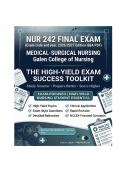
,INSTANT PDF DOWNLOAD — Verified NUR 242
Final Exam | Medical Surgical Nursing | Galen
College of Nursing | Q & A | 2026/2027 Edition
(PDF)
1. A patient with COPD is receiving oxygen therapy. Which nursing consideration is most
important?
A) Limit oxygen flow to 2-3 L/min to prevent respiratory depression
B) Provide oxygen at 10 L via non-rebreather mask regardless of symptoms
C) Maintain oxygen saturation levels between 98% and 100%
D) Encourage the patient to breathe rapidly and shallowly
Correct Answer: A) Limit oxygen flow to 2-3 L/min to prevent respiratory depression
Rationale: Patients with COPD may rely on a hypoxic drive to breathe; high levels of oxygen can
suppress this drive, leading to CO₂ retention and respiratory arrest. Maintaining a lower flow
rate (2-3 L/min) with a target SpO₂ of 88-92% is standard practice unless the patient is in acute
distress.
2. A client is diagnosed with left-sided heart failure. Which clinical manifestation should the
nurse expect to assess?
,A) Crackles or wheezing in the lungs
B) Jugular venous distention (JVD)
C) Peripheral edema in the lower extremities
D) Splenomegaly and hepatomegaly
Correct Answer: A) Crackles or wheezing in the lungs
Rationale: Left-sided heart failure causes blood to back up into the pulmonary circulation,
leading to pulmonary congestion, crackles, and shortness of breath. JVD, peripheral edema, and
hepatomegaly are signs of right-sided heart failure.
3. A patient is taking digoxin for heart failure. Which electrolyte imbalance increases the risk of
digoxin toxicity?
A) Hypernatremia
B) Hypokalemia
C) Hypercalcemia
D) Hypermagnesemia
Correct Answer: B) Hypokalemia
Rationale: Hypokalemia increases the risk of digoxin toxicity by increasing the binding of digoxin
to the sodium-potassium pump. Potassium levels should be monitored closely in patients taking
digoxin.
, 4. A patient is admitted with a suspected stroke. What is the priority nursing action?
A) Administer aspirin immediately
B) Activate the stroke team and obtain a CT scan
C) Administer tPA immediately
D) Document the findings and monitor
Correct Answer: B) Activate the stroke team and obtain a CT scan
Rationale: The nurse should activate the stroke team and obtain a CT scan to differentiate
between ischemic and hemorrhagic stroke. tPA is given only for ischemic stroke within 3-4.5
hours of symptom onset and only after CT confirms no hemorrhage.
5. Which assessment finding is a classic sign of meningitis?
A) Positive Kernig's sign
B) Negative Romberg sign
C) Positive Babinski reflex
D) Hyperactive bowel sounds
Correct Answer: A) Positive Kernig's sign
Rationale: Kernig's sign (pain when the knee is extended with the hip flexed) and Brudzinski's
sign are classic physical findings indicating meningeal irritation. Meningitis also presents with
photophobia, nuchal rigidity, and headache.
Final Exam | Medical Surgical Nursing | Galen
College of Nursing | Q & A | 2026/2027 Edition
(PDF)
1. A patient with COPD is receiving oxygen therapy. Which nursing consideration is most
important?
A) Limit oxygen flow to 2-3 L/min to prevent respiratory depression
B) Provide oxygen at 10 L via non-rebreather mask regardless of symptoms
C) Maintain oxygen saturation levels between 98% and 100%
D) Encourage the patient to breathe rapidly and shallowly
Correct Answer: A) Limit oxygen flow to 2-3 L/min to prevent respiratory depression
Rationale: Patients with COPD may rely on a hypoxic drive to breathe; high levels of oxygen can
suppress this drive, leading to CO₂ retention and respiratory arrest. Maintaining a lower flow
rate (2-3 L/min) with a target SpO₂ of 88-92% is standard practice unless the patient is in acute
distress.
2. A client is diagnosed with left-sided heart failure. Which clinical manifestation should the
nurse expect to assess?
,A) Crackles or wheezing in the lungs
B) Jugular venous distention (JVD)
C) Peripheral edema in the lower extremities
D) Splenomegaly and hepatomegaly
Correct Answer: A) Crackles or wheezing in the lungs
Rationale: Left-sided heart failure causes blood to back up into the pulmonary circulation,
leading to pulmonary congestion, crackles, and shortness of breath. JVD, peripheral edema, and
hepatomegaly are signs of right-sided heart failure.
3. A patient is taking digoxin for heart failure. Which electrolyte imbalance increases the risk of
digoxin toxicity?
A) Hypernatremia
B) Hypokalemia
C) Hypercalcemia
D) Hypermagnesemia
Correct Answer: B) Hypokalemia
Rationale: Hypokalemia increases the risk of digoxin toxicity by increasing the binding of digoxin
to the sodium-potassium pump. Potassium levels should be monitored closely in patients taking
digoxin.
, 4. A patient is admitted with a suspected stroke. What is the priority nursing action?
A) Administer aspirin immediately
B) Activate the stroke team and obtain a CT scan
C) Administer tPA immediately
D) Document the findings and monitor
Correct Answer: B) Activate the stroke team and obtain a CT scan
Rationale: The nurse should activate the stroke team and obtain a CT scan to differentiate
between ischemic and hemorrhagic stroke. tPA is given only for ischemic stroke within 3-4.5
hours of symptom onset and only after CT confirms no hemorrhage.
5. Which assessment finding is a classic sign of meningitis?
A) Positive Kernig's sign
B) Negative Romberg sign
C) Positive Babinski reflex
D) Hyperactive bowel sounds
Correct Answer: A) Positive Kernig's sign
Rationale: Kernig's sign (pain when the knee is extended with the hip flexed) and Brudzinski's
sign are classic physical findings indicating meningeal irritation. Meningitis also presents with
photophobia, nuchal rigidity, and headache.


