
• Wrong document? Swap it for free
  • Written by students who passed
  • Immediately available after payment
  • Read online or as PDF
Sell
Where do you study
Your language
Document preview thumbnail
Preview 1 out of 4 pages
Exam (elaborations)

APRD 1003 EXAM 2 QUESTIONS ANSWERED CORRECTLY LATEST UPDATE 2026

Document preview thumbnail
Preview 1 out of 4 pages

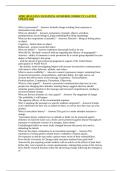
APRD 1003 EXAM 2 QUESTIONS ANSWERED CORRECTLY LATEST UPDATE 2026 What is persuasion? - Answers Attitude change resulting from exposure to information from others. What are attitudes? - Answers evaluations of people, objects, and ideas, predispositions toward things (Liking something/Not liking something) What are the components of attitudes? - Answers Affective - liking or feeling about an object Cognitive - beliefs about an object Behavioral - actions toward the object What are beliefs? - Answers statements that people hold to be true What did Dr. Hovland's research indicate regarding the efficacy of propaganda? - Answers - ability of someone to resist persuasion by a certain group depended on your degree of belonging to the group. - with the advent of government propaganda in support of the United States' participation in World War II - the artifacts worth investigating helped with increase of persuasive communication with intent to affect behavior, attitude, and values. What is source credibility? - Answers a source's persuasive impact, stemming from its perceived expertise, trustworthiness, and believability, the right source can increase the effectiveness of the message. Expertness, Trustworthiness, Professionalism, Competence, Dynamism, Objectivity. What is a fear appeal? - Answers a persuasive communication that tries to scare people into changing their attitudes, learning theory suggests that fear should stimulate greater attention to the message and increased comprehension, leading to increased attitude change. What are the key elements of a fear appeal? - Answers The magnitude of danger The probability it will happen The apparent efficacy of the recommended response Why is targeting the message to a specific audience important? - Answers It helps you to determine the best way to market to them, as well as how they may use your product. What is inoculation theory? - Answers The goal is to make attitudes resistant to change. "Inoculation theory explains how an attitude or belief can be protected against influence in much the same way a body can be protected against disease-through pre-exposure to weakened versions of a stronger, future threat." Unchallenged beliefs are more easily changed because the person isn't used to defending the beliefs What are the major components in an inoculation message? - Answers The experience of seeing attacks refuted lowers credibility of future attacks. Pre-exposure to attacks may make a person more aware of their vulnerabilities. How did the University of Chicago study inoculate students from junk food? - Answers By pre-exposing certain students with an article on the effects of junk food before they were exposed to a snack questionnaire, making them aware of the choices. How did the research function within the advertising change following the emergence of account planning? - Answers Account planner began to replace researchers in the 1980's. Account planners dealt heavility with the creative side while researchers typically worked with or on behalf of clients. What is the disruption process pioneered by TBWA? - Answers - the desired break in existing patterns of behavior of the target audience in response to a highly creative message - "disruption" Signals a departure from the norm. - creative disruption helps disrupt the normal flow in the way a target processes a massive volume of marketing messaging, so they pause to consider the message they have received. What was a brand that benefited from the disruption process? - Answers Absolut Vodka? "Snobbiest drink in the US" What was the strategy behind the famous Saatchi & Saatchi "Labour Isn't Working" campaign? - Answers It was cost effective and only ran on a few sites and exposed the honest truth of the industry, very controversial but effective. According to the art director, how did the "Labour Isn't Working" campaign attract so much publicity? - Answers They made it controversial. What is the Elaboration Likelihood Model? - Answers The elaboration likelihood model of persuasion is a dual process theory describing the change of attitudes. The ELM was developed by Richard E. Petty and John Cacioppo in 1980. The model aims to explain different ways of processing stimuli, why they are used, and their outcomes on attitude change. What does elaboration mean? - Answers "the process of developing or presenting a theory, policy, or system in further detail." "the addition of more detail concerning what has already been said." What is meant by Central Route processing? - Answers - Central Route Processing method focuses on facts and the content of the message in order to convince the listener - as opposed to relying on peripheral factors like the personality of the speaker, or how the message was delivered. - (ex.) a TV ad that presents laboratory findings to demonstrate the effectiveness of an acne treatment would be using the Central Route to Persuasion, as opposed to one that only uses a celebrity endorser. What are characteristics of an ad that demands Central Route processing? - Answers A logic-driven argument using data and facts to convince people of an argument's worthiness. What types of communication devices are used to encourage Central Route processing? - Answers - a persuasive method that focuses on facts and the content of the message in order to convince the listener - as opposed to relying on peripheral factors like the personality of the speaker, or how the message was delivered. - (ex.)a TV ad that presents laboratory findings to demonstrate the effectiveness of an acne treatment would be using the Central Route to Persuasion, as opposed to one that only uses a celebrity endorser. This method of persuasion works best when the facts presented are strong, the topic is relevant to the listener, and the audience is motivated to listen. What are the two factors that are necessary for the success of communications that encourage Central Route processing? - Answers One would need a good logic-driven argument that use data and facts (quantitative data). What is meant by Peripheral Route processing? - Answers Occurs when someone evaluates a message, such as an advertisement, on the basis of physical attractiveness, background music, or other surface-level characteristics rather than the actual content of the message. What are the most common "heuristics" (tactics) used to achieve Peripheral Route processing? - Answers - one person persuades another person; an indirect route relies on association of peripheral cue (such as positive commotion and celebrity endorsement) to associate positivity with a message. - all about associations Why does Robert Heath believe that Peripheral Route processing is more persuasive than Central Route processing? - Answers Robert Heath argued that "truly great advertising does something far more important than delivering a rational message: What it does is to establish associations." What are the types of communication that Robert Heath believes can benefit from Central Route processing? - Answers Advertising that has the tactical aim of communicating factual information (i.e., product improvements, performance advantages, promotions, telephone numbers, prices, website addresses, etc.) will benefit from more attention, because that way you remember better what the message is. How do the types of intended processing (Central vs. Peripheral) affect the assessment of advertising effectiveness? - Answers Define affect - Answers emotional

Content preview

APRD 1003 EXAM 2 QUESTIONS ANSWERED CORRECTLY LATEST
UPDATE 2026


What is persuasion? - Answers Attitude change resulting from exposure to
information from others.
What are attitudes? - Answers evaluations of people, objects, and ideas,
predispositions toward things (Liking something/Not liking something)
What are the components of attitudes? - Answers Affective - liking or feeling about
an object
Cognitive - beliefs about an object
Behavioral - actions toward the object
What are beliefs? - Answers statements that people hold to be true
What did Dr. Hovland's research indicate regarding the efficacy of propaganda? -
Answers - ability of someone to resist persuasion by a certain group depended on your
degree of belonging to the group.
- with the advent of government propaganda in support of the United States'
participation in World War II
- the artifacts worth investigating helped with increase of persuasive communication
with intent to affect behavior, attitude, and values.
What is source credibility? - Answers a source's persuasive impact, stemming from
its perceived expertise, trustworthiness, and believability, the right source can
increase the effectiveness of the message. Expertness, Trustworthiness,
Professionalism, Competence, Dynamism, Objectivity.
What is a fear appeal? - Answers a persuasive communication that tries to scare
people into changing their attitudes, learning theory suggests that fear should
stimulate greater attention to the message and increased comprehension, leading to
increased attitude change.
What are the key elements of a fear appeal? - Answers The magnitude of danger
The probability it will happen
The apparent efficacy of the recommended response
Why is targeting the message to a specific audience important? - Answers It helps
you to determine the best way to market to them, as well as how they may use your
product.
What is inoculation theory? - Answers The goal is to make attitudes resistant to
change.
"Inoculation theory explains how an attitude or belief can be protected against
influence in much the same way a body can be protected against disease-through pre-
exposure to weakened versions of a stronger, future threat."
Unchallenged beliefs are more easily changed because the person isn't used to
defending the beliefs
What are the major components in an inoculation message? - Answers The
experience of seeing attacks refuted lowers credibility of future attacks.
Pre-exposure to attacks may make a person more aware of their vulnerabilities.
How did the University of Chicago study inoculate students from junk food? -
Answers By pre-exposing certain students with an article on the effects of junk food
before they were exposed to a snack questionnaire, making them aware of the choices.
How did the research function within the advertising change following the emergence
of


Document information

Uploaded on
September 3, 2026
Number of pages
4
Written in
2026/2027
Type
Exam (elaborations)
Contains
Questions & answers
$11.99

Wrong document? Swap it for free Within 14 days of purchase and before downloading, you can choose a different document. You can simply spend the amount again.
Written by students who passed
Immediately available after payment
Read online or as PDF

Seller avatar
Reputation scores are based on the amount of documents a seller has sold for a fee and the reviews they have received for those documents. There are three levels: Bronze, Silver and Gold. The better the reputation, the more your can rely on the quality of the sellers work.
joshuawesonga22
3.5
(14)
Sold
130
Followers
2
Items
15395
Last sold
3 days ago


Why students choose Stuvia

Created by fellow students, verified by reviews

Quality you can trust: written by students who passed their tests and reviewed by others who've used these notes.

Didn't get what you expected? Choose another document

No worries! You can instantly pick a different document that better fits what you're looking for.

Pay as you like, start learning right away

No subscription, no commitments. Pay the way you're used to via credit card and download your PDF document instantly.

Student with book image

“Bought, downloaded, and aced it. It really can be that simple.”

Alisha Student

Working on your references?

Create accurate citations in APA, MLA and Harvard with our free citation generator.

Working on your references?

Frequently asked questions
