

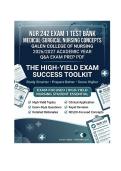
,NUR 242 Exam 1 Test Bank | Medical-Surgical
Nursing Concepts | Galen College of Nursing |
2026/2027 Q&A Exam Prep PDF
1. The nurse is caring for a client who reports pain rated 8 on a 0-10 scale. Which statement by
the nurse reflects the priority action for pain management?
A) "I will document your pain level and reassess in 4 hours."
B) "I will administer your prescribed analgesic and reassess your pain."
C) "Pain is expected after surgery, so try to relax."
D) "Let's try a distraction technique before giving medication."
Correct Answer: B) "I will administer your prescribed analgesic and reassess your pain."
Rationale: A pain rating of 8 indicates severe pain requiring pharmacological intervention. The
nurse should administer the prescribed analgesic and reassess to evaluate effectiveness. The
patient's self-report is the gold standard for pain assessment. Delaying intervention is
inappropriate for severe pain.
2. The nurse is teaching a patient about patient-centered care. Which statement by the patient
indicates understanding of this concept?
A) "Patient-centered care means the healthcare team makes all decisions for me."
B) "Patient-centered care respects my values, preferences, and needs."
C) "Patient-centered care focuses only on my physical health."
D) "Patient-centered care means I don't need to be involved in my care."
Correct Answer: B) "Patient-centered care respects my values, preferences, and needs."
,Rationale: Patient-centered care respects patient values, preferences, and expressed needs;
coordinates and integrates care; provides information, communication, and education; ensures
physical comfort; offers emotional support; involves family and friends; and ensures transition
and continuity of care.
3. The nurse is caring for an older adult client. The nurse understands that the fastest growing
subset of the older population is which group?
A) Young old (ages 65-74)
B) Middle old (ages 75-84)
C) Old old (ages 85 and older)
D) Elite old (ages 95 and older)
Correct Answer: C) Old old (ages 85 and older)
Rationale: The fastest growing subset of the older population is the "old old" (ages 85 and
older). This group has the highest healthcare needs and requires comprehensive geriatric
assessment and management.
4. A patient is immobile after a hip fracture. Which intervention is most effective for preventing
venous thromboembolism (VTE)?
A) Limiting fluid intake to reduce edema
B) Applying sequential compression devices (SCDs)
C) Keeping the patient on strict bed rest
D) Massaging the patient's lower extremities
Correct Answer: B) Applying sequential compression devices (SCDs)
, Rationale: SCDs promote venous return and prevent venous stasis, reducing the risk of deep
vein thrombosis. Early ambulation is also important. Fluid restriction and bed rest increase VTE
risk; massage can dislodge existing clots.
5. The nurse is assessing a patient's skin and notes a reddened area that does not blanch with
pressure. The nurse should document this finding as:
A) Stage 1 pressure injury
B) Stage 2 pressure injury
C) Stage 3 pressure injury
D) Stage 4 pressure injury
Correct Answer: A) Stage 1 pressure injury
Rationale: A Stage 1 pressure injury is characterized by non-blanchable erythema on intact skin.
Stage 2 involves partial-thickness skin loss; Stage 3 involves full-thickness loss with
subcutaneous tissue; Stage 4 involves bone, tendon, or muscle exposure.
6. The nurse is educating a patient about complementary and alternative therapies. Which
therapy is considered a complementary therapy?
A) Pet therapy
B) Massage therapy
C) Guided imagery
D) All of the above
Correct Answer: D) All of the above
Rationale: Complementary and alternative therapies include pet therapy, massage therapy,
guided imagery, biofeedback, exercise and fitness programs, nutritional supplements,
aromatherapy, music therapy, acupuncture, and acupressure.
Nursing Concepts | Galen College of Nursing |
2026/2027 Q&A Exam Prep PDF
1. The nurse is caring for a client who reports pain rated 8 on a 0-10 scale. Which statement by
the nurse reflects the priority action for pain management?
A) "I will document your pain level and reassess in 4 hours."
B) "I will administer your prescribed analgesic and reassess your pain."
C) "Pain is expected after surgery, so try to relax."
D) "Let's try a distraction technique before giving medication."
Correct Answer: B) "I will administer your prescribed analgesic and reassess your pain."
Rationale: A pain rating of 8 indicates severe pain requiring pharmacological intervention. The
nurse should administer the prescribed analgesic and reassess to evaluate effectiveness. The
patient's self-report is the gold standard for pain assessment. Delaying intervention is
inappropriate for severe pain.
2. The nurse is teaching a patient about patient-centered care. Which statement by the patient
indicates understanding of this concept?
A) "Patient-centered care means the healthcare team makes all decisions for me."
B) "Patient-centered care respects my values, preferences, and needs."
C) "Patient-centered care focuses only on my physical health."
D) "Patient-centered care means I don't need to be involved in my care."
Correct Answer: B) "Patient-centered care respects my values, preferences, and needs."
,Rationale: Patient-centered care respects patient values, preferences, and expressed needs;
coordinates and integrates care; provides information, communication, and education; ensures
physical comfort; offers emotional support; involves family and friends; and ensures transition
and continuity of care.
3. The nurse is caring for an older adult client. The nurse understands that the fastest growing
subset of the older population is which group?
A) Young old (ages 65-74)
B) Middle old (ages 75-84)
C) Old old (ages 85 and older)
D) Elite old (ages 95 and older)
Correct Answer: C) Old old (ages 85 and older)
Rationale: The fastest growing subset of the older population is the "old old" (ages 85 and
older). This group has the highest healthcare needs and requires comprehensive geriatric
assessment and management.
4. A patient is immobile after a hip fracture. Which intervention is most effective for preventing
venous thromboembolism (VTE)?
A) Limiting fluid intake to reduce edema
B) Applying sequential compression devices (SCDs)
C) Keeping the patient on strict bed rest
D) Massaging the patient's lower extremities
Correct Answer: B) Applying sequential compression devices (SCDs)
, Rationale: SCDs promote venous return and prevent venous stasis, reducing the risk of deep
vein thrombosis. Early ambulation is also important. Fluid restriction and bed rest increase VTE
risk; massage can dislodge existing clots.
5. The nurse is assessing a patient's skin and notes a reddened area that does not blanch with
pressure. The nurse should document this finding as:
A) Stage 1 pressure injury
B) Stage 2 pressure injury
C) Stage 3 pressure injury
D) Stage 4 pressure injury
Correct Answer: A) Stage 1 pressure injury
Rationale: A Stage 1 pressure injury is characterized by non-blanchable erythema on intact skin.
Stage 2 involves partial-thickness skin loss; Stage 3 involves full-thickness loss with
subcutaneous tissue; Stage 4 involves bone, tendon, or muscle exposure.
6. The nurse is educating a patient about complementary and alternative therapies. Which
therapy is considered a complementary therapy?
A) Pet therapy
B) Massage therapy
C) Guided imagery
D) All of the above
Correct Answer: D) All of the above
Rationale: Complementary and alternative therapies include pet therapy, massage therapy,
guided imagery, biofeedback, exercise and fitness programs, nutritional supplements,
aromatherapy, music therapy, acupuncture, and acupressure.


