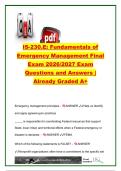
This 8-page FEMA IS-230.E: Fundamentals of Emergency Management Final Exam 2026/2027 study resource contains 40 exam questions with supplied answers covering the core principles, authorities, organizations, mission areas, and planning concepts used in emergency management. The document addresses the responsibilities of FEMA, local and tribal governments, State Governors, emergency managers, Emergency Operations Centers (EOCs), nonprofit organizations, and Federal response partners, making it a focused review resource for learners preparing for the IS-230.E course assessment.
A major section examines the fundamental emergency management principles and Whole Community approach. Students review comprehensive, collaborative, and integrated emergency management; shared responsibility among emergency management partners; community participation; resource typing; public education and information; and the relationships among residents, government officials, emergency management practitioners, organizations, and community leaders. The material emphasizes assessing community needs and strengthening available assets, capacities, and interests.
The document also provides extensive coverage of the emergency management mission areas, including Prevention, Protection, Mitigation, Response, and Recovery-related concepts. Questions address reducing disaster impacts, protecting lives and property, controlling access to facilities, meeting basic human needs, long-term recovery, hazard mitigation, and the Hazard Mitigation Grant Program (HMGP). Students also review the distinction between day-to-day emergency management program functions and core functions implemented during emergencies.
Another important area is emergency planning and incident coordination. The material covers Emergency Operations Plans (EOPs), the Basic Plan, roles and responsibilities during incidents, Emergency Operations Centers, Multiagency Coordination Systems, the Incident Command System, Incident Commanders, resource support, common terminology, and Incident Action Plans. It also addresses how EOCs allow decision-makers and support personnel to coordinate and communicate while helping ensure incident command has necessary personnel, equipment, and other resources.
Federal, State, tribal, territorial, and local authorities receive substantial attention. Students review the Robert T. Stafford Disaster Relief and Emergency Assistance Act, Presidential emergency and major-disaster declarations, State Governor responsibilities, Home Rule, local emergency management responsibilities, territorial and insular-area challenges, and the principle that Federal assistance supplements rather than replaces State, local, and private-sector resources. The document also identifies the National Response Framework (NRF) as the framework used to organize Federal response capabilities and coordinate with response partners under the circumstances described in the material.
For authoritative study, the most directly relevant reference is FEMA IS-230.E: Fundamentals of Emergency Management, together with FEMA's current National Response Framework, National Preparedness System materials, Stafford Act guidance, and emergency-management doctrine. These references are identified as appropriate contextual sources because the uploaded document itself does not provide a formal bibliography or textbook/journal citation. The supplied answers should therefore be treated as the document's study answers; where accuracy matters for certification, students should compare them with the current official FEMA course materials.
Relevant Students: FEMA IS-230.E candidates, emergency management students, FEMA Independent Study learners, emergency managers, disaster preparedness students, public safety personnel, first responders, government employees, Emergency Operations Center staff, homeland security students, public administration students, nonprofit disaster-response personnel, community preparedness professionals, NIMS and ICS trainees, and professionals pursuing FEMA emergency management training.
Keywords: FEMA IS 230 E, IS 230 E final exam, FEMA Fundamentals of Emergency Management, FEMA IS 230 E questions and answers, IS 230 E exam answers, FEMA final exam , emergency management exam, emergency management principles, FEMA Independent Study, Emergency Operations Center, EOC emergency management, NIMS, Incident Command System, ICS, Multiagency Coordination System, National Response Framework, NRF, Stafford Act, Stafford Act disaster declaration, Whole Community approach, emergency operations plan, EOP, emergency management planning, hazard mitigation, Hazard Mitigation Grant Program, HMGP, disaster response, disaster recovery, prevention mission area, protection mission area, mitigation mission area, response mission area, emergency preparedness, resource typing, local emergency manager, Home Rule, FEMA disaster management, emergency management certification, FEMA exam preparation
Content preview
IS-230.E: Fundamentals of
Emergency Management Final
Exam 2026/2027 Exam
Questions and Answers |
Already Graded A+
Emergency management principles - ANSWER ✔✔Help us identify
and apply agreed-upon practices
_____ is responsible for coordinating Federal resources that support
State; local; tribal; and territorial efforts when a Federal emergency or
disaster is declared. - ANSWER ✔✔FEMA
Which of the following statements is FALSE? - ANSWER
✔✔Nonprofit organizations often have a commitment to the specific set
, of interests and values of their members; and therefore should be
excluded from emergency management planning efforts.
One key function of Emergency Operations Center (EOC) personnel is
to - ANSWER ✔✔Ensure that the Incident Commander has needed
resources (i.e.personnel; tools; and equipment)
Which of the following is NOT a key function of the Multiagency
Coordination System? - ANSWER ✔✔Incident command
What type of measures consider ways to reduce consequences together
with the overall risk from specific threats and other community goals? -
ANSWER ✔✔Mitigation
Which of the following statements about the Stafford Act is correct?
Under the Stafford Act: - ANSWER ✔✔The President may only
declare a major disaster at the request of a Governor or tribal Chief
Executive who certifies the State or tribal government and affected local
governments are overwhelmed.
All of the following are important emergency management planning
principles EXCEPT FOR: - ANSWER ✔✔Planning results in unique
plans for every type of threat or hazard.