
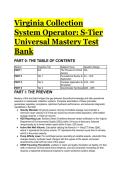
Virginia Collection
System Operator: S-Tier
Universal Mastery Test
Bank
PART 0: THE TABLE OF CONTENTS
Section Cognitive Tier Subject Focus Question Range
PART I N/A The Preview & Critical N/A
Axioms
PART II Tier 1 Foundational Syntax & Q1 – Q18
Application
PART II Tier 2 Complex Application & Q19 – Q37
Simulation
PART II Tier 3 Grandmaster Synthesis Q38 – Q55
PART I: THE PREVIEW
Mastery of this test bank bridges the gap between theoretical knowledge and elite operational
execution in wastewater collection systems. Complete assimilation of these principles
guarantees regulatory compliance, optimized hydraulic performance, and advanced diagnostic
capabilities in the field.
● Velocity Mandate: All gravity sewers carrying nonsettled sewage must maintain a
minimum mean velocity of 2.0 feet per second to prevent solids deposition, while settled
sewage requires 1.3 feet per second.
● SSO Reporting Law: Sanitary Sewer Overflows demand verbal notification to the Virginia
Department of Environmental Quality (DEQ) within 24 hours of discovery, followed
unequivocally by a formal written report within 5 days (120 hours).
● Active Wet Well Volume: Calculated utilizing the formula V = \frac{CT \times Q}{4},
where V represents the active volume, CT represents the minimum cycle time in minutes,
and Q is the pump capacity.
● Pump Affinity Laws: For centrifugal pumps operating at variable speeds, volumetric flow
changes linearly, hydraulic head changes with the square of the speed, and power
requirements scale with the cube of the speed.
● VOSH Trenching Thresholds: Ladders or stairs are legally mandatory at depths of 4 feet
(with a maximum 25-foot lateral travel distance), and any excavation exceeding 20 feet
requires a registered professional engineer's custom protective system design.
,Core SCAT Gravity Sewer Slope Minimums
Nominal Pipe Diameter Minimum Slope (Nonsettled Sewage)
6 inch 0.49%
8 inch 0.40%
10 inch 0.28%
12 inch 0.22%
24 inch 0.08%
PART II: THE ELITE TEST BANK
Q1: An operator reviews the Continuing Professional Education (CPE) requirements for a
Virginia Class 1 wastewater works license. Based on updated Department of Professional and
Occupational Regulation (DPOR) guidelines, what is the EXACT minimum contact hour
requirement per renewal cycle? A) 16 contact hours, with no specific management hour
requirements. B) 18 contact hours, including a minimum of 4 hours in utility management topics.
C) 20 contact hours, completed annually by the last day of February. D) 24 contact hours,
specifically focused on nutrient removal and activated sludge.
● Answer: B (18 contact hours, including a minimum of 4 hours in utility management
topics.)
● Distractor Analysis:
○ A is incorrect: 16 contact hours is the minimum threshold for Class 4 wastewater
operators, an entry-level classification lacking the rigor of Class 1 and 2
expectations.
○ C is incorrect: The 20-hour requirement represents an outdated DPOR framework;
current regulations mandate 18 hours per biennial cycle, not annually.
○ D is incorrect: 24 contact hours applies to Class 2 waterworks operators under
separate administrative statutes, completely invalidating it for wastewater.
The Mentor's Analysis: Regulatory compliance forms the absolute baseline of operational
mastery. Under recently updated Virginia DPOR statutes, Class 1 and Class II wastewater
works operators must secure exactly 18 CPE hours every two-year cycle, with an explicit
mandate that 4 of those hours focus on utility management to maintain active licensure.
Professional Intuition: Always align continuing education cycles with the specific DPOR
tier; Class 1 wastewater mandates 18 hours, with 4 dedicated to management.
Q2: A municipal design engineer is plotting a new 8-inch gravity sewer extension. Based on the
Virginia Sewage Collection and Treatment (SCAT) Regulations (9VAC25-790), what is the
MINIMUM allowable slope for this nonsettled sewage line? A) 0.22% B) 0.28% C) 0.40% D)
0.49%
● Answer: C (0.40%)
● Distractor Analysis:
○ A is incorrect: The 0.22% parameter is exclusively reserved for 12-inch gravity
mains, which possess the hydraulic radius to maintain velocity at flatter grades.
○ B is incorrect: The 0.28% slope is the regulatory minimum for a 10-inch pipe,
leaving an 8-inch pipe vulnerable to severe solids deposition.
○ D is incorrect: The 0.49% slope applies to 6-inch laterals and small-diameter mains,
representing an unnecessarily steep grade for 8-inch infrastructure.
The Mentor's Analysis: Proper pipe slope is critical to maintaining the minimum 2.0 feet per
, second scouring velocity required to prevent internal septicity and physical blockages. The
SCAT regulations dictate a strict, uncompromising baseline of 0.40% for all 8-inch pipes carrying
nonsettled municipal sewage. Professional Intuition: Hydraulic self-cleansing depends on
strict slope adherence: 8-inch mains require a minimum 0.40% grade.
Q3: During a heavy rain event, an aging collection system experiences a Sanitary Sewer
Overflow (SSO). According to VPDES permit reporting requirements, what is the MAXIMUM
allowable time frame to submit the formal written report to the Virginia DEQ? A) 24 hours from
the exact moment of initial discovery. B) 48 hours following the complete containment of the
overflow. C) 5 days from the time the operator becomes aware of the noncompliance event. D)
14 days following the end of the calendar month in which the spill occurred.
● Answer: C (5 days from the time the operator becomes aware of the noncompliance
event.)
● Distractor Analysis:
○ A is incorrect: The 24-hour deadline governs the initial verbal notification to the
DEQ, not the comprehensive written documentation.
○ B is incorrect: A 48-hour post-containment window is a common internal utility
benchmark, not the state regulatory deadline.
○ D is incorrect: The 14-day interval applies to progress reports on interim compliance
schedules or Discharge Monitoring Reports (DMRs), not emergency SSO reporting.
The Mentor's Analysis: Environmental emergencies demand precise administrative execution.
The VPDES framework requires rapid verbal notification of an SSO within 24 hours to initiate
agency awareness, followed unequivocally by a comprehensive written report detailing the
volume, impact, and mitigation steps within 5 days. Professional Intuition: SSO reporting is a
rigid two-phase protocol: 24 hours for verbal alerting, 5 days for written documentation.
Q4: A maintenance crew is preparing to jet a commercial sewer line that is entirely blocked by a
hardened grease plug. Which sewer jetting nozzle is the MOST APPROPRIATE initial selection
for this specific obstruction? A) A standard flushing nozzle. B) A high-velocity penetrating
nozzle. C) A 360-degree rotating nozzle. D) A hydraulic root-cutting nozzle.
● Answer: B (A high-velocity penetrating nozzle.)
● Distractor Analysis:
○ A is incorrect: Flushing nozzles utilize wide rear-angled jets designed for routine
scouring and sweeping; they completely lack the forward concussive force required
to break a solid plug.
○ C is incorrect: Rotating nozzles are highly effective for scrubbing grease from pipe
walls after baseline flow is established, but they cannot efficiently punch through a
total, hardened blockage.
○ D is incorrect: Root cutters utilize mechanical chains or saw blades specifically
engineered for shearing biological root growth, not piercing hardened fats, oils, and
grease (FOG).
The Mentor's Analysis: Nozzle selection dictates tactical success and equipment longevity. A
solid obstruction requires concentrated, forward-directed hydraulic energy to bore a pilot hole
and restore baseline gravitational flow before secondary circumferential scrubbing can occur.
Professional Intuition: Always restore flow first; deploy penetrating nozzles for solid
blockages before switching to rotating or flushing nozzles.
Q5: An operator is sizing a wet well for a new lift station equipped with a single constant-speed
pump delivering 200 gallons per minute (GPM). To prevent heat damage to the motor stator, a
minimum cycle time of 5 minutes is required. What is the MINIMUM required active wet well
volume? A) 125 gallons B) 250 gallons C) 500 gallons D) 1000 gallons
System Operator: S-Tier
Universal Mastery Test
Bank
PART 0: THE TABLE OF CONTENTS
Section Cognitive Tier Subject Focus Question Range
PART I N/A The Preview & Critical N/A
Axioms
PART II Tier 1 Foundational Syntax & Q1 – Q18
Application
PART II Tier 2 Complex Application & Q19 – Q37
Simulation
PART II Tier 3 Grandmaster Synthesis Q38 – Q55
PART I: THE PREVIEW
Mastery of this test bank bridges the gap between theoretical knowledge and elite operational
execution in wastewater collection systems. Complete assimilation of these principles
guarantees regulatory compliance, optimized hydraulic performance, and advanced diagnostic
capabilities in the field.
● Velocity Mandate: All gravity sewers carrying nonsettled sewage must maintain a
minimum mean velocity of 2.0 feet per second to prevent solids deposition, while settled
sewage requires 1.3 feet per second.
● SSO Reporting Law: Sanitary Sewer Overflows demand verbal notification to the Virginia
Department of Environmental Quality (DEQ) within 24 hours of discovery, followed
unequivocally by a formal written report within 5 days (120 hours).
● Active Wet Well Volume: Calculated utilizing the formula V = \frac{CT \times Q}{4},
where V represents the active volume, CT represents the minimum cycle time in minutes,
and Q is the pump capacity.
● Pump Affinity Laws: For centrifugal pumps operating at variable speeds, volumetric flow
changes linearly, hydraulic head changes with the square of the speed, and power
requirements scale with the cube of the speed.
● VOSH Trenching Thresholds: Ladders or stairs are legally mandatory at depths of 4 feet
(with a maximum 25-foot lateral travel distance), and any excavation exceeding 20 feet
requires a registered professional engineer's custom protective system design.
,Core SCAT Gravity Sewer Slope Minimums
Nominal Pipe Diameter Minimum Slope (Nonsettled Sewage)
6 inch 0.49%
8 inch 0.40%
10 inch 0.28%
12 inch 0.22%
24 inch 0.08%
PART II: THE ELITE TEST BANK
Q1: An operator reviews the Continuing Professional Education (CPE) requirements for a
Virginia Class 1 wastewater works license. Based on updated Department of Professional and
Occupational Regulation (DPOR) guidelines, what is the EXACT minimum contact hour
requirement per renewal cycle? A) 16 contact hours, with no specific management hour
requirements. B) 18 contact hours, including a minimum of 4 hours in utility management topics.
C) 20 contact hours, completed annually by the last day of February. D) 24 contact hours,
specifically focused on nutrient removal and activated sludge.
● Answer: B (18 contact hours, including a minimum of 4 hours in utility management
topics.)
● Distractor Analysis:
○ A is incorrect: 16 contact hours is the minimum threshold for Class 4 wastewater
operators, an entry-level classification lacking the rigor of Class 1 and 2
expectations.
○ C is incorrect: The 20-hour requirement represents an outdated DPOR framework;
current regulations mandate 18 hours per biennial cycle, not annually.
○ D is incorrect: 24 contact hours applies to Class 2 waterworks operators under
separate administrative statutes, completely invalidating it for wastewater.
The Mentor's Analysis: Regulatory compliance forms the absolute baseline of operational
mastery. Under recently updated Virginia DPOR statutes, Class 1 and Class II wastewater
works operators must secure exactly 18 CPE hours every two-year cycle, with an explicit
mandate that 4 of those hours focus on utility management to maintain active licensure.
Professional Intuition: Always align continuing education cycles with the specific DPOR
tier; Class 1 wastewater mandates 18 hours, with 4 dedicated to management.
Q2: A municipal design engineer is plotting a new 8-inch gravity sewer extension. Based on the
Virginia Sewage Collection and Treatment (SCAT) Regulations (9VAC25-790), what is the
MINIMUM allowable slope for this nonsettled sewage line? A) 0.22% B) 0.28% C) 0.40% D)
0.49%
● Answer: C (0.40%)
● Distractor Analysis:
○ A is incorrect: The 0.22% parameter is exclusively reserved for 12-inch gravity
mains, which possess the hydraulic radius to maintain velocity at flatter grades.
○ B is incorrect: The 0.28% slope is the regulatory minimum for a 10-inch pipe,
leaving an 8-inch pipe vulnerable to severe solids deposition.
○ D is incorrect: The 0.49% slope applies to 6-inch laterals and small-diameter mains,
representing an unnecessarily steep grade for 8-inch infrastructure.
The Mentor's Analysis: Proper pipe slope is critical to maintaining the minimum 2.0 feet per
, second scouring velocity required to prevent internal septicity and physical blockages. The
SCAT regulations dictate a strict, uncompromising baseline of 0.40% for all 8-inch pipes carrying
nonsettled municipal sewage. Professional Intuition: Hydraulic self-cleansing depends on
strict slope adherence: 8-inch mains require a minimum 0.40% grade.
Q3: During a heavy rain event, an aging collection system experiences a Sanitary Sewer
Overflow (SSO). According to VPDES permit reporting requirements, what is the MAXIMUM
allowable time frame to submit the formal written report to the Virginia DEQ? A) 24 hours from
the exact moment of initial discovery. B) 48 hours following the complete containment of the
overflow. C) 5 days from the time the operator becomes aware of the noncompliance event. D)
14 days following the end of the calendar month in which the spill occurred.
● Answer: C (5 days from the time the operator becomes aware of the noncompliance
event.)
● Distractor Analysis:
○ A is incorrect: The 24-hour deadline governs the initial verbal notification to the
DEQ, not the comprehensive written documentation.
○ B is incorrect: A 48-hour post-containment window is a common internal utility
benchmark, not the state regulatory deadline.
○ D is incorrect: The 14-day interval applies to progress reports on interim compliance
schedules or Discharge Monitoring Reports (DMRs), not emergency SSO reporting.
The Mentor's Analysis: Environmental emergencies demand precise administrative execution.
The VPDES framework requires rapid verbal notification of an SSO within 24 hours to initiate
agency awareness, followed unequivocally by a comprehensive written report detailing the
volume, impact, and mitigation steps within 5 days. Professional Intuition: SSO reporting is a
rigid two-phase protocol: 24 hours for verbal alerting, 5 days for written documentation.
Q4: A maintenance crew is preparing to jet a commercial sewer line that is entirely blocked by a
hardened grease plug. Which sewer jetting nozzle is the MOST APPROPRIATE initial selection
for this specific obstruction? A) A standard flushing nozzle. B) A high-velocity penetrating
nozzle. C) A 360-degree rotating nozzle. D) A hydraulic root-cutting nozzle.
● Answer: B (A high-velocity penetrating nozzle.)
● Distractor Analysis:
○ A is incorrect: Flushing nozzles utilize wide rear-angled jets designed for routine
scouring and sweeping; they completely lack the forward concussive force required
to break a solid plug.
○ C is incorrect: Rotating nozzles are highly effective for scrubbing grease from pipe
walls after baseline flow is established, but they cannot efficiently punch through a
total, hardened blockage.
○ D is incorrect: Root cutters utilize mechanical chains or saw blades specifically
engineered for shearing biological root growth, not piercing hardened fats, oils, and
grease (FOG).
The Mentor's Analysis: Nozzle selection dictates tactical success and equipment longevity. A
solid obstruction requires concentrated, forward-directed hydraulic energy to bore a pilot hole
and restore baseline gravitational flow before secondary circumferential scrubbing can occur.
Professional Intuition: Always restore flow first; deploy penetrating nozzles for solid
blockages before switching to rotating or flushing nozzles.
Q5: An operator is sizing a wet well for a new lift station equipped with a single constant-speed
pump delivering 200 gallons per minute (GPM). To prevent heat damage to the motor stator, a
minimum cycle time of 5 minutes is required. What is the MINIMUM required active wet well
volume? A) 125 gallons B) 250 gallons C) 500 gallons D) 1000 gallons


