

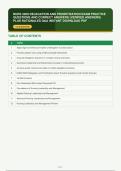
NURS 3209 DELEGATION AND PRIORITIZATION EXAM PRACTICE
QUESTIONS AND CORRECT ANSWERS (VERIFIED ANSWERS)
PLUS RATIONALES Q&A INSTANT DOWNLOAD PDF
130 QUESTIONS
TABLE OF CONTENTS
# TOPIC
1 Apply legal and ethical principles of delegation to safe practice
2 Prioritize patient care using evidence-based frameworks
3 Evaluate delegation decisions in complex clinical scenarios
4 Synthesize leadership and followership concepts in interprofessional teams
5 Analyze quality improvement data to modify delegation practices
6 NURS 3209 Delegation and Prioritization Exam Practice Questions And Correct Answers
7 Verified Answers
8 Plus Rationales Q&A Instant Download Pdf
9 Foundations of Nursing Leadership and Management
10 Applied Nursing Leadership and Management
11 Advanced Nursing Leadership and Management
12 Nursing Leadership and Management Review
Page 1
,Q1 APPLY LEGAL AND ETHICAL PRINCIPLES OF DELEGATION TO SAFE PRACTICE
In a state where the Nurse Practice Act does not explicitly list medication
administration as a delegable task, which of the following is the most appropriate
basis for a registered nurse to delegate medication administration to a licensed
practical nurse?
A. The RN's professional judgment and the stability of the patient
B. The LPN's documented competency in medication administration
C. The facility's policy that allows LPNs to administer medications
D. The state's Board of Nursing advisory opinion that permits delegation CORRECT
RATIONALE: When the Nurse Practice Act is silent, the Board of Nursing's advisory opinions and
rules provide authoritative guidance on delegable tasks. The RN's judgment, LPN competency,
and facility policy are insufficient and cannot override legal boundaries.
Q2 APPLY LEGAL AND ETHICAL PRINCIPLES OF DELEGATION TO SAFE PRACTICE
A nurse is prioritizing care for four patients: one with chest pain and diaphoresis,
one with a blood glucose of 40 mg/dL, one with a newly diagnosed deep vein
thrombosis, and one with a pressure injury requiring dressing change. Using the
urgency-based prioritization framework, which patient should the nurse assess
first?
A. The patient with chest pain and diaphoresis CORRECT
B. The patient with blood glucose of 40 mg/dL
C. The patient with newly diagnosed DVT
D. The patient with pressure injury needing dressing change
RATIONALE: According to Maslow's hierarchy and urgency-based frameworks, chest pain with
diaphoresis suggests acute coronary syndrome, which is immediately life-threatening.
Hypoglycemia is urgent but can be quickly corrected. DVT and pressure injury are lower priority.
Page 2
,Q3 APPLY LEGAL AND ETHICAL PRINCIPLES OF DELEGATION TO SAFE PRACTICE
A nurse is delegating vital sign measurement to an unlicensed assistive personnel
(UAP). Which action by the nurse reflects the most appropriate application of the
'right supervision'?
A. Instructing the UAP to report values outside the normal range immediately CORRECT
B. Asking the UAP to document the readings in the electronic health record
C. Reviewing the UAP's previous performance before delegating
D. Telling the UAP to notify the charge nurse if any value is abnormal
RATIONALE: Right supervision requires the RN to give clear directives and establish parameters
for reporting. Instructing the UAP to report abnormal values immediately ensures timely
follow-up. Documentation and prior performance are part of other rights, and delegating to
charge nurse is inappropriate.
Q4 APPLY LEGAL AND ETHICAL PRINCIPLES OF DELEGATION TO SAFE PRACTICE
A registered nurse is leading a rapid response team. A practical nurse (PN) reports
a patient's oxygen saturation is 90% on room air. The team is busy with another
patient. Which action demonstrates effective delegation and prioritization?
A. Instruct the PN to apply oxygen at 2 L via nasal cannula
B. Ask the PN to reassess the patient in 15 minutes
C. Delegate the PN to start an IV line for fluids
D. Direct the PN to stay with the patient while the RN completes the current task CORRECT
RATIONALE: The RN must maintain supervision and cannot delegate assessment or initiation of
oxygen without an order. Having the PN stay with the patient ensures safety while the RN
finishes the immediate task, then can assess. Reassessment in 15 minutes is unsafe.
Page 3
, Q5 APPLY LEGAL AND ETHICAL PRINCIPLES OF DELEGATION TO SAFE PRACTICE
A charge nurse is creating assignments for a medical-surgical unit. Which patient
assignment best demonstrates appropriate delegation to a licensed practical
nurse (LPN)?
A. A patient with unstable angina requiring continuous cardiac monitoring
B. A patient with diabetes needing insulin administration and teaching
C. A patient with a tracheostomy requiring frequent suctioning
D. A patient with a urinary tract infection receiving IV antibiotics CORRECT
RATIONALE: LPNs can administer IV antibiotics in many states, and a UTI patient is stable.
Unstable angina requires RN-level assessment; insulin administration may be permitted but
teaching is an RN responsibility; tracheostomy suctioning may be within LPN scope but requires
assessment. The UTI patient is most appropriate.
Q6 APPLY LEGAL AND ETHICAL PRINCIPLES OF DELEGATION TO SAFE PRACTICE
A nurse is using the SBAR format to hand off a patient. Which statement reflects
the 'Assessment' component?
A. "The patient is a 65-year-old male with a history of hypertension."
B. "I think the patient is having a stroke because of sudden weakness." CORRECT
C. "I recommend a stat CT scan and neurology consult."
D. "The patient's blood pressure is 180/100 and he has slurred speech."
RATIONALE: In SBAR, Assessment is the nurse's interpretation or impression of the situation.
The patient's history is Background, vital signs and symptoms are Situation, and the CT scan
request is Recommendation.
Page 4
QUESTIONS AND CORRECT ANSWERS (VERIFIED ANSWERS)
PLUS RATIONALES Q&A INSTANT DOWNLOAD PDF
130 QUESTIONS
TABLE OF CONTENTS
# TOPIC
1 Apply legal and ethical principles of delegation to safe practice
2 Prioritize patient care using evidence-based frameworks
3 Evaluate delegation decisions in complex clinical scenarios
4 Synthesize leadership and followership concepts in interprofessional teams
5 Analyze quality improvement data to modify delegation practices
6 NURS 3209 Delegation and Prioritization Exam Practice Questions And Correct Answers
7 Verified Answers
8 Plus Rationales Q&A Instant Download Pdf
9 Foundations of Nursing Leadership and Management
10 Applied Nursing Leadership and Management
11 Advanced Nursing Leadership and Management
12 Nursing Leadership and Management Review
Page 1
,Q1 APPLY LEGAL AND ETHICAL PRINCIPLES OF DELEGATION TO SAFE PRACTICE
In a state where the Nurse Practice Act does not explicitly list medication
administration as a delegable task, which of the following is the most appropriate
basis for a registered nurse to delegate medication administration to a licensed
practical nurse?
A. The RN's professional judgment and the stability of the patient
B. The LPN's documented competency in medication administration
C. The facility's policy that allows LPNs to administer medications
D. The state's Board of Nursing advisory opinion that permits delegation CORRECT
RATIONALE: When the Nurse Practice Act is silent, the Board of Nursing's advisory opinions and
rules provide authoritative guidance on delegable tasks. The RN's judgment, LPN competency,
and facility policy are insufficient and cannot override legal boundaries.
Q2 APPLY LEGAL AND ETHICAL PRINCIPLES OF DELEGATION TO SAFE PRACTICE
A nurse is prioritizing care for four patients: one with chest pain and diaphoresis,
one with a blood glucose of 40 mg/dL, one with a newly diagnosed deep vein
thrombosis, and one with a pressure injury requiring dressing change. Using the
urgency-based prioritization framework, which patient should the nurse assess
first?
A. The patient with chest pain and diaphoresis CORRECT
B. The patient with blood glucose of 40 mg/dL
C. The patient with newly diagnosed DVT
D. The patient with pressure injury needing dressing change
RATIONALE: According to Maslow's hierarchy and urgency-based frameworks, chest pain with
diaphoresis suggests acute coronary syndrome, which is immediately life-threatening.
Hypoglycemia is urgent but can be quickly corrected. DVT and pressure injury are lower priority.
Page 2
,Q3 APPLY LEGAL AND ETHICAL PRINCIPLES OF DELEGATION TO SAFE PRACTICE
A nurse is delegating vital sign measurement to an unlicensed assistive personnel
(UAP). Which action by the nurse reflects the most appropriate application of the
'right supervision'?
A. Instructing the UAP to report values outside the normal range immediately CORRECT
B. Asking the UAP to document the readings in the electronic health record
C. Reviewing the UAP's previous performance before delegating
D. Telling the UAP to notify the charge nurse if any value is abnormal
RATIONALE: Right supervision requires the RN to give clear directives and establish parameters
for reporting. Instructing the UAP to report abnormal values immediately ensures timely
follow-up. Documentation and prior performance are part of other rights, and delegating to
charge nurse is inappropriate.
Q4 APPLY LEGAL AND ETHICAL PRINCIPLES OF DELEGATION TO SAFE PRACTICE
A registered nurse is leading a rapid response team. A practical nurse (PN) reports
a patient's oxygen saturation is 90% on room air. The team is busy with another
patient. Which action demonstrates effective delegation and prioritization?
A. Instruct the PN to apply oxygen at 2 L via nasal cannula
B. Ask the PN to reassess the patient in 15 minutes
C. Delegate the PN to start an IV line for fluids
D. Direct the PN to stay with the patient while the RN completes the current task CORRECT
RATIONALE: The RN must maintain supervision and cannot delegate assessment or initiation of
oxygen without an order. Having the PN stay with the patient ensures safety while the RN
finishes the immediate task, then can assess. Reassessment in 15 minutes is unsafe.
Page 3
, Q5 APPLY LEGAL AND ETHICAL PRINCIPLES OF DELEGATION TO SAFE PRACTICE
A charge nurse is creating assignments for a medical-surgical unit. Which patient
assignment best demonstrates appropriate delegation to a licensed practical
nurse (LPN)?
A. A patient with unstable angina requiring continuous cardiac monitoring
B. A patient with diabetes needing insulin administration and teaching
C. A patient with a tracheostomy requiring frequent suctioning
D. A patient with a urinary tract infection receiving IV antibiotics CORRECT
RATIONALE: LPNs can administer IV antibiotics in many states, and a UTI patient is stable.
Unstable angina requires RN-level assessment; insulin administration may be permitted but
teaching is an RN responsibility; tracheostomy suctioning may be within LPN scope but requires
assessment. The UTI patient is most appropriate.
Q6 APPLY LEGAL AND ETHICAL PRINCIPLES OF DELEGATION TO SAFE PRACTICE
A nurse is using the SBAR format to hand off a patient. Which statement reflects
the 'Assessment' component?
A. "The patient is a 65-year-old male with a history of hypertension."
B. "I think the patient is having a stroke because of sudden weakness." CORRECT
C. "I recommend a stat CT scan and neurology consult."
D. "The patient's blood pressure is 180/100 and he has slurred speech."
RATIONALE: In SBAR, Assessment is the nurse's interpretation or impression of the situation.
The patient's history is Background, vital signs and symptoms are Situation, and the CT scan
request is Recommendation.
Page 4


