
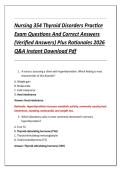
Nursing 354 Thyroid Disorders Practice
Exam Questions And Correct Answers
(Verified Answers) Plus Rationales 2026
Q&A Instant Download Pdf
1. A nurse is assessing a client with hyperthyroidism. Which finding is most
characteristic of this disorder?
A. Weight gain
B. Bradycardia
C. Cold intolerance
D. Heat intolerance
Answer: Heat intolerance
Rationale: Hyperthyroidism increases metabolic activity, commonly causing heat
intolerance, sweating, tachycardia, and weight loss.
2. Which laboratory value is most commonly decreased in primary
hyperthyroidism?
A. Free T4
B. Thyroid-stimulating hormone (TSH)
C. Thyroid-stimulating immunoglobulin
D. Total triiodothyronine (T3)
Answer: Thyroid-stimulating hormone (TSH)
,Rationale: Excess thyroid hormone suppresses pituitary TSH secretion through
negative feedback.
3. A client with Graves disease asks why the eyes appear prominent. Which
condition causes this manifestation?
A. Hashimoto thyroiditis
B. Thyroid storm
C. Graves ophthalmopathy
D. Myxedema
Answer: Graves ophthalmopathy
Rationale: Graves disease can cause autoimmune inflammation and swelling of
tissues behind the eyes, producing exophthalmos or eye prominence.
4. Which assessment finding is most consistent with hypothyroidism?
A. Diarrhea
B. Tachycardia
C. Fatigue and cold intolerance
D. Increased appetite
Answer: Fatigue and cold intolerance
Rationale: Reduced thyroid hormone slows metabolism, resulting in fatigue,
lethargy, weight gain, constipation, and cold intolerance.
5. Which thyroid hormone is considered the biologically active form that is
primarily responsible for metabolic effects?
A. Thyroxine-binding globulin
B. Thyroglobulin
C. Thyroxine (T4)
D. Triiodothyronine (T3)
Answer: Triiodothyronine (T3)
Rationale: T3 is more biologically active than T4 and has a stronger effect on
cellular metabolism.
, 6. A client has a high TSH and low free T4. How should the nurse interpret
these results?
A. Secondary hyperthyroidism
B. Primary hyperthyroidism
C. Primary hypothyroidism
D. Euthyroidism
Answer: Primary hypothyroidism
Rationale: Primary thyroid failure produces low thyroid hormone levels, which
stimulate the pituitary to release more TSH.
7. Which autoimmune disorder is a common cause of hypothyroidism?
A. Graves disease
B. Addison disease
C. Cushing syndrome
D. Hashimoto thyroiditis
Answer: Hashimoto thyroiditis
Rationale: Hashimoto thyroiditis is an autoimmune disorder in which immune-
mediated destruction of thyroid tissue can lead to hypothyroidism.
8. Which medication is commonly prescribed as lifelong replacement therapy
for primary hypothyroidism?
A. Methimazole
B. Propylthiouracil
C. Levothyroxine
D. Radioactive iodine
Answer: Levothyroxine
Rationale: Levothyroxine is synthetic T4 and is the standard thyroid hormone
replacement for hypothyroidism.
9. How should the nurse instruct a client to take levothyroxine?
, A. With an iron supplement
B. Immediately after a high-fiber meal
C. Only when symptoms occur
D. On an empty stomach, consistently at the same time each day
Answer: On an empty stomach, consistently at the same time each day
Rationale: Levothyroxine is generally best absorbed on an empty stomach.
Consistent administration helps maintain stable thyroid hormone levels.
10.Which medication can interfere with levothyroxine absorption?
A. Acetaminophen
B. Calcium supplements
C. Saline
D. Albuterol
Answer: Calcium supplements
Rationale: Calcium can reduce levothyroxine absorption. Calcium and iron
supplements should generally be separated from levothyroxine by several hours.
11.Which finding in a client taking levothyroxine may indicate excessive thyroid
hormone replacement?
A. Weight gain
B. Constipation
C. Palpitations and tachycardia
D. Cold intolerance
Answer: Palpitations and tachycardia
Rationale: Excessive levothyroxine can produce symptoms resembling
hyperthyroidism, including tachycardia, palpitations, tremors, anxiety, and
insomnia.
12.A client with hyperthyroidism is prescribed methimazole. What is the
primary purpose of this medication?
Exam Questions And Correct Answers
(Verified Answers) Plus Rationales 2026
Q&A Instant Download Pdf
1. A nurse is assessing a client with hyperthyroidism. Which finding is most
characteristic of this disorder?
A. Weight gain
B. Bradycardia
C. Cold intolerance
D. Heat intolerance
Answer: Heat intolerance
Rationale: Hyperthyroidism increases metabolic activity, commonly causing heat
intolerance, sweating, tachycardia, and weight loss.
2. Which laboratory value is most commonly decreased in primary
hyperthyroidism?
A. Free T4
B. Thyroid-stimulating hormone (TSH)
C. Thyroid-stimulating immunoglobulin
D. Total triiodothyronine (T3)
Answer: Thyroid-stimulating hormone (TSH)
,Rationale: Excess thyroid hormone suppresses pituitary TSH secretion through
negative feedback.
3. A client with Graves disease asks why the eyes appear prominent. Which
condition causes this manifestation?
A. Hashimoto thyroiditis
B. Thyroid storm
C. Graves ophthalmopathy
D. Myxedema
Answer: Graves ophthalmopathy
Rationale: Graves disease can cause autoimmune inflammation and swelling of
tissues behind the eyes, producing exophthalmos or eye prominence.
4. Which assessment finding is most consistent with hypothyroidism?
A. Diarrhea
B. Tachycardia
C. Fatigue and cold intolerance
D. Increased appetite
Answer: Fatigue and cold intolerance
Rationale: Reduced thyroid hormone slows metabolism, resulting in fatigue,
lethargy, weight gain, constipation, and cold intolerance.
5. Which thyroid hormone is considered the biologically active form that is
primarily responsible for metabolic effects?
A. Thyroxine-binding globulin
B. Thyroglobulin
C. Thyroxine (T4)
D. Triiodothyronine (T3)
Answer: Triiodothyronine (T3)
Rationale: T3 is more biologically active than T4 and has a stronger effect on
cellular metabolism.
, 6. A client has a high TSH and low free T4. How should the nurse interpret
these results?
A. Secondary hyperthyroidism
B. Primary hyperthyroidism
C. Primary hypothyroidism
D. Euthyroidism
Answer: Primary hypothyroidism
Rationale: Primary thyroid failure produces low thyroid hormone levels, which
stimulate the pituitary to release more TSH.
7. Which autoimmune disorder is a common cause of hypothyroidism?
A. Graves disease
B. Addison disease
C. Cushing syndrome
D. Hashimoto thyroiditis
Answer: Hashimoto thyroiditis
Rationale: Hashimoto thyroiditis is an autoimmune disorder in which immune-
mediated destruction of thyroid tissue can lead to hypothyroidism.
8. Which medication is commonly prescribed as lifelong replacement therapy
for primary hypothyroidism?
A. Methimazole
B. Propylthiouracil
C. Levothyroxine
D. Radioactive iodine
Answer: Levothyroxine
Rationale: Levothyroxine is synthetic T4 and is the standard thyroid hormone
replacement for hypothyroidism.
9. How should the nurse instruct a client to take levothyroxine?
, A. With an iron supplement
B. Immediately after a high-fiber meal
C. Only when symptoms occur
D. On an empty stomach, consistently at the same time each day
Answer: On an empty stomach, consistently at the same time each day
Rationale: Levothyroxine is generally best absorbed on an empty stomach.
Consistent administration helps maintain stable thyroid hormone levels.
10.Which medication can interfere with levothyroxine absorption?
A. Acetaminophen
B. Calcium supplements
C. Saline
D. Albuterol
Answer: Calcium supplements
Rationale: Calcium can reduce levothyroxine absorption. Calcium and iron
supplements should generally be separated from levothyroxine by several hours.
11.Which finding in a client taking levothyroxine may indicate excessive thyroid
hormone replacement?
A. Weight gain
B. Constipation
C. Palpitations and tachycardia
D. Cold intolerance
Answer: Palpitations and tachycardia
Rationale: Excessive levothyroxine can produce symptoms resembling
hyperthyroidism, including tachycardia, palpitations, tremors, anxiety, and
insomnia.
12.A client with hyperthyroidism is prescribed methimazole. What is the
primary purpose of this medication?


