

APEX NIH Stroke Scale Group B Patient 1–6
(AdventHealth 2025/2026) — PASSED!!
Competency Exam Study Guide — 40 Questions and Answers
Aligned with 2025/2026 AHA/ASA Stroke Guidelines, LVO Screening (RACE/LAMS), and Tele-Stroke
Best Practices
This competency exam study guide assesses mastery of the National Institutes of Health Stroke Scale (NIHSS) within
the AdventHealth APEX Group B curriculum, covering Patients 1 through 6. The 40-question instrument is
structured across four sections: (1) NIHSS fundamentals, scoring rules, and administration principles; (2) Patient 1
and 2 case analysis and scoring; (3) Patient 3 and 4 case analysis and scoring; and (4) Patient 5 and 6 case analysis,
total scoring, and 2025/2026 stroke protocols. Cognitive level distribution targets approximately 30% recall, 50%
application, and 20% analysis. Each question includes a step-by-step rationale explaining the exact NIHSS scoring
rule applied, the clinical significance of the deficit, and why distractors represent incorrect scoring or unsafe clinical
actions. A grading rubric and solution key concludes the document, defining the 80% mastery threshold required to
achieve a 'Passed' status.
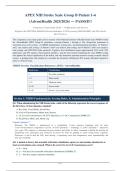
NIHSS Severity Classification Reference (APEX / AdventHealth)
Total Score Classification
0 No stroke symptoms
1–4 Minor stroke
5–15 Moderate stroke
16–20 Severe stroke
21–42 Severe / very severe stroke
Section 1: NIHSS Fundamentals, Scoring Rules, & Administration Principles
Q1: When administering the NIH Stroke Scale, which of the following represents the correct sequence of
the first three (3) item domains evaluated?
A. Best Gaze, Visual Fields, Facial Palsy
B. Level of Consciousness, Motor Arm, Sensory
C. 1a. Level of Consciousness, 1b. LOC Questions, 1c. LOC Commands [CORRECT]
D. Facial Palsy, Motor Arm, Motor Leg
Correct Answer: C
Rationale: The NIHSS is administered in a standardized 11-item sequence beginning with the three
Level-of-Consciousness components (1a LOC, 1b LOC Questions — month/age, 1c LOC Commands — open/close
eyes, grip). This sequence is intentional because alertness and ability to follow commands establish the baseline for
interpreting every subsequent item. Distractor B inverts the order by jumping to motor testing before cognition;
Distractors A and D skip the LOC triad entirely, a sequencing error that compromises score reproducibility and
inter-rater reliability.
Q2: A patient is drowsy but arousable with minor stimulation, opens eyes and sustains attention for at
least several minutes once aroused. What is the correct 1a Level of Consciousness score?
A. 0 — Alert
B. 1 — Not alert, but arousable with minor stimulation [CORRECT]
C. 2 — Not alert, requires repeated stimulation
Page 1
, APEX NIH Stroke Scale Group B (AdventHealth 2025/2026) — Competency Exam Study Guide
D. 3 — Responds only with reflex motor activity
Correct Answer: B
Rationale: A score of 1 is assigned when the patient is not fully alert but can be aroused with minor (non-noxious)
stimulation and can sustain attention briefly. Score 0 requires the patient to be fully alert and responsive with no
drowsiness. Score 2 requires repeated, often stronger, stimulation to maintain attention. Score 3 is reserved for patients
who respond only reflexively or not at all. Selecting 0 (A) over-scores alertness; selecting 2 or 3 under-scores a patient
who is easily arousable, which would distort total score calculation and severity classification.
Q3: During Best Gaze testing, the patient has a forced conjugate deviation of the eyes to the right that
cannot be overcome by oculocephalic (doll's eye) maneuver. The correct score for item 2 is:
A. 0 — Normal horizontal gaze
B. 1 — Partial gaze palsy
C. 2 — Forced deviation or total gaze palsy not overcome by doll's eye maneuver [CORRECT]
D. UN — Untestable because the patient is aphasic
Correct Answer: C
Rationale: Forced deviation that is not overcome by the oculocephalic maneuver represents the maximum (worst) gaze
score of 2. Score 1 is reserved for partial gaze palsy where gaze is limited but some horizontal movement persists in one
or both directions. Score 0 requires full horizontal excursions. Gaze is a motor cranial nerve function and is fully
assessable even in an aphasic patient, so 'UN' (D) is an incorrect application of the untestable rule. Mis-assigning 1
instead of 2 understates brainstem/cortical involvement and may delay recognition of a large vessel occlusion.
Q4: A patient cannot count fingers due to aphasia, but blinks to visual threat in all four quadrants of
both eyes. The examiner should score Visual Fields (item 3) as:
A. 0 — No visual field deficit, based on blink-to-threat response [CORRECT]
B. 1 — Partial hemianopia, because counting could not be performed
C. 3 — Complete hemianopia, because formal testing failed
D. UN — Untestable, because the patient is aphasic
Correct Answer: A
Rationale: When formal finger counting is impossible (e.g., aphasia, poor cooperation), blink-to-threat is an acceptable
substitute, and a normal response in all four quadrants is scored 0. Visual fields are a sensory-motor function
independent of language, so aphasia does not make the item 'UN'. Scoring 1 or 3 (B, C) over-estimates a deficit that was
not demonstrated, which would inflate the total NIHSS and could misclassify stroke severity. The item is scored based
on what was observed, not on what could not be tested by the preferred method.
Q5: When scoring Facial Palsy (item 4), the examiner asks the patient to 'show teeth or raise eyebrows
and squeeze eyes shut.' A patient has a flattened right nasolabial fold and asymmetric smile with
forehead sparing, but can close the eye against resistance on both sides. The correct score is:
A. 0 — Normal symmetric facial movement
B. 1 — Minor paralysis (flattened nasolabial fold, asymmetry of smile) [CORRECT]
C. 2 — Partial paralysis (lower face, near-total)
D. 3 — Complete unilateral or bilateral facial paralysis
Correct Answer: B
Rationale: A flattened nasolabial fold with asymmetry of the smile — but with preserved forehead and eye closure
against resistance — is the classic finding for score 1 (minor paralysis). Score 2 requires near-total unilateral lower-face
paralysis, and score 3 requires complete paralysis of one or both sides. The forehead-sparing pattern reflects an upper
motor neuron (cortical) lesion, which is precisely what minor facial palsy (score 1) is designed to capture. Assigning 0
(A) misses the deficit; assigning 2 or 3 overstates a partial deficit.
Q6: For Motor Arm (item 5), the limb is extended and held at 90 degrees (or 45 degrees if supine) for 10
seconds. The patient's right arm drifts downward at 7 seconds but does not reach the bed. The correct
score is:
A. 0 — No drift, because the arm was initially held up
Page 2
(AdventHealth 2025/2026) — PASSED!!
Competency Exam Study Guide — 40 Questions and Answers
Aligned with 2025/2026 AHA/ASA Stroke Guidelines, LVO Screening (RACE/LAMS), and Tele-Stroke
Best Practices
This competency exam study guide assesses mastery of the National Institutes of Health Stroke Scale (NIHSS) within
the AdventHealth APEX Group B curriculum, covering Patients 1 through 6. The 40-question instrument is
structured across four sections: (1) NIHSS fundamentals, scoring rules, and administration principles; (2) Patient 1
and 2 case analysis and scoring; (3) Patient 3 and 4 case analysis and scoring; and (4) Patient 5 and 6 case analysis,
total scoring, and 2025/2026 stroke protocols. Cognitive level distribution targets approximately 30% recall, 50%
application, and 20% analysis. Each question includes a step-by-step rationale explaining the exact NIHSS scoring
rule applied, the clinical significance of the deficit, and why distractors represent incorrect scoring or unsafe clinical
actions. A grading rubric and solution key concludes the document, defining the 80% mastery threshold required to
achieve a 'Passed' status.
NIHSS Severity Classification Reference (APEX / AdventHealth)
Total Score Classification
0 No stroke symptoms
1–4 Minor stroke
5–15 Moderate stroke
16–20 Severe stroke
21–42 Severe / very severe stroke
Section 1: NIHSS Fundamentals, Scoring Rules, & Administration Principles
Q1: When administering the NIH Stroke Scale, which of the following represents the correct sequence of
the first three (3) item domains evaluated?
A. Best Gaze, Visual Fields, Facial Palsy
B. Level of Consciousness, Motor Arm, Sensory
C. 1a. Level of Consciousness, 1b. LOC Questions, 1c. LOC Commands [CORRECT]
D. Facial Palsy, Motor Arm, Motor Leg
Correct Answer: C
Rationale: The NIHSS is administered in a standardized 11-item sequence beginning with the three
Level-of-Consciousness components (1a LOC, 1b LOC Questions — month/age, 1c LOC Commands — open/close
eyes, grip). This sequence is intentional because alertness and ability to follow commands establish the baseline for
interpreting every subsequent item. Distractor B inverts the order by jumping to motor testing before cognition;
Distractors A and D skip the LOC triad entirely, a sequencing error that compromises score reproducibility and
inter-rater reliability.
Q2: A patient is drowsy but arousable with minor stimulation, opens eyes and sustains attention for at
least several minutes once aroused. What is the correct 1a Level of Consciousness score?
A. 0 — Alert
B. 1 — Not alert, but arousable with minor stimulation [CORRECT]
C. 2 — Not alert, requires repeated stimulation
Page 1
, APEX NIH Stroke Scale Group B (AdventHealth 2025/2026) — Competency Exam Study Guide
D. 3 — Responds only with reflex motor activity
Correct Answer: B
Rationale: A score of 1 is assigned when the patient is not fully alert but can be aroused with minor (non-noxious)
stimulation and can sustain attention briefly. Score 0 requires the patient to be fully alert and responsive with no
drowsiness. Score 2 requires repeated, often stronger, stimulation to maintain attention. Score 3 is reserved for patients
who respond only reflexively or not at all. Selecting 0 (A) over-scores alertness; selecting 2 or 3 under-scores a patient
who is easily arousable, which would distort total score calculation and severity classification.
Q3: During Best Gaze testing, the patient has a forced conjugate deviation of the eyes to the right that
cannot be overcome by oculocephalic (doll's eye) maneuver. The correct score for item 2 is:
A. 0 — Normal horizontal gaze
B. 1 — Partial gaze palsy
C. 2 — Forced deviation or total gaze palsy not overcome by doll's eye maneuver [CORRECT]
D. UN — Untestable because the patient is aphasic
Correct Answer: C
Rationale: Forced deviation that is not overcome by the oculocephalic maneuver represents the maximum (worst) gaze
score of 2. Score 1 is reserved for partial gaze palsy where gaze is limited but some horizontal movement persists in one
or both directions. Score 0 requires full horizontal excursions. Gaze is a motor cranial nerve function and is fully
assessable even in an aphasic patient, so 'UN' (D) is an incorrect application of the untestable rule. Mis-assigning 1
instead of 2 understates brainstem/cortical involvement and may delay recognition of a large vessel occlusion.
Q4: A patient cannot count fingers due to aphasia, but blinks to visual threat in all four quadrants of
both eyes. The examiner should score Visual Fields (item 3) as:
A. 0 — No visual field deficit, based on blink-to-threat response [CORRECT]
B. 1 — Partial hemianopia, because counting could not be performed
C. 3 — Complete hemianopia, because formal testing failed
D. UN — Untestable, because the patient is aphasic
Correct Answer: A
Rationale: When formal finger counting is impossible (e.g., aphasia, poor cooperation), blink-to-threat is an acceptable
substitute, and a normal response in all four quadrants is scored 0. Visual fields are a sensory-motor function
independent of language, so aphasia does not make the item 'UN'. Scoring 1 or 3 (B, C) over-estimates a deficit that was
not demonstrated, which would inflate the total NIHSS and could misclassify stroke severity. The item is scored based
on what was observed, not on what could not be tested by the preferred method.
Q5: When scoring Facial Palsy (item 4), the examiner asks the patient to 'show teeth or raise eyebrows
and squeeze eyes shut.' A patient has a flattened right nasolabial fold and asymmetric smile with
forehead sparing, but can close the eye against resistance on both sides. The correct score is:
A. 0 — Normal symmetric facial movement
B. 1 — Minor paralysis (flattened nasolabial fold, asymmetry of smile) [CORRECT]
C. 2 — Partial paralysis (lower face, near-total)
D. 3 — Complete unilateral or bilateral facial paralysis
Correct Answer: B
Rationale: A flattened nasolabial fold with asymmetry of the smile — but with preserved forehead and eye closure
against resistance — is the classic finding for score 1 (minor paralysis). Score 2 requires near-total unilateral lower-face
paralysis, and score 3 requires complete paralysis of one or both sides. The forehead-sparing pattern reflects an upper
motor neuron (cortical) lesion, which is precisely what minor facial palsy (score 1) is designed to capture. Assigning 0
(A) misses the deficit; assigning 2 or 3 overstates a partial deficit.
Q6: For Motor Arm (item 5), the limb is extended and held at 90 degrees (or 45 degrees if supine) for 10
seconds. The patient's right arm drifts downward at 7 seconds but does not reach the bed. The correct
score is:
A. 0 — No drift, because the arm was initially held up
Page 2


