
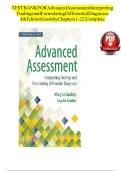
TESTBANK FORAdvanced Assessment Interpreting
b b b b b
Findings and FormulatingDifferentialDiagnoses
b b b b b b
4th Edition Goolsby Chapters 1- 22 | Complete
b b b b b b b b b
, TABLE OF CONTENTS b b
➢ Chapter 1. Assessment and Clinical Decision Making: An Overview
b b b b b b b b
➢ Chapter 2. Genomic Assessment: Interpreting Findings and Formulating Differential Diagnoses
b b b b b b b b b
➢ Chapter 3. Skin
b b
➢ Chapter 4. Head, Face, and Neck
b b b b b
➢ Chapter 5. The Eye
b b b
➢ Chapter 6. Ear, Nose, Mouth, and Throat
b b b b b b
➢ Chapter 7. Cardiac and Peripheral Vascular Systems
b b b b b b
➢ Chapter 8. Respiratory System
b b b
➢ Chapter 9. Breasts
b b
➢ Chapter 10. Abdomen
b b
➢ Chapter 11. Genitourinary System
b b b
➢ Chapter 12. Male Reproductive System
b b b b
➢ Chapter 13. Female Reproductive System
b b b b
➢ Chapter 14. Musculoskeletal System
b b b
➢ Chapter 15. Neurological System
b b b
➢ Chapter 16. Nonspecific Complaints
b b b
➢ Chapter 17. Psychiatric Mental Health
b b b b
➢ Chapter 18. Pediatric Patients
b b b
➢ Chapter 19. Pregnant Patients
b b b
➢ Chapter 20. Assessment of the Transgender or Gender Diverse Adult
b b b b b b b b b
➢ Chapter 21. Older Patients
b b b
➢ Chapter 22. Persons With Disabilities
b b b b
, ➢ Chapter 1. Assessment and Clinical Decision Making: An Overview
b b b b b b b b
Multiple Choice
b
Identifythechoicethatbestcompletesthestatementoranswers thequestion.
b b b b b b b b b b b
b 1. Which typeof clinical decision-makingis most reliable? b b b b b b b
A. Intuitive
B. Analytical
C. Experiential
D. Augenblick
b 2. Whichofthefollowingisfalse?Toobtainadequatehistory, health-careprovidersmustbe: b b b b b b b b b b b b b
A. Methodicalandsystematic b b
B. Attentivetothepatient’sverbal andnonverballanguage b b b b b b b
C. Able toaccuratelyinterpret thepatient’s responses
b b b b b b
D. Adept atreadingintothepatient’sstatements
b b b b b b
b 3. Essentialpartsofahealthhistoryinclude all ofthefollowing except: b b b b b b b b b b b
A. Chiefcomplaint b
B. Historyofthe present illness b b b b
C. Currentvital signs b b
D. Alloftheabove areessential historycomponents
b b b b b b b
b 4. Whichofthefollowingisfalse?Whileperformingthephysical examination,theexaminer mustbeableto:
b b b b b b b b b b b b b b b b
A. Differentiatebetweennormal andabnormalfindings b b b b b
B. Recallknowledgeofarangeofconditionsandtheirassociated signsandsymptoms
b b b b b b b b b b b b
C. Recognizehowcertainconditionsaffect theresponseto otherconditions b b b b b b b b b
D. Foreseeunpredictablefindings b b
b 5. Thefollowingistheleast reliablesourceofinformation for diagnosticstatistics:
b b b b b b b b b b b
A. Evidence-basedinvestigations b
B. Primaryreports ofresearch b b b
C. Estimationbasedonaprovider’sexperience b b b b b
D. Publishedmeta-analyses b
b 6. Thefollowingcan beusedtoassist in sound clinicaldecision-making:
b b b b b b b b b b
A. Algorithmpublished in apeer-reviewed journal article b b b b b b
B. Clinicalpracticeguidelines b b
C. Evidence-basedresearch b
D. All oftheabove
b b b
b 7. Ifadiagnosticstudyhashigh sensitivity, this indicates a:
b b b b b b b b b
A. Highpercentageofpersons withthegiven condition willhaveanabnormal result
b b b b b b b b b b b b
B. Lowpercentageofpersonswith thegivencondition willhavean abnormal result
b b b b b b b b b b b b
C. Lowlikelihoodofnormal resultinpersonswithout agivencondition
b b b b b b b b b b
D. Noneoftheabove b b b
b 8. Ifa diagnosticstudyhas highspecificity, thisindicates a:
b b b b b b b b b
A. Lowpercentage ofhealthyindividuals will showanormalresult
b b b b b b b b b
B. High percentage ofhealthyindividualswill showanormal result
b b b b b b b b b
C. Highpercentageofindividuals with adisorderwill showanormalresult
b b b b b b b b b b b
D. Lowpercentageofindividuals withadisorder will showanabnormal result
b b b b b b b b b b b
b 9. Alikelihood ratio above 1indicates that adiagnostictest showinga:
b b b b b b b b b b b
A. Positive resultis stronglyassociated withthedisease b b b b b b b
B. Negativeresultisstronglyassociated with absence ofthedisease b b b b b b b b b
C. Positiveresultisweaklyassociated withthedisease b b b b b b b
D. Negativeresultis weaklyassociated with absence ofthedisease b b b b b b b b b
, b 10. Whichofthefollowingclinicalreasoningtoolsisdefinedasevidence-based resourcebased onmathematical modeling
b b b b b b b b b b b b b b b
toexpressthelikelihoodofa conditioninselectsituations, settings,and/orpatients?
b b b b b b b b b b b b
b b b b b
Findings and FormulatingDifferentialDiagnoses
b b b b b b
4th Edition Goolsby Chapters 1- 22 | Complete
b b b b b b b b b
, TABLE OF CONTENTS b b
➢ Chapter 1. Assessment and Clinical Decision Making: An Overview
b b b b b b b b
➢ Chapter 2. Genomic Assessment: Interpreting Findings and Formulating Differential Diagnoses
b b b b b b b b b
➢ Chapter 3. Skin
b b
➢ Chapter 4. Head, Face, and Neck
b b b b b
➢ Chapter 5. The Eye
b b b
➢ Chapter 6. Ear, Nose, Mouth, and Throat
b b b b b b
➢ Chapter 7. Cardiac and Peripheral Vascular Systems
b b b b b b
➢ Chapter 8. Respiratory System
b b b
➢ Chapter 9. Breasts
b b
➢ Chapter 10. Abdomen
b b
➢ Chapter 11. Genitourinary System
b b b
➢ Chapter 12. Male Reproductive System
b b b b
➢ Chapter 13. Female Reproductive System
b b b b
➢ Chapter 14. Musculoskeletal System
b b b
➢ Chapter 15. Neurological System
b b b
➢ Chapter 16. Nonspecific Complaints
b b b
➢ Chapter 17. Psychiatric Mental Health
b b b b
➢ Chapter 18. Pediatric Patients
b b b
➢ Chapter 19. Pregnant Patients
b b b
➢ Chapter 20. Assessment of the Transgender or Gender Diverse Adult
b b b b b b b b b
➢ Chapter 21. Older Patients
b b b
➢ Chapter 22. Persons With Disabilities
b b b b
, ➢ Chapter 1. Assessment and Clinical Decision Making: An Overview
b b b b b b b b
Multiple Choice
b
Identifythechoicethatbestcompletesthestatementoranswers thequestion.
b b b b b b b b b b b
b 1. Which typeof clinical decision-makingis most reliable? b b b b b b b
A. Intuitive
B. Analytical
C. Experiential
D. Augenblick
b 2. Whichofthefollowingisfalse?Toobtainadequatehistory, health-careprovidersmustbe: b b b b b b b b b b b b b
A. Methodicalandsystematic b b
B. Attentivetothepatient’sverbal andnonverballanguage b b b b b b b
C. Able toaccuratelyinterpret thepatient’s responses
b b b b b b
D. Adept atreadingintothepatient’sstatements
b b b b b b
b 3. Essentialpartsofahealthhistoryinclude all ofthefollowing except: b b b b b b b b b b b
A. Chiefcomplaint b
B. Historyofthe present illness b b b b
C. Currentvital signs b b
D. Alloftheabove areessential historycomponents
b b b b b b b
b 4. Whichofthefollowingisfalse?Whileperformingthephysical examination,theexaminer mustbeableto:
b b b b b b b b b b b b b b b b
A. Differentiatebetweennormal andabnormalfindings b b b b b
B. Recallknowledgeofarangeofconditionsandtheirassociated signsandsymptoms
b b b b b b b b b b b b
C. Recognizehowcertainconditionsaffect theresponseto otherconditions b b b b b b b b b
D. Foreseeunpredictablefindings b b
b 5. Thefollowingistheleast reliablesourceofinformation for diagnosticstatistics:
b b b b b b b b b b b
A. Evidence-basedinvestigations b
B. Primaryreports ofresearch b b b
C. Estimationbasedonaprovider’sexperience b b b b b
D. Publishedmeta-analyses b
b 6. Thefollowingcan beusedtoassist in sound clinicaldecision-making:
b b b b b b b b b b
A. Algorithmpublished in apeer-reviewed journal article b b b b b b
B. Clinicalpracticeguidelines b b
C. Evidence-basedresearch b
D. All oftheabove
b b b
b 7. Ifadiagnosticstudyhashigh sensitivity, this indicates a:
b b b b b b b b b
A. Highpercentageofpersons withthegiven condition willhaveanabnormal result
b b b b b b b b b b b b
B. Lowpercentageofpersonswith thegivencondition willhavean abnormal result
b b b b b b b b b b b b
C. Lowlikelihoodofnormal resultinpersonswithout agivencondition
b b b b b b b b b b
D. Noneoftheabove b b b
b 8. Ifa diagnosticstudyhas highspecificity, thisindicates a:
b b b b b b b b b
A. Lowpercentage ofhealthyindividuals will showanormalresult
b b b b b b b b b
B. High percentage ofhealthyindividualswill showanormal result
b b b b b b b b b
C. Highpercentageofindividuals with adisorderwill showanormalresult
b b b b b b b b b b b
D. Lowpercentageofindividuals withadisorder will showanabnormal result
b b b b b b b b b b b
b 9. Alikelihood ratio above 1indicates that adiagnostictest showinga:
b b b b b b b b b b b
A. Positive resultis stronglyassociated withthedisease b b b b b b b
B. Negativeresultisstronglyassociated with absence ofthedisease b b b b b b b b b
C. Positiveresultisweaklyassociated withthedisease b b b b b b b
D. Negativeresultis weaklyassociated with absence ofthedisease b b b b b b b b b
, b 10. Whichofthefollowingclinicalreasoningtoolsisdefinedasevidence-based resourcebased onmathematical modeling
b b b b b b b b b b b b b b b
toexpressthelikelihoodofa conditioninselectsituations, settings,and/orpatients?
b b b b b b b b b b b b


